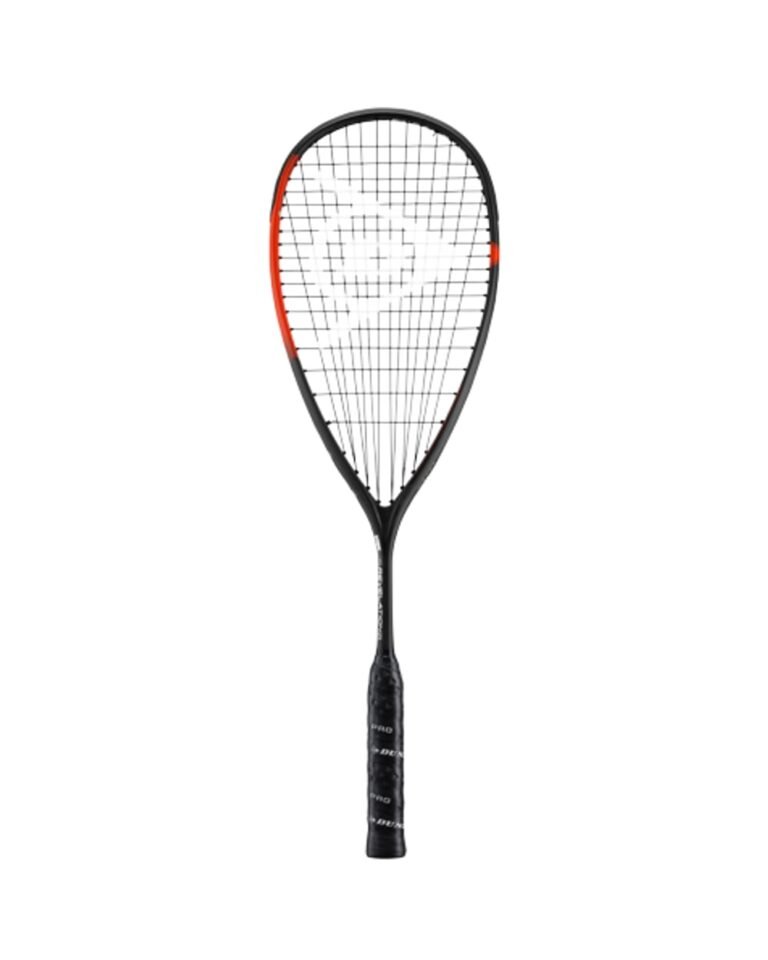
Your strings touch the ball, but your grip is the only thing that touches you. These are the seven grips worth wrapping a squash handle in — the benchmark replacement grips and the overgrips that fix sweaty hands — compared by type, thickness and feel.
In this guide
- Why your grip matters more than you think
- The 7 best squash grips, reviewed
- Comparison table: all seven at a glance
- Replacement grip vs overgrip: which do you need?
- Thickness and handle size: the hidden trade
- Tack vs absorbency: match the grip to your hands
- Grip choice and your handshake grip
- Fitting, care and how often to replace
- Squash grip FAQs
Why Your Grip Matters More Than You Think
Every shot you hit is negotiated through about fifteen centimetres of wrapped polyurethane. Your hand never touches the racket itself — it touches the grip, and the grip alone decides whether the handle sits still through a full-blooded drive or twists a few degrees in your palm at contact. A few degrees sounds like nothing. At the front wall, it is the difference between a straight drive that dies in the back corner and one that clips the side wall and sits up. When players say a racket “felt wrong today”, the frame is rarely the culprit. The grip — worn smooth, soaked through, or simply the wrong thickness for their hand — usually is.
Grips are also the most neglected consumable in the bag. Strings get restrung, balls get replaced when they go smooth, but the factory grip that arrived on a racket often stays there for years, hardening and polishing with use until the racket is quietly blamed and replaced. That is a waste: a fresh grip costs a fraction of any other upgrade in the sport and changes the connection between hand and racket more than most of them. If you have just bought one of the frames in our best squash rackets for beginners guide, know that its factory grip is a starting point chosen for shelf appeal, not for your hand — this page is how you choose its successor deliberately.
This guide owns one decision only: what goes around your handle, how thick it should be, and whether you should be shopping for a full replacement grip or a thin overgrip. It will not re-teach you how to hold the racket — our beginner’s guide to the essential shots covers the handshake grip in detail — and it makes no durability promises it cannot source. Every grip below is a current model, verified against manufacturer and retailer listings, with its material and thickness stated exactly as published. Where a performance claim belongs to the manufacturer, we say so. Where advice is general club practice, we say that too.
The 7 Best Squash Grips, Reviewed
Seven grips, six brands, two families. The first four are replacement grips — the full layer that wraps the bare handle and defines its size and cushioning. The last three are overgrips — thin sacrificial layers wrapped over the top and changed often. Read the cards in order, or jump straight to the one whose “best for” line sounds like your hand.
Karakal PU Super Grip
Best for: almost everyone — the default first grip change, and the one to beat.
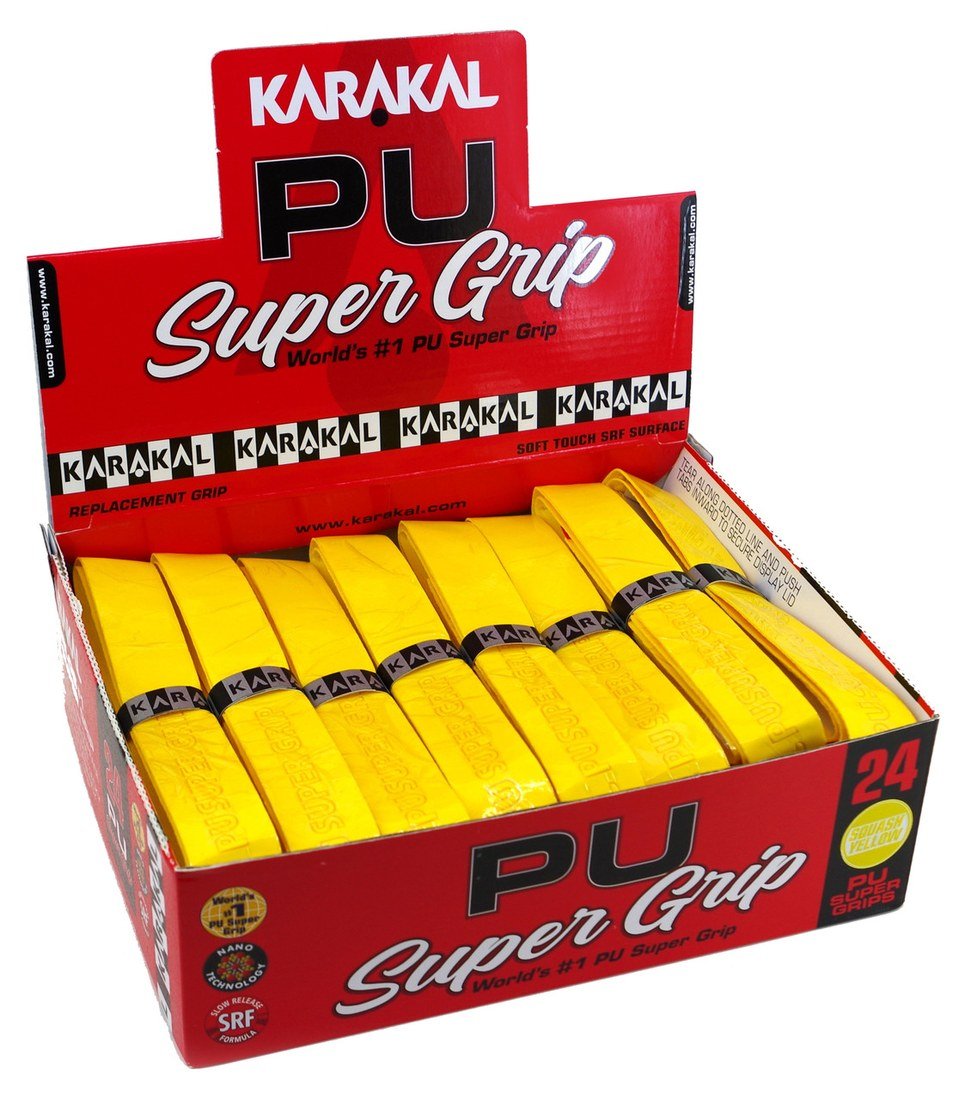
If one grip defines squash, it is this one. Karakal introduced the PU Super Grip nearly thirty years ago, and it remains the grip you will find in club shops, stringers’ drawers and pro-shop display boxes — the packaging in our photo is the 24-count counter box, which tells you how stringers buy it: in bulk, because players ask for it by name. Karakal markets it as the world’s No.1 PU grip, and while that is the maker’s own claim, the product’s three-decade run at the top of the squash market is a matter of simple retail fact. The formula is a thick polyurethane layer with what Karakal calls an SRF (Slow Release Formula) surface, designed to stay tacky rather than turning slick as it wears, and the brand credits nano-sized particles in the material with improving durability, gripping power and comfort.
The playing signature is soft, deep and secure: at 1.85 mm it is the joint-thickest replacement grip here, so it fills the hand, cushions impact and gives sweaty palms a lot of absorbent material to work with. Karakal sells it in a squash-specific 100 cm length (alongside a longer universal version), in a famously long colour list that runs to two-tone Duo and rainbow Multi variants, and in singles, 6-packs and 24-packs. Two honest cautions. That thickness is a real decision: on a handle that already fits you, it will feel a size fuller — wonderful for larger hands, too much for small ones. And the soft surface that makes it so comfortable is a consumable like any other; it stays tackier longer than most, but it is not immortal, and the replacement rhythm in our care section still applies.
What we like
- The benchmark feel — thick, soft and tacky, with genuine sweat capacity
- SRF surface is built to hold its tack rather than polish smooth quickly
- Squash-specific 100 cm length — no trimming a tennis grip down
- Enormous colour range and bulk packs that suit regular changers
Consider
- 1.85 mm build can oversize a handle that already fits — small hands beware
- Soft PU eventually wears; it outlasts rivals, not physics
- Colour choice is vast, which matters to some players more than others
HEAD HydroSorb Squash
Best for: players who want a grip engineered for squash alone — thin, light and built to move sweat.
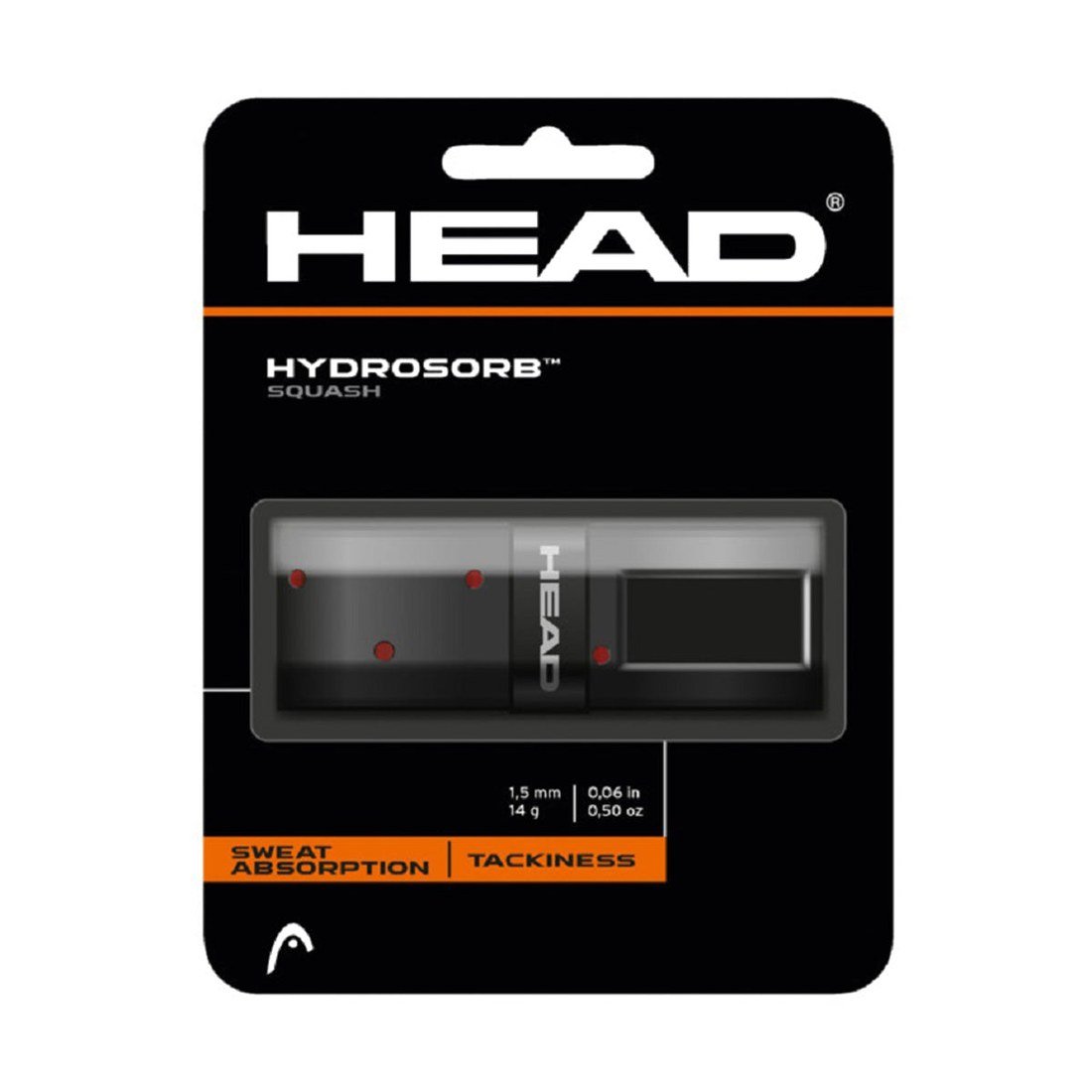
Most grips on this page are racket-sport generalists. The HydroSorb Squash is not: HEAD sells it as a squash product, full stop — the word is printed on the pack — and its specification reads like it was written for this sport’s short, slim handle. At 1.5 mm it is the thinnest replacement grip here, and at 14 g the lightest, so it changes your handle’s size and your racket’s balance less than any rival on the page. For players whose racket already fits and who simply want the worn factory layer renewed without side effects, that restraint is the whole point.
The surface is a high-tack elastomer, and underneath it HEAD builds what it calls a twin-channel airflow system: two channels running the grip’s length that give sweat somewhere to go and air a path under the surface, aimed at the twin problems of a grip that stays wet and a grip that stays hot. The pack’s own two-word summary — sweat absorption, tackiness — is the honest brief. What it is not is a cushion: 1.5 mm of elastomer gives a firm, direct connection to the bevels, which feel players love and players with sore hands may find lean. If your priority is a plush, padded hold, the Karakal above is your card. If your priority is a squash-length, squash-weight grip that keeps a tacky surface working through a long match, this is the specialist.
What we like
- Genuinely squash-specific — length, weight and thickness all sized for this sport
- Twin-channel airflow gives sweat an escape route instead of a puddle
- Thinnest, lightest replacement here — preserves handle size and balance
- Firm elastomer surface keeps the bevels readable under your fingers
Consider
- Lean cushioning — players wanting a soft, padded hold should look up-page
- Tack-forward surface suits mildly sweaty hands better than soaked ones
- One grip per pack — frequent changers will feel the rhythm
Tecnifibre Squash Feel
Best for: touch players who read the handle’s bevels through the grip and want a slim, tacky wrap.
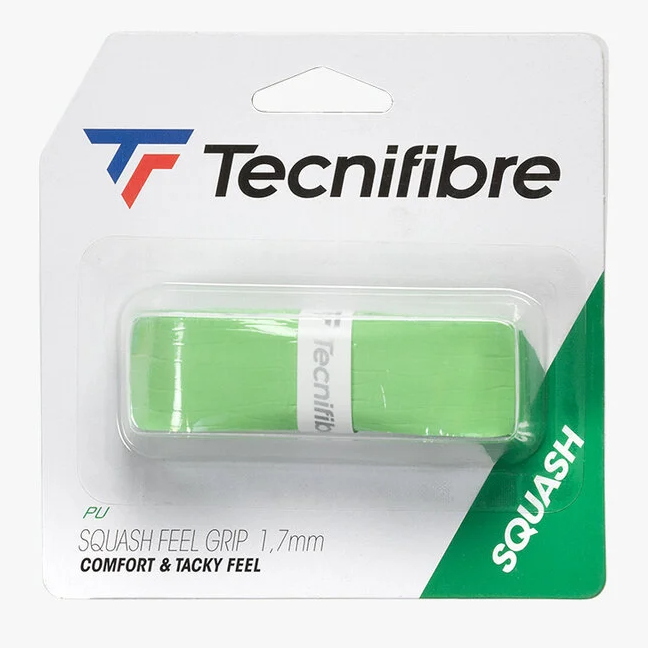
Tecnifibre is the most squash-committed of the big racket brands, and the Squash Feel is its dedicated grip for the sport: a replacement grip built from felt and polyurethane, sold in squash green, black or white, with the pack promising exactly what the name does — comfort and a tacky feel. At 1.7 mm it sits in the instructive middle of this page: slimmer than the Karakal’s deep cushion, fuller than the HydroSorb’s minimal layer. For a player who finds the benchmark too much grip and the specialist too little, this is the calibrated option.
The felt content is the interesting engineering choice. Where a pure PU surface relies on its own tack, the felt-and-PU blend gives the Squash Feel a slightly drier, more textile hand-feel that stays consistent as palms warm up, and the self-adhesive strip makes fitting a clean, bubble-free job — peel, wrap, done. It is also the natural house match for the many club players whose racket already carries a Tecnifibre badge and whose factory grip this directly succeeds. The trade to know: felt-forward grips trade a little of the Karakal’s outright stickiness for that consistency, so the heaviest sweaters should keep reading to the overgrips below, where the true sweat specialists live.
What we like
- The middle thickness done right — bevels stay readable, cushion stays real
- Felt + PU blend keeps its character as hands heat up mid-match
- Self-adhesive strip makes a neat, crease-free fitting straightforward
- A squash-line product from the sport’s most committed big brand
Consider
- Less outright tack than the Karakal — heavy sweaters should pair or pass
- Three colours only, against the Karakal’s catalogue
- Sold singly — no bulk-pack economy for very frequent changers
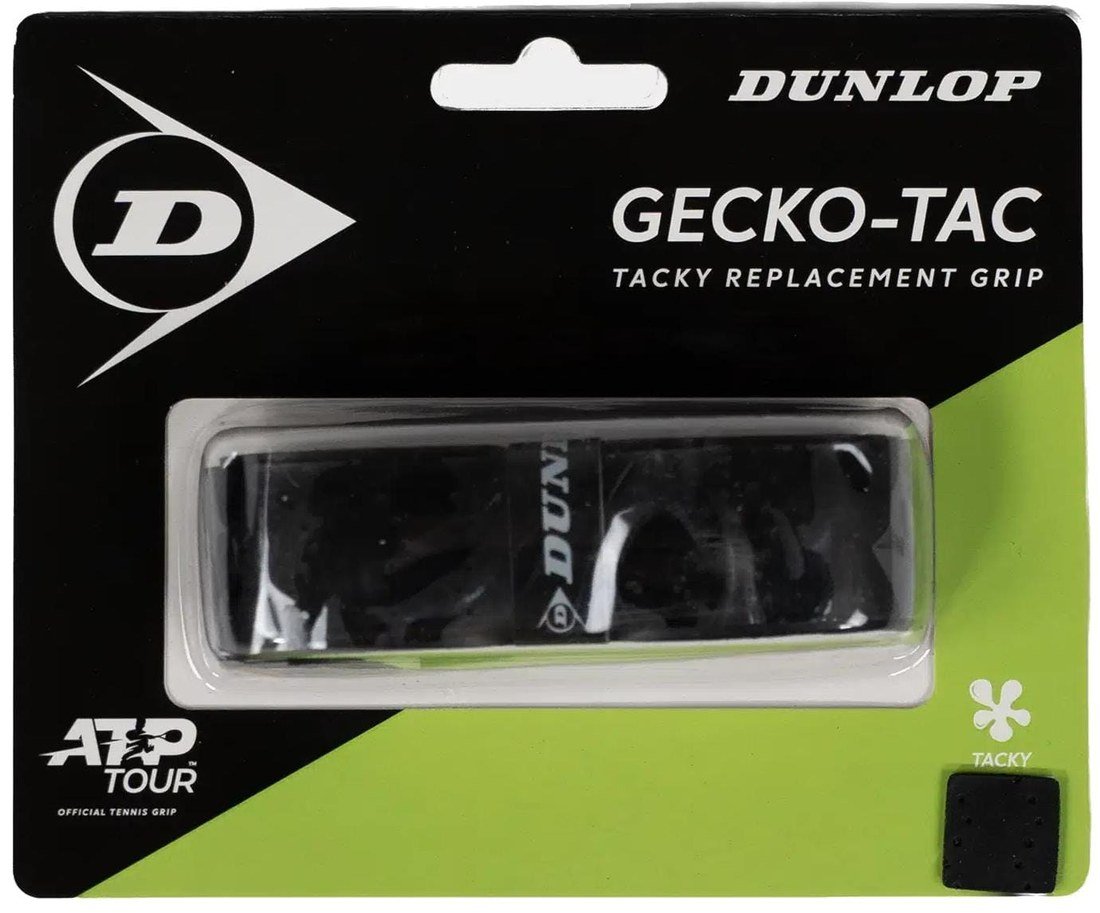
Dunlop Gecko-Tac Replacement Grip
Best for: players whose racket twists on hard drives and who want maximum stick from a replacement grip.
Dunlop’s grip takes its name and its brief from a gecko’s foot — the natural world’s benchmark for a surface that holds on without glue. The Gecko-Tac’s tacky PU skin is moulded over an anti-vibration foam core, and Dunlop credits the design with up to 50% more grip than its previous grips; that is the maker’s figure, not a laboratory result we can stand behind, but the direction of travel is easy to understand the first time you wrap a hand around one: this is the stickiest replacement grip on the page, and it is sticky in a grabby, confidence-giving way rather than a gummy one.
At 1.9 mm it is also the joint-thickest card here, level with the Karakal, so the same handle-size warning applies — and the same comfort dividend. The foam core earns its keep for players who feel impact through the handle on mishits high in the string bed, softening the sting without going vague. Choose between this and the Karakal by surface preference: the Dunlop is the firmer, tackier hold, the Karakal the softer, more absorbent cushion. One buying note: Dunlop sells Gecko-Tac as both this replacement grip and a thinner overgrip under the same name, so check the pack says “replacement” before you strip your handle down to the bare pallet.
What we like
- The strongest tack of any replacement grip here — built for anti-twist security
- Foam core takes the sting out of off-centre hits
- Thick 1.9 mm build fills the hand like the benchmark Karakal
- From the sport’s ball-and-racket establishment — easy to find at squash retailers
Consider
- Same oversizing caution as any 1.9 mm grip on an already-full handle
- Tack-first surface is not the most absorbent here — pair with a towel habit
- Replacement and overgrip versions share the name — buy the right one
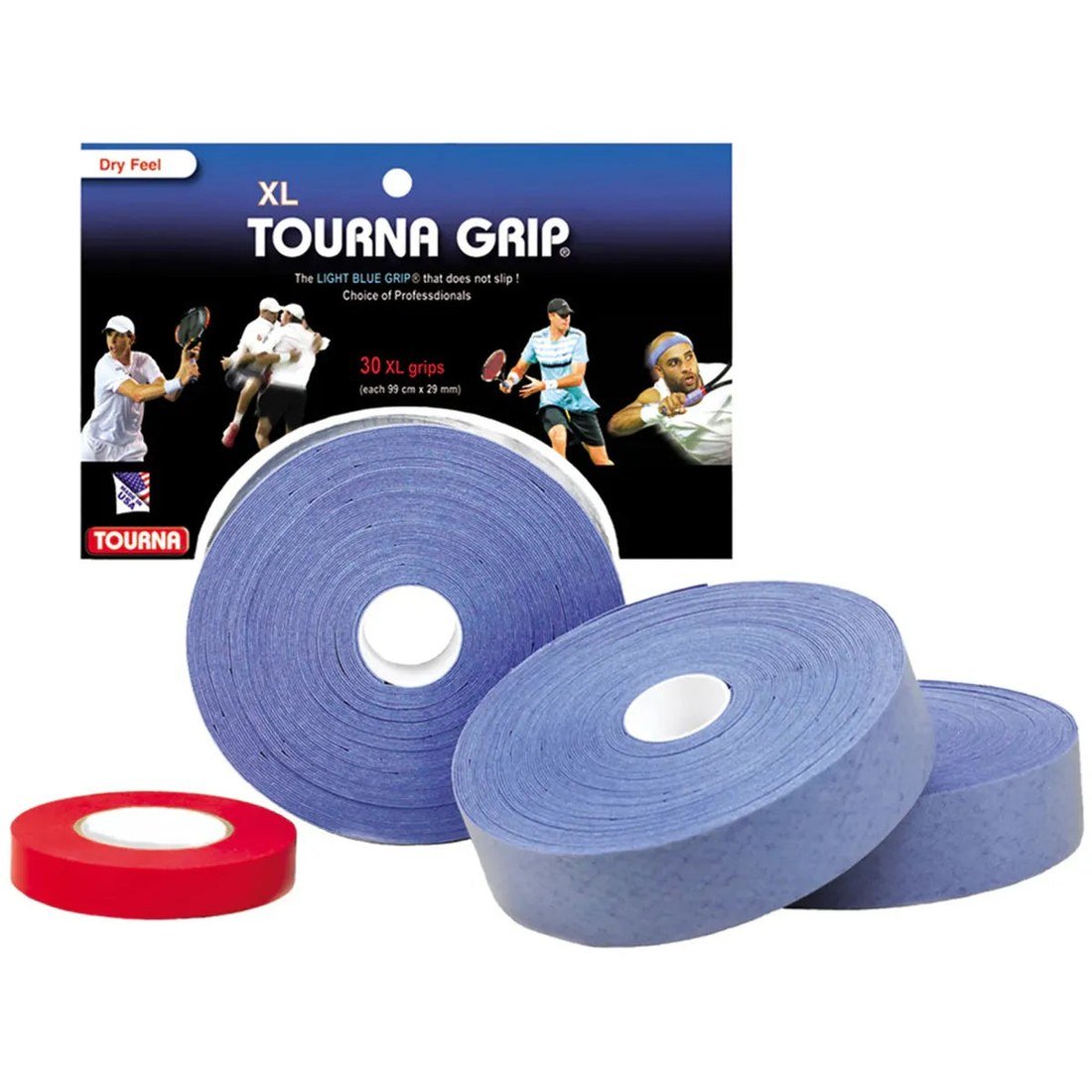
Tourna Grip XL
Best for: heavy sweaters and hot-club players whose tacky grips turn to soap by game three.
Every other grip on this page fights sweat with stickiness. The Tourna Grip fights it with absorption, and it has been doing so since Unique Sports created the original in 1977 — “the light blue grip that does not slip” is a slogan generations of racket players can verify from their own kit bags. The maker’s headline claim is that the material soaks up 350% of its own weight in moisture; treat the number as a manufacturer’s figure, but the behaviour behind it is the product’s whole reputation: where a tacky PU surface gets slicker as it gets wetter, the Tourna’s dry, almost chalky surface gets tackier when wet. For the player whose hands are the weather, that inversion is everything.
Buy the XL. The original Tourna Grip is cut short and narrow (99 cm × 25 mm) for one-handed tennis backhands; the XL’s 29 mm width covers a squash handle fully with a normal overlap, as the 30-roll pack in our photo shows. It is also reversible — flip it when the first side tires and you double its working life, a trick no other card here offers. The honest trades: the feel is dry rather than plush, players who love a sticky, cushioned hold often dislike it on first touch, and as a thin overgrip it is a consumable measured in weeks, not months. But when the question is purely “my racket slips when I sweat”, this is the answer the racket sports settled on decades ago.
What we like
- The sweat specialist — absorbent surface that grips harder as it gets wet
- Reversible: two working lives from every wrap
- XL width covers a squash handle properly, unlike the short original cut
- Nearly fifty years of continuous production — the category’s reference point
Consider
- Dry, thin feel divides opinion — tack-and-cushion lovers may not convert
- A true consumable: expect weeks per wrap under heavy use, even flipped
- Only ever light blue — your handle will look like everyone else’s
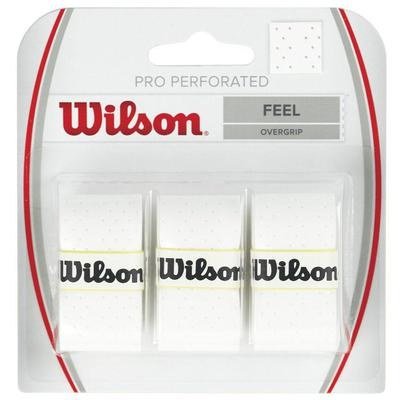
Wilson Pro Overgrip Perforated
Best for: players who want overgrip tack with maximum ball feel — and perforations to breathe.
The Wilson Pro Overgrip is one of the best-selling overgrips in racket sport, full stop, and the Perforated version is the one squash players should reach for. The base formula is a super-thin, high-stretch felt at 0.6 mm that wraps tight, adds almost nothing to your handle size, and keeps the bevels talking to your fingers — the feel-first overgrip on this page. The perforations punched through it are the squash-relevant upgrade: Wilson’s retail listings credit them with improving moisture absorption and drying faster than the standard version, which is exactly the failure mode — a tacky overgrip that stays wet and goes smooth — that squash’s rally density creates.
It earns its place here on a practical point too: specialist racket retailers list the Pro Overgrip Perforated for squash handles explicitly, and its 3, 12 and 60-pack ladder lets you match buying to habit — a 3-pack to try, the tub if it becomes your weekly ritual. Know its nature before you buy: 0.6 mm of felt is a feel product, not a cushion, and perforated or not it is a tacky-surface overgrip, so the genuinely soaked-hand player still belongs with the Tourna above. For everyone else — the player who wants the handle to feel fresh, thin and grippy every Monday — this is the refined choice.
What we like
- 0.6 mm thinness preserves bevel feel better than any rival overgrip
- Perforations target the wet-grip problem directly and dry fast between games
- High-stretch felt wraps tight and neat, even for first-time fitters
- Pack sizes scale from trial 3-pack to a season’s 60-tub
Consider
- Tacky family, not absorbent family — the heaviest sweaters need the Tourna
- Minimal cushioning by design; sore hands may want a thicker base layer
- White shows court grime quickly — the black version hides a season better
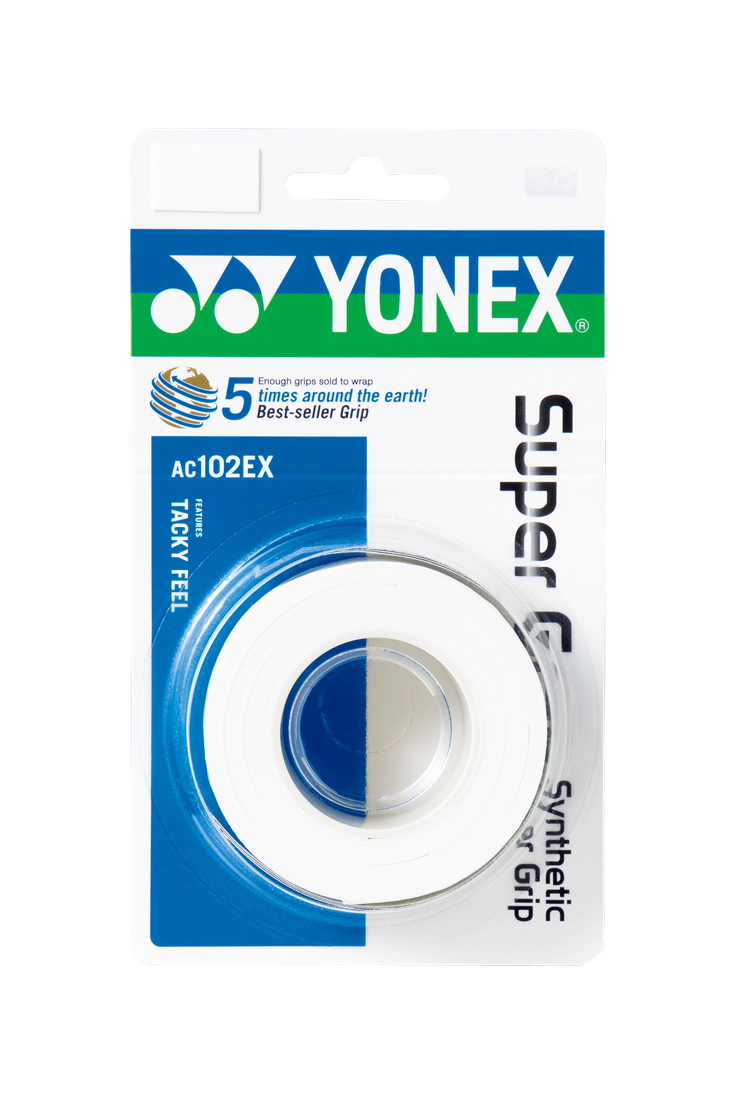
Yonex Super Grap (AC102)
Best for: frequent changers who want a fresh, tacky handle every week without thinking about cost per wrap.
Yonex launched the Super Grap in 1987 and calls it its best-selling overgrip — the maker likes to note it has sold enough tape to wrap around the world several times over, and for once the boast is easy to believe, because the AC102 is the overgrip you see on handles in every racket sport on earth. The recipe is a tacky polyurethane at 0.6 mm, a full 1,200 mm long and 25 mm wide, so a single wrap covers a squash handle with length to spare for a generous overlap. Yonex positions it as absorbing both shock and moisture, and in the hand it is the balanced middle of the overgrip family: tackier than the Tourna, softer than the Wilson felt, fresh-feeling for longer than either in mild-to-moderate sweat.
Its real superpower is logistics. Super Grap sells in 3-packs, rolls and tubs up to 60 wraps, in a colour catalogue that runs from plain white and black to citrus green and wine red, which makes it the easiest grip on this page to turn into a habit: keep a tub in the kit bag, rewrap whenever the surface dulls, never nurse a dying grip through another month. It will not out-absorb the Tourna in a soaked fifth game, and it will not out-feel the Wilson for the first hour. As the overgrip you actually change on schedule — which is the behaviour that matters most — nothing here is simpler to live with.
What we like
- The balanced tacky overgrip — secure, soft and consistent for most hands
- Generous 1,200 mm length makes a tidy, well-overlapped wrap easy
- Bulk tubs make the change-it-often habit genuinely cheap to keep
- A colour for every racket — and a fresh wrap is a small morale upgrade
Consider
- Middle of the family in both directions — neither the sweat fix nor the feel pick
- Tack fades with heavy use like all PU overgrips; the tub exists for a reason
- Long tape needs a trim at the top of a squash handle — scissors required
Comparison Table: All Seven Grips at a Glance
Every grip above, reduced to the four facts that decide a purchase: what kind of grip it is, what it is made of, how thick it is, and whose hand it suits. Types, materials and thicknesses are as published by the manufacturers.
| Grip | Type | Material | Thickness | Feel | Best for |
|---|---|---|---|---|---|
| Karakal PU Super Grip | Replacement | Polyurethane, SRF surface | 1.85 mm | Soft, tacky, absorbent | The all-round default; larger hands |
| HEAD HydroSorb Squash | Replacement | High-tack elastomer, twin channels | 1.5 mm | Firm, tacky, direct | Squash-specific fit; minimal size change |
| Tecnifibre Squash Feel | Replacement | Felt + polyurethane | 1.7 mm | Tacky, textile, consistent | Touch players; bevel readers |
| Dunlop Gecko-Tac | Replacement | Polyurethane over foam core | 1.9 mm | Maximum tack, cushioned | Anti-twist security; hard hitters |
| Tourna Grip XL | Overgrip | Absorbent dry-feel wrap | Thin (99 × 29 mm) | Dry, gets tackier wet | Heavy sweaters; hot clubs |
| Wilson Pro Overgrip Perforated | Overgrip | Perforated high-stretch felt | 0.6 mm | Thin, tacky, fast-drying | Feel players; mild-to-moderate sweat |
| Yonex Super Grap | Overgrip | Polyurethane | 0.6 mm | Balanced tack, soft | Frequent changers; bulk value |
Thickness figures are the manufacturers’ published specifications. The Tourna Grip XL is specified by dimensions rather than a thickness figure; it wears as a thin overgrip comparable to the 0.6 mm class. Maker performance claims in the cards (Karakal’s No.1 positioning, Tourna’s 350% absorbency, Dunlop’s 50% grip improvement) are the brands’ own and are attributed as such in the text.
Grip Choice and Your Handshake Grip
Squash is played with one grip for everything: the handshake grip, with the V of thumb and index finger running along the top bevel of the handle, serves forehand, backhand, drop, lob, volley and serve — our beginner’s guide to the essential squash shots teaches it shot by shot. That single-grip technique makes your wrap a piece of technique equipment, not just a comfort item, because the handshake is located by feel: your hand finds the V’s bevel by touch, dozens of times a rally, without looking.

Three fit consequences follow. First, bevel definition: the thicker and softer the wrap, the rounder and vaguer the bevels feel, and the harder the V is to find blind — one more reason touch players gravitate to the thinner cards here, and power players who set their grip once per rally tolerate the thick ones happily. Second, the overlap ridge: every wrapped grip spirals, and a consistent, even overlap gives your fingers a subtle indexing texture that helps the hand land in the same place every time — sloppy, bunched wrapping does the opposite, which is why the fitting notes below matter. Third, security without squeezing: the right surface lets the hand stay relaxed between shots, which is what keeps the wrist loose for touch at the front. If you are re-gripping mid-rally or strangling the handle to stop it twisting, read that as a grip verdict, not a technique flaw — the shots guide’s handshake is built on a handle that stays where it is put.
Fitting, Care and How Often to Replace
Fitting a replacement grip is a five-minute craft. Strip the old grip completely — old adhesive and all — and start the new wrap at the butt cap, tapered edge first, pulling firm and even tension as you spiral up with a small, consistent overlap of a few millimetres. Keep the bevels’ rhythm: the wrap should climb in a smooth helix, not bunch at the turns. Trim the top at an angle, finish with the supplied tape, and refit the butt cap or wrap over its edge as the grip’s design intends. An overgrip is the same spiral with less commitment: start at the butt, wrap up, tape the top, done — and because it carries no adhesive, it comes off clean whenever you say so.
How often to change? Framed honestly as general club practice rather than laboratory measurement: an overgrip is finished when its surface goes smooth and shiny, when it stops feeling different from the layer beneath, or when the racket first twists on a hard drive — for regular players that is typically a matter of weeks, and competitive players often rewrap weekly or per tournament. A replacement grip lasts far longer — months of regular play — but it is dying when it hardens, polishes smooth, cracks at the edges or starts to smell like the inside of a kit bag that never airs. Rotate two rackets if you play daily, let grips dry between sessions rather than sealing them in a bag, and wipe a tacky grip down after play: sweat left sitting in any surface is what ages it fastest.
Our Verdict: Start With the Karakal, Then Specialise
For most readers, this guide ends where it began: fit the Karakal PU Super Grip and play it for a month. It is the benchmark because it does the guide’s title in full — tack, cushion and absorbency in one thick, proven wrap — and because its squash-length cut and bulk packs make it the easiest grip in the sport to live with. Specialise from there with intent. Want the sport’s own specialist, thinner and lighter? The HEAD HydroSorb Squash. Read your bevels like braille? The Tecnifibre Squash Feel. Racket twisting on your biggest drives? The Dunlop Gecko-Tac. Sweating through everything by game three? Build around the Tourna Grip XL. And if your foundation is sound and you simply want the surface fresh on a rhythm, the Wilson Pro Perforated for feel or the Yonex Super Grap for value will keep it that way.
Complete the contact points while you are here: a fresh grip deserves strings that still bite and a ball matched to your level — our guides to the best squash strings and the squash ball dot system cover the other two. The grip is the cheapest of the three to fix and the one you touch on every single shot. Fix it first.
Squash Grip FAQs
What is the best squash grip overall?
The Karakal PU Super Grip is the default recommendation: a 1.85 mm polyurethane replacement grip with a tacky, absorbent SRF surface and a squash-specific 100 cm length. It has been a club standard for nearly thirty years, suits the widest range of hands, and sells in bulk packs that make regular replacement painless. Players with small hands or very sweaty hands should read the thinner HEAD HydroSorb Squash and the absorbent Tourna Grip XL cards before defaulting to it.
Do I need a replacement grip or an overgrip?
They do different jobs. A replacement grip is the foundation layer on the bare handle — it sets your handle size and cushioning, and you change it when the factory grip wears out or feels the wrong thickness. An overgrip is a thin layer wrapped over the top, changed often to keep the surface fresh and to tune feel. If your handle size feels right, start with overgrips alone. If the handle itself feels wrong — too slim, too fat, hard or dead — replace the foundation grip first.
How often should you replace a squash grip?
As general club practice: change an overgrip when its surface goes smooth and shiny or the racket first twists on a hard drive — typically every few weeks for regular players, weekly for many competitive players. A replacement grip lasts months, and is due when it hardens, polishes smooth, cracks at the edges or will not dry out between sessions. Letting grips air after play, rather than sealing them in a kit bag, extends both intervals.
What grip thickness should I choose?
Match thickness to your hand and your current handle. Thick replacement grips (1.85–1.9 mm, like the Karakal PU Super and Dunlop Gecko-Tac) fill the hand and add cushion — good for larger hands and players who squeeze. Thin ones (1.5–1.7 mm, like the HEAD HydroSorb Squash and Tecnifibre Squash Feel) preserve bevel feel — good for smaller hands and touch players. Remember every layer adds size on all sides, and each overgrip adds a further step of roughly half a size.
What is the best squash grip for sweaty hands?
The Tourna Grip XL overgrip. Its dry-feel absorbent surface is designed for sweat: the maker states it absorbs 350% of its own weight in moisture, and unusually it becomes tackier as it gets wet rather than slick. It is also reversible, so you can flip it for a second working life. As support, the HEAD HydroSorb Squash replacement grip’s twin-channel airflow system is built to move sweat away beneath the surface.
Can I use a tennis grip on a squash racket?
Yes — the materials and wrapping method are identical, and most overgrips are universal. Two practical notes: squash handles are shorter, so a tennis-length replacement grip will need trimming to length (Karakal sells the PU Super in a 100 cm squash cut to avoid exactly that), and thick tennis replacement grips combined with an overgrip can oversize a slim squash handle quickly. Purpose-sold squash grips like the HEAD HydroSorb Squash and Tecnifibre Squash Feel remove the guesswork.
Why does my racket keep twisting in my hand?
Usually the grip, in one of three ways: the surface has worn smooth and lost its tack, sweat has overwhelmed a tacky surface that needed an absorbent one, or the wrap is too thick for your hand so your fingers cannot anchor the bevels of the handshake grip. Work through them in that order — fresh grip, right surface family, right thickness — before blaming technique. A relaxed hand on a secure grip is also what keeps your wrist loose for touch shots at the front.
How do you fit a new squash grip?
Strip the old grip and its adhesive completely. Start the new grip at the butt cap with its tapered edge, pull firm, even tension, and spiral upward with a small, consistent overlap so the bevels keep their shape. Trim the top at an angle and secure it with the finishing tape provided. An overgrip follows the same spiral but needs no adhesive removal when it comes off — which is why it is the layer to experiment with first.
Affiliate disclosure: Ali Shuttler is a participant in the Amazon Services LLC Associates Program. Product links on this page are affiliate links — if you buy through them we may earn a commission at no additional cost to you. Rankings are editorial, based on published specifications and manufacturer positioning, and are never sold.