Everything a first-time player actually needs: how to hold the bat, where to stand, the four strokes that carry your first year, how a point flows from the open-palm serve to the last bounce, and how scoring to 11 works — the game explained at the depth a beginner needs, with the deep detail linked to the guides that own it.
Table tennis looks simple from the doorway of a club hall: two players, a low net, a small white ball moving faster than seems reasonable for its size. Then you pick up a bat and discover the game’s real shape — the ball must bounce on both sides of the net on the serve but only on your opponent’s side after that, you are not allowed to volley it out of the air the way you would in tennis, and the whole contest is scored in a brisk race to eleven points with the serve changing hands every two of them. None of it is hard. All of it is specific. This page teaches the specifics in the order you will meet them at the table.
Think of this guide as the front door of the sport. It covers the grip, the ready stance, the starter strokes, the flow of a point and the scoring system at honest beginner depth — enough to play a legal, enjoyable game tonight. Where a topic has a dedicated home on this site, this page says so and links it instead of repeating it: the complete table tennis rules guide owns the clause-level ITTF rulebook, our serve guide owns serve technique, and our footwork guide owns movement patterns. Read this page to start playing; read those to start arguing — and winning arguments.
One question to settle before the first serve, because every beginner asks it: is this table tennis or ping pong? Same game, two names — one is the sport’s official name and governing-body term, the other the older social name it grew up with. The short version lives in the FAQs below; the full story of how the two names split is in our table tennis vs ping pong explainer. For everything on this page, the names are interchangeable — the rules are not.
The whole game on one card
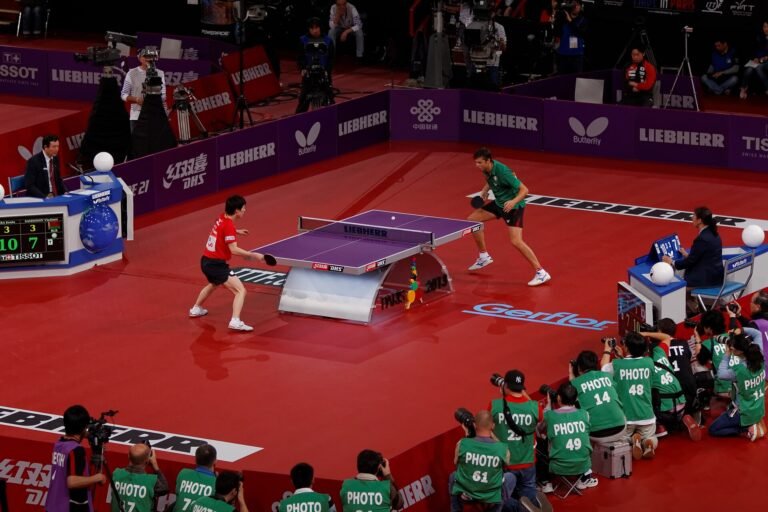
Table tennis is played on a 2.74 × 1.525 metre table split by a 15.25 cm net, with a 40 mm plastic ball. Every point starts with a serve: the ball rests on your open palm, is tossed up at least 16 cm without spin, and is struck as it falls so it bounces first on your own side, then on your opponent’s. After the serve, each shot needs only one bounce — on the opponent’s side — and you may never hit the ball before it bounces on yours: there are no volleys in this sport. Players alternate shots until one fails to return the ball legally. A game is won by the first player to 11 points (two clear if it reaches 10-all), the serve swaps every 2 points, and a match is the best of 5 games at most levels. That is table tennis. Everything below is the detail that makes those sentences work at a real table.
Bounce, then hit
Every ball you play must bounce on your side before you strike it, and land on theirs after. No bounce on your side, no shot — the volley does not exist here.
Shake hands with the bat
Start with the shakehand grip: the handle held as if shaking hands, thumb and index finger framing the blade. It plays both wings with no grip change.
Open palm, honest toss
The serve is the most regulated shot in the game: flat open palm, a toss of at least 16 cm, struck falling, bouncing on your side first.
Eleven points, serves in twos
First to 11 wins the game, two clear at 10-all. You serve twice, then your opponent serves twice. Best of 5 games takes the match.
In this guide
Table tennis in 30 seconds
Strip the sport down and it is a conversation conducted at speed. The server starts the point by bouncing the ball on their own side of the net and then across onto yours. From there the players take turns: each shot must clear the net (it may brush the net on the way over and still count) and bounce once on the opponent’s side of the table. The rally continues until somebody fails — hits the ball into the net, off the end of the table, into the ceiling lights of their own ambition, or breaks one of the handful of rules that govern a legal return. The winner of the rally takes the point, and the score climbs towards eleven.
Three ideas do most of the work in that paragraph, and every call at a table tennis table comes back to them:
Notice what the game does not restrict once a rally is running: how hard you hit, how much spin you apply, whether you stand at the table or three metres behind it, or which side of the bat you use. That freedom inside a table barely nine feet long is the sport’s engine. A 40 mm ball crossed by a spinning rubber surface behaves in ways that reward touch and timing over raw strength — which is why your first rallies will feel clumsy for twenty minutes and then, quite suddenly, start to flow. The sections below build the game in order: the equipment, your hand on the bat, your feet on the floor, the anatomy of a point, the four strokes, the scoring, and a complete first session you can copy.
The table, the net, the ball and the bat
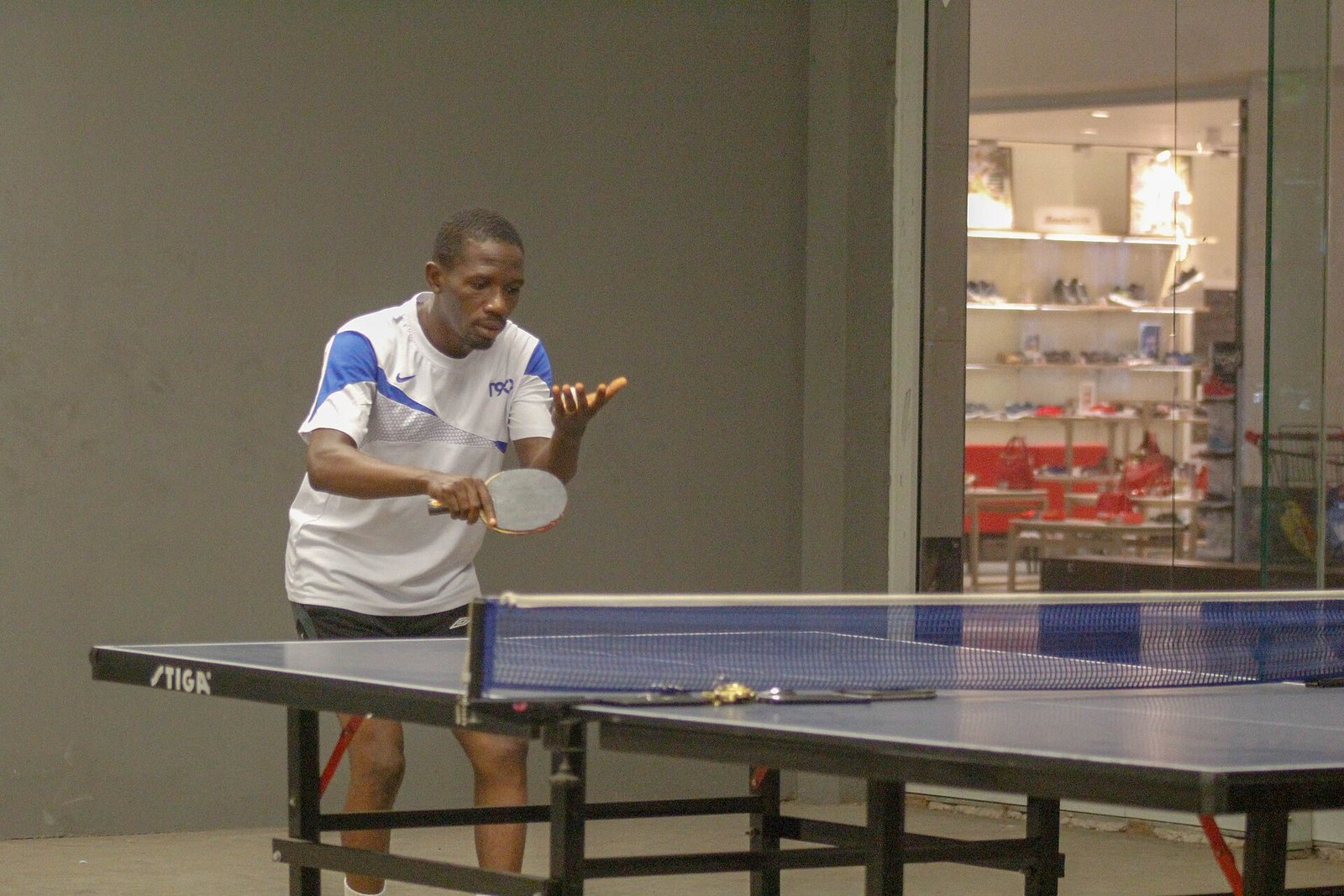
You can play table tennis on almost any table with almost any bat and have a recognisable game — people do, on kitchen tables and office desks, every day. But the sport’s dimensions are fixed by the ITTF Laws, and knowing them explains much of how the game is played: why the strokes are short, why touch matters, and why the ball seems to arrive sooner than your eyes promised.
The table and the net
The playing surface is a rectangle 2.74 metres long by 1.525 metres wide, standing 76 cm above the floor — about the footprint of a large dining table, at about dining height. White lines 2 cm wide mark the edges, and those lines are in: a ball that catches the line or the top edge of the table has landed on the surface. The vertical sides of the tabletop are a different matter — they are not part of the playing surface at all, so a ball that strikes the side of the table below the edge has missed, even if it then bounces up picturesquely (Law 2.1). The net divides the table across its middle and its top edge runs exactly 15.25 cm above the surface along its whole length — low enough that shots skim it constantly, high enough that a lazy return finds it. For doubles, a thin white centre line runs down the length of the table, splitting each side into two half-courts; it matters only for the serve, which must travel diagonally from right half-court to right half-court.
| Feature | ITTF specification | What it means for your game |
|---|---|---|
| Table size | 2.74m × 1.525m, 76cm high | Every ball is within one step; reaction time, not sprinting, is the currency |
| Net height | 15.25cm along its whole length | Low shots skim it; a serve or return that clips the tape can still be good |
| Ball | 40mm diameter, 2.7g, plastic, white or orange | Feather-light — spin and placement move it more than power does |
| Lines and edges | Top edge counts as in; vertical side does not | An “edge ball” off the top edge is a legal, nearly unreturnable shot |
| Centre line | 3mm wide, doubles only | Draws the two half-courts the doubles serve must travel between |
The ball
The modern ball is a seamless-feeling plastic sphere of 40 mm diameter weighing 2.7 grams — lighter than a sheet of A4 paper is not far off — in matt white or orange. Its lightness is the sport: air resistance and spin bend its flight visibly, the bounce off a rubber surface is dramatic, and a ball struck at full professional pace crosses the table in a fraction of a second yet can be slowed to a near-stop by a soft block. As a beginner you need only two ball facts. First, use balls marked for play rather than the dimpled novelties sold with beach sets — a true, round 40 mm ball bounces honestly. Second, orange and white are simply visibility choices against different backgrounds; there is no playing difference to shop for.
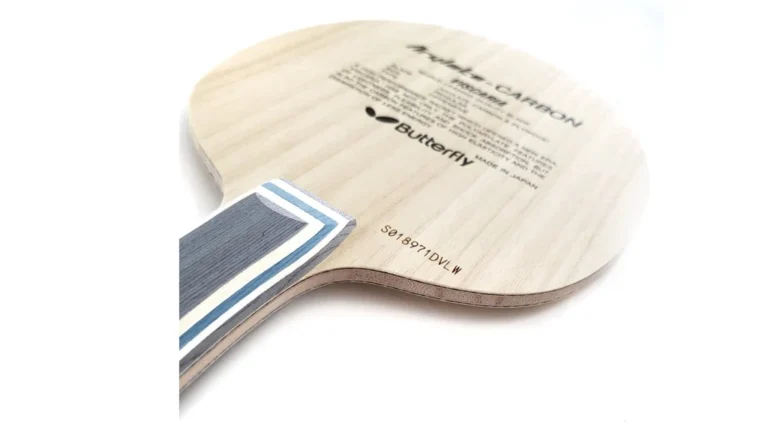
The bat: blade plus rubber
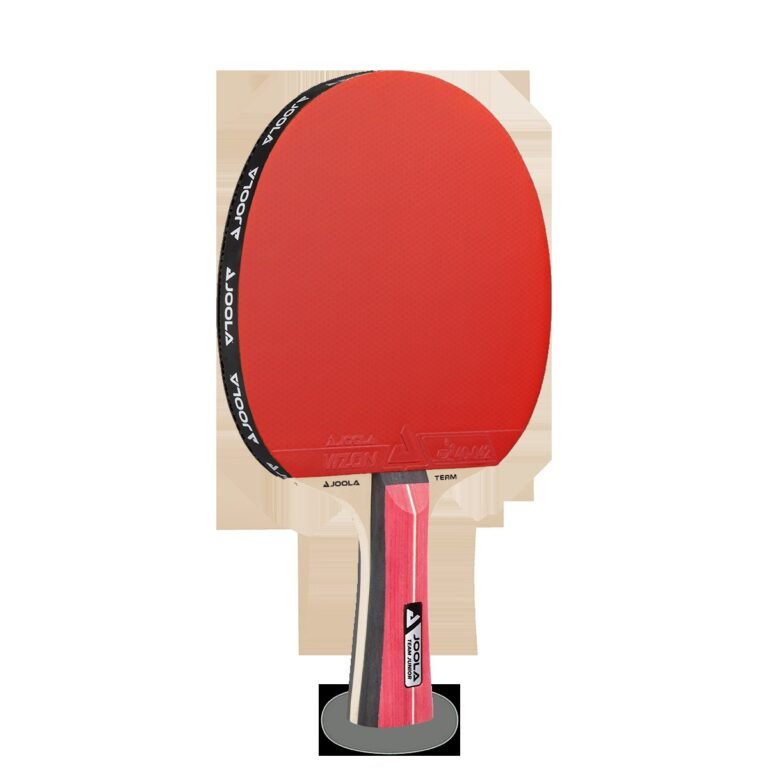
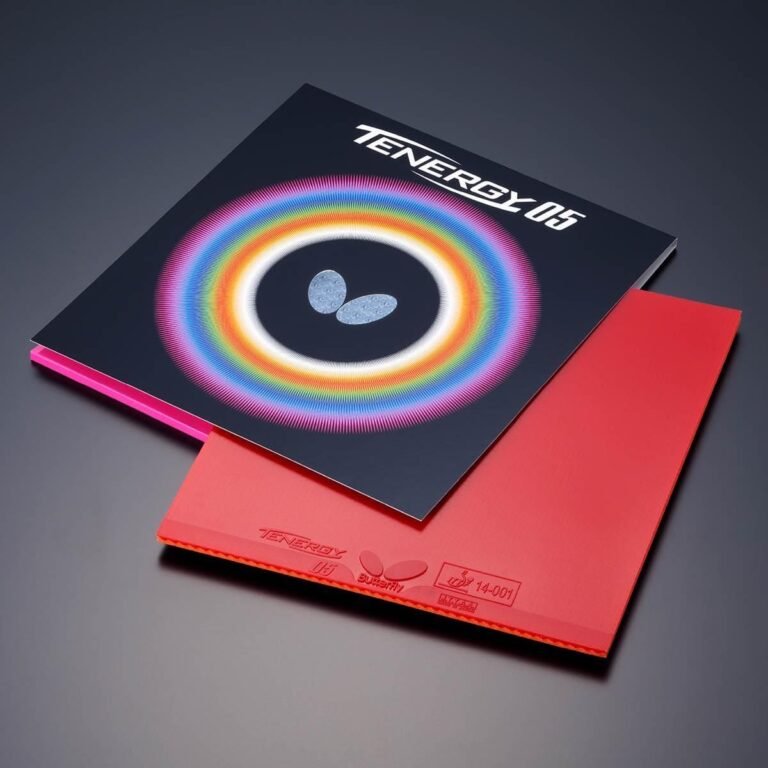
The Laws call it a racket; British players say bat; Americans say paddle. All three words mean the same two-part tool. The blade is the wooden head and handle — flat and rigid, and by rule at least 85% natural wood by thickness. The rubber is the playing surface glued to each side: by modern rule one side is black and the other a bright colour clearly different from black and from the ball, so your opponent can tell at a glance which surface struck the ball — the two sides genuinely play differently, and reading them is a skill the colour rule exists to make fair. The full anatomy — ply counts, composite layers, why one blade is faster than another — is a buying topic with its own home in our guide to the best table tennis blades. For your first sessions, the only decision that matters is the first-bat one: a ready-made bat with proper rubber on both sides, bought as a complete unit. Our guide to the best table tennis bats for beginners owns that decision — which pre-made bats have real rubber you can learn spin with, and which to avoid — and it is worth ten minutes before you spend anything, because the dimpled toy bats bundled with home tables will teach you almost nothing about the real game.
The grip: shakehand first, penhold explained
Before stance, before strokes, your hand goes on the bat — and table tennis has two great families of grip, divided by continent and era. Almost every beginner worldwide now starts with one of them, and this section teaches that one properly, then explains the other so you recognise it across the table.
Shakehand: the default, and how to hold it
The shakehand grip holds the bat exactly as its name suggests — as if you were shaking hands with the handle. It is the grip of the overwhelming majority of the world’s players and coaches’ standard recommendation for a beginner, for one decisive reason: it plays forehand and backhand with the same hold, so a rally never asks you to rearrange your hand mid-exchange. Set it up like this:
Setting the shakehand grip
Step 1 — Offer the handshake. Hold the bat out in front of you, blade upright, and take the handle in your playing hand as if greeting it. The handle settles diagonally across your palm, and the edge of the blade — its “shoulder” — should sit neatly in the V between your thumb and index finger. That V is the grip’s anchor: if the blade sits there, the angle of the bat face follows your forearm naturally.
Step 2 — Frame the blade with thumb and index finger. Your index finger lies along the bottom edge of the rubber on the backhand side of the blade, and your thumb rests along the bottom edge of the rubber on the forehand side. These two fingers steer the bat: they set and adjust its angle for every stroke, which is why coaches talk about “pinching” the blade between them.
Step 3 — Wrap the remaining three fingers. Your middle, ring and little fingers curl loosely around the handle — holding it, never strangling it. A white-knuckle grip locks the wrist and forearm, and a locked wrist cannot adjust the bat angle or generate the small, quick movements this sport is built on. The test: your grip should be firm enough that the bat stays put, loose enough that someone could almost slide it out of your hand.
Step 4 — Keep the wrist straight and the grip unchanged. The bat should feel like an extension of your forearm, wrist neither cocked back nor bent forward. Then leave it alone: forehand, backhand, serve, block — one grip for everything. The moment a beginner starts regripping between shots, rallies fall apart; the shakehand grip’s whole point is that you never have to.
Two beginner errors to dodge from day one. Gripping too far up the handle — “choking” the blade until your fingers spread across the rubber — kills the wrist freedom the strokes need and puts your fingertips where the ball lands. And holding the bat like a frying pan, handle vertical in a fist, points the blade face at the ceiling and turns every drive into a lob. If your handshake is honest and your fingers are framed as above, you are holding it correctly; the rest is practice.
Penhold: the other family
The penhold grip holds the bat the way you hold a pen to write: thumb and index finger curl around the front of the handle close to the blade, and the other three fingers rest against the back of the blade, either spread for stability (the Chinese style) or curled. The bat hangs head-down from that pinch, and the same face of the blade traditionally plays both forehand and most backhands — the modern Chinese game added a reverse-penhold backhand played with the blade’s far side, but that is an advanced development, not a starting point. Penhold bats themselves differ: the Japanese/Korean style has a longer handle with a squared cork block on the front for the fingers to hook against, while the Chinese style uses a shorter, rounded handle closer to a shakehand shape.
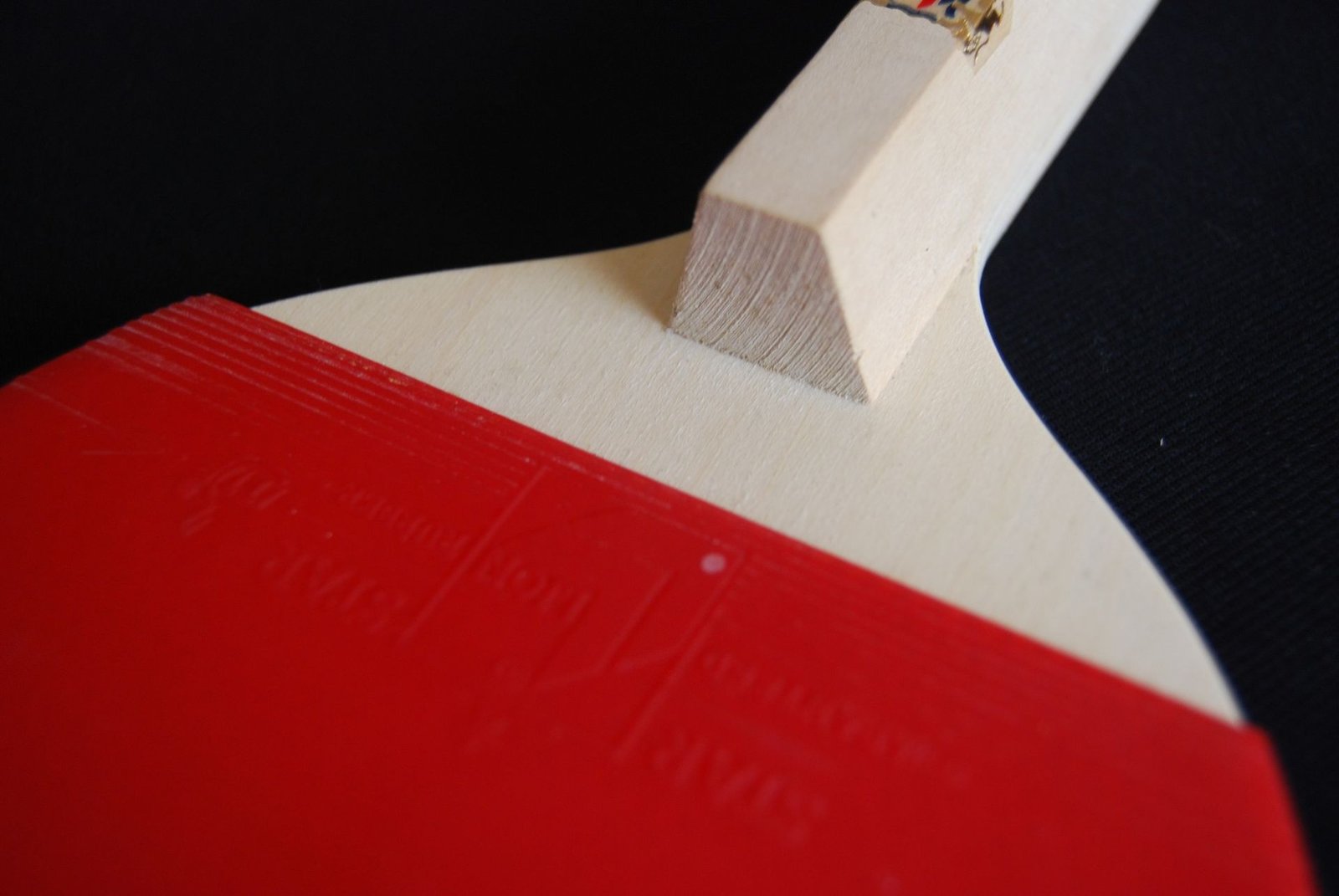
Should a beginner start penhold? If you grew up writing with chopsticks in hand and a coach who teaches it, it remains a beautiful, forehand-dominant style with real strengths — a naturally strong forehand and quick play close to the table. For everyone else, the honest coaching answer is shakehand: it is easier to learn a two-winged game with, easier to find instruction for, and nothing about it will hold back your first several years. Whichever you choose, choose once and commit — grip changes mid-learning are the most expensive restart in the sport.
The ready stance
Watch any competent player between shots and you will see the same photograph: knees soft, weight forward, bat up and out in front, eyes on the ball. That photograph is the ready stance, and it matters because table tennis gives you so little time that the rally is largely won or lost by where you are standing when the ball arrives. The stance itself is simple enough to learn in one session:
Feet and legs. Stand a comfortable arm’s length behind the table — close enough to reach a short ball with one step, far enough that a fast ball to your body is not already past you. Feet roughly shoulder-width apart, knees bent, weight on the balls of your feet rather than your heels. A right-handed shakehand player usually angles in slightly: left foot a half-step closer to the table than the right, body turned a fraction towards the backhand corner, which squares you to receive on either wing. Penholders angle more openly towards their forehand. Nobody stands bolt upright, square-on and flat-footed — that is a spectator, not a player.
The bat and free hand. Hold the bat up and in front of your body, roughly at net height or a little above, blade angled between forehand and backhand readiness — not dangling by your thigh, not raised like a shield. Your free hand mirrors it loosely in front of you, for balance. From this neutral perch either stroke is one small movement away, which is the entire point: the ready stance is not a pose, it is a starting line.
Recover, every time. The habit that separates players from ball-hitters: after every shot, return to the stance and the spot. Hit, recover, be ready, then move again for the next ball. What happens between the stance and the ball — the side-shuffles, the step in for a short ball, the crossover step when you are dragged wide — is a whole discipline of its own, and it is deliberately not this page’s job: our table tennis footwork for beginners guide owns those patterns one by one, with the errors that break them. Learn the stance here; learn to move from it there.
How a point flows: serve, receive, rally
Every point in table tennis has the same three-act structure, and learning it means learning which rules apply at which moment — because the serve is governed more tightly than anything that follows it, and the receive has one job that surprises every ex-tennis player at the table.
Act one: the serve
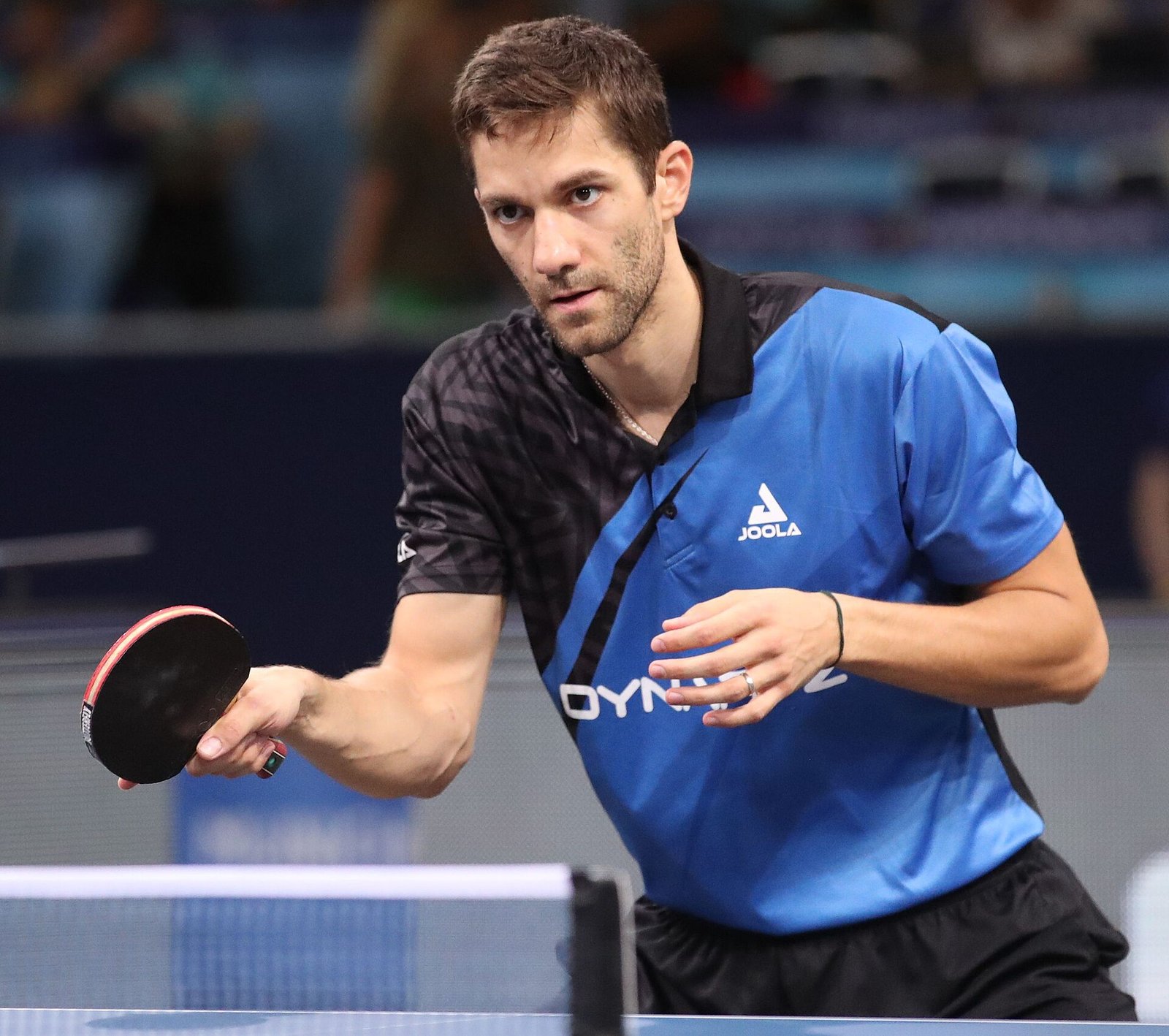
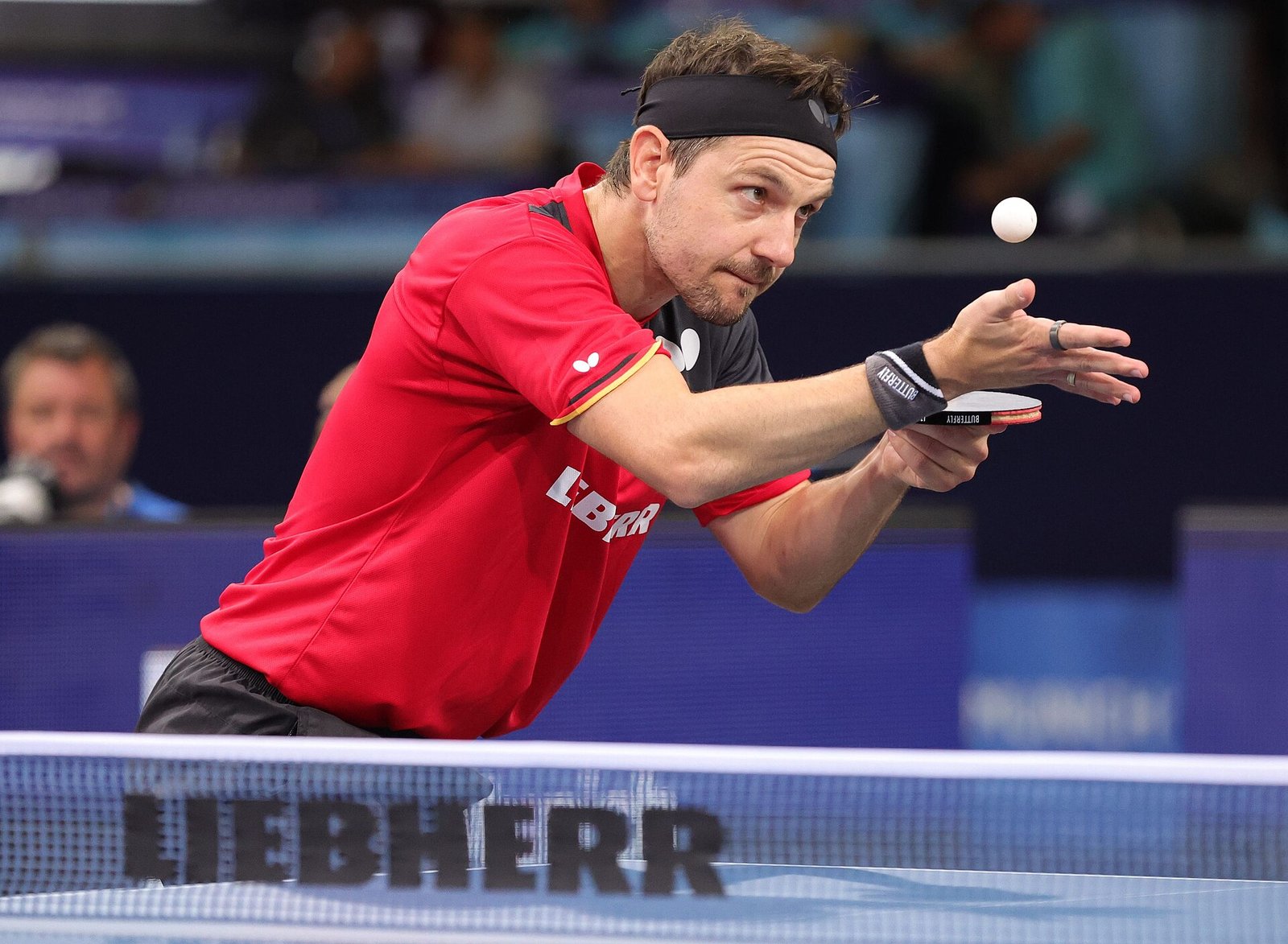
The serve is the most regulated shot in table tennis, and its rules exist to keep it honest — visible, spin-fair and impossible to hide. The legal shape of it, in the order the Laws give (Law 2.6): the ball starts resting freely on the open palm of your free hand, held still, above the level of the table and behind your end line. You throw it near vertically upwards, without putting spin on it, and it must rise at least 16 cm after leaving your palm. Only as it falls do you strike it — and the strike sends it to bounce once on your own side of the table, then over the net to bounce on your opponent’s side. From the moment the serve starts until the ball is struck, it must stay visible to the receiver: no hiding it behind your body, your arm or a dipped shoulder.
That is what a legal serve is. How to build one — the pendulum action, the spin variations, the short and long placements that turn the serve into a weapon — is technique this page deliberately does not teach, because our table tennis serves for beginners guide owns it stroke by stroke. The beginner’s serve needs only this ambition: a plain, legal, medium-paced serve that bounces once on each side and gives the rally a fair start. Two faults to know on day one: serving out of your hand without a real toss (the “finger serve” of playground legend) is illegal at any organised level, and a serve that misses your own bounce, or theirs, loses the point immediately.
Act two: the receive
The receiver’s one commandment: let it bounce. However tempting the ball looks hanging over the net, you may not strike it until it has bounced on your side — that is the obstruction rule from the 30-seconds section, and serve receives are where beginners break it most. After the bounce, your return has the standard shape: over or around the net, onto their side, once. A return may brush the net assembly on the way and remain good (Law 2.7). A receive that clips the net cord and drops over is not a foul and not replayed — it is simply a very good, slightly rude receive; apologise out of politeness and take the point.
The serve has one equivalent moment of luck with the opposite ruling: if a serve touches the net on its way over but is otherwise correct — it was heading for the right bounces — the rally is a let and the serve is retaken with no score (Law 2.9). A serve that touches the net and then misses the receiver’s side is just a fault. Lets also cover a serve delivered while the receiver is plainly not ready and makes no attempt, and disturbances nobody caused — a ball wandering in from the next table is the everyday case. The clause-by-clause version of lets, faults and point endings lives in the complete table tennis rules guide; at beginner level, “net-cord serve that was going in = serve again” covers nearly everything you will meet.
Act three: the rally
Once the receive is made, the point is a rally and the alternation is strict: you hit, they hit, you hit. In doubles the alternation runs through four players in a fixed sequence — server, receiver, server’s partner, receiver’s partner, and round again — so partners must take turns striking the ball, and a pair whose wrong member plays the shot loses the point (Law 2.8). Singles players have only the geometry to obey: one bounce on the far side per shot, no second chances.
A rally ends in one of a short list of ways. The ball is driven into the net, or past the end line or wide of the side lines without touching the table — including the floating shot that looks in until gravity files its report. The ball bounces twice on one side before being played. A player volleys it (obstruction), strikes it twice deliberately, touches the net assembly, moves the table, or lets their free hand touch the playing surface — leaning on the table mid-rally is a lost point, and a wonderfully common beginner one. Or the ball finds the top edge of the table and spits sideways beyond anyone’s reach: a legal, point-winning “edge”, greeted by a raised hand of apology that is pure etiquette and changes nothing. Every ending on that list, with its law number and its edge cases, is catalogued in the rules guide — this page’s list is the version you need to score your own games fairly without one.
The four starter strokes
You could fill a coaching library with table tennis strokes. A beginner needs four, and this section introduces each at the depth an introduction should: what it is for, the shape of it, and the error that ruins it. These are summaries to start rallies with — your strokes will be refined by practice and, ideally, by a coach’s eye, not by any webpage.
1. The forehand drive
The default rallying stroke and the first one to learn. Stand in the ready stance angled slightly side-on, and as the ball bounces on your forehand side, take the bat back a short distance — a compact turn of the forearm and shoulder, not a tennis backswing — then swing forward and slightly upward, meeting the ball around the top of its bounce, in front of your body. The follow-through finishes up around head height, pointing roughly where the ball went, and then you recover to the stance. The drive is played with a fairly flat bat angle and a brushing-flat contact: it is the stroke that keeps a rally going at increasing pace, and the platform everything attacking is later built on. The beginner error: swinging across the body or leaning back — both lift the ball off the end of the table. Weight forward, swing forward.
2. The backhand drive
The forehand’s mirror, played from a shorter distance. The bat starts close in front of your stomach, elbow bent and acting as the hinge, forearm roughly parallel to the table. As the ball bounces, the forearm extends forward and slightly up — players describe it as throwing a frisbee gently or opening a door — with contact in front of the body and a short follow-through. There is no room and no need for a big swing: the backhand drive is a compact, quick, repeatable stroke, and at beginner level its reliability matters more than its power. The beginner error: dropping the elbow and scooping from underneath, which balloons the ball up. Keep the elbow up and the swing level.
3. The backhand push
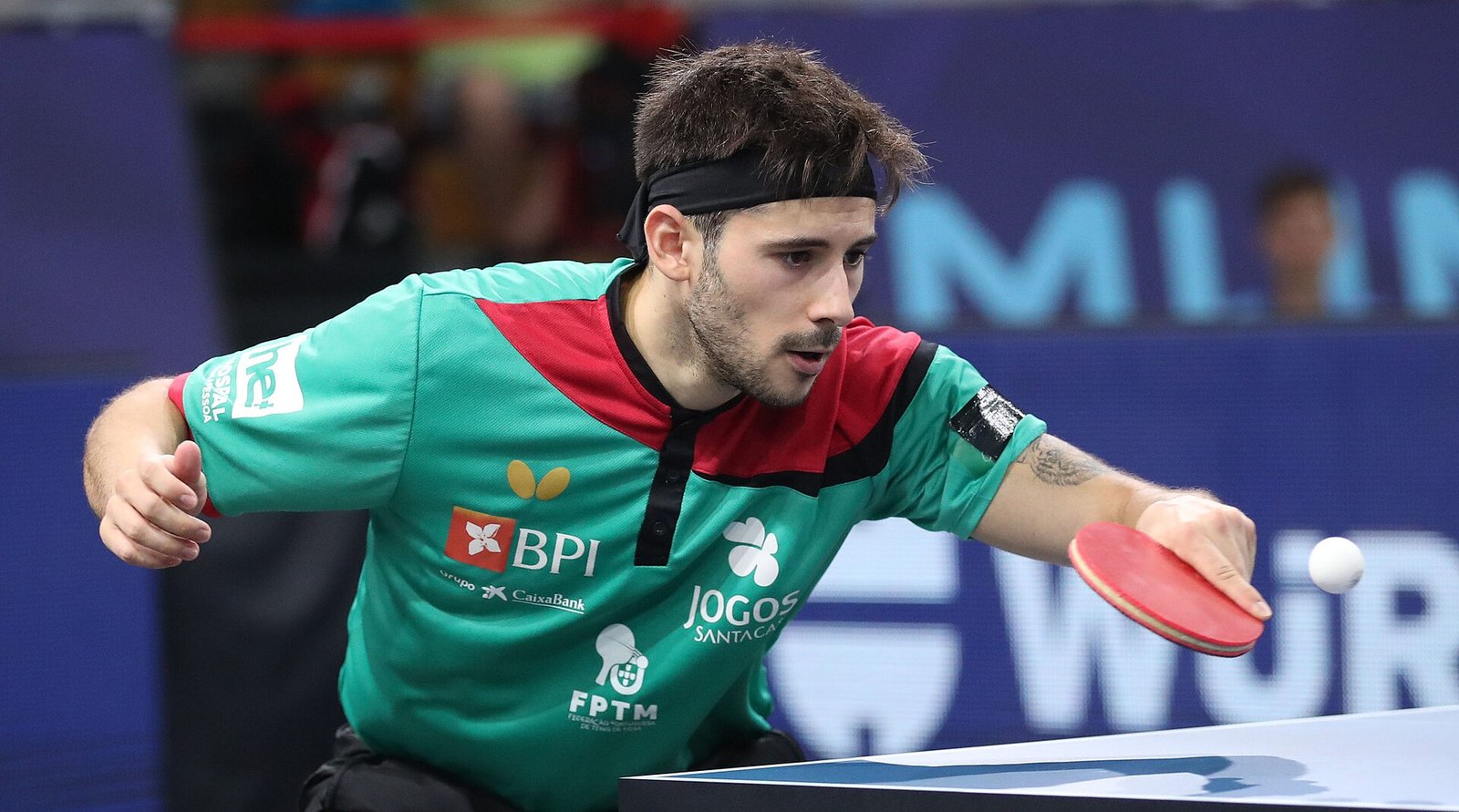
The control stroke, and the answer to the short ball. When a ball lands short on your side — too close to the net to drive — you step in and push: bat angled open (face tilted up towards the ceiling), you glide it forward and slightly down under the back of the ball, a smooth pushing contact rather than a hit. The push keeps the ball low and short in return, adds a touch of backspin of its own as you play it regularly, and is the standard way beginners receive anything they cannot attack — most serves in your first months will be answered with exactly this stroke. The beginner error: stabbing at the ball with a stiff wrist, which pops it up. The push is a glide, not a jab.
4. The block
The defensive sponge, and the easiest stroke in the game to describe: hold the bat still, angled slightly closed, just behind the bounce, and let your opponent’s pace do the work. The ball rebounds off your rubber and back over the net. The block is how you survive a fast drive without retreating — you borrow its speed instead of answering it — and it teaches the single most useful sense in the sport, bat angle: too open and the block floats long, too closed and it dives into the net, and the adjustment is measured in millimetres of wrist. The beginner error: swinging at the ball. The block has no swing; the moment you add one, you have invented a worse drive.
And the idea waiting behind them: topspin
Notice what all four strokes have in common: they meet the ball fairly flat and send it in a fairly straight line. The sport’s signature stroke bends that line. A topspin shot brushes up the back of the ball as it strikes, spinning it forwards; the spin drags the ball down in flight (so you can hit harder and still land it) and kicks it forward off the bounce. The forehand drive, played with a more closed bat and a brushing contact, grows into the forehand topspin — the attacking stroke the modern game is built around. You do not need it in week one, and this summary is deliberately where this page leaves it: learn the four strokes flat and reliable first, and topspin arrives as a variation of the drive rather than a mystery. It begins, as everything in this section does, from the ready stance and the one bounce.
Scoring and match format
Table tennis scoring was rebuilt in 2001 to make games shorter and television happier, and the modern system is mercifully simple — simpler than tennis scoring, and quicker to learn than padel’s tie-breaks. Three numbers run everything: 11, 2, and 5.
Eleven — the game. A game is won by the first player to score 11 points. Every rally is worth one point to its winner, whoever served — this is not tennis, where only the server scores. If the score reaches 10-all, the game continues until one player leads by two points: 12-10 ends it, 11-10 does not (Law 2.11).
Two — the serve rotation. Each player serves for two points, then the serve passes to the other player, all the way through the game. At 10-all, the rotation tightens: the serve changes after every single point. In doubles, the serving pair decide which partner serves first in each game, the receiving pair choose their first receiver, and at each change of service the previous receiver becomes the server while the previous server’s partner becomes the receiver — the four-player sequence from the rally section turning like a carousel (Law 2.13).
Five (or seven) — the match. A match is the best of any odd number of games (Law 2.12): best of 5 — first to 3 games — is the standard for club and most competitive play, with best of 7 at the top level and best of 3 perfectly respectable for a lunch-break rivalry. Players change ends after every game, and in the deciding game they change ends once more as soon as the first player reaches 5 points — a small rule that stops one end’s draught or lighting deciding a match.
| Question | The rule | Beginner’s note |
|---|---|---|
| Points in a game | First to 11; two clear at 10-all | Every rally scores — server and receiver alike |
| Serves in a row | 2 per player; 1 each at 10-all | Count them silently: “one, two, change” |
| Games in a match | Best of 5 (club standard) | First to 3 games; best of 3 or 7 by level |
| Changing ends | After each game; at 5 points in the decider | Also your moment for water and a towel |
| Who serves first | Decided by lot — a coin, or rally for serve | In casual play, one knock-up rally settles it |
Keeping score is the server’s courtesy job: call it before you serve, your points first — “7-4” — on every point, without being asked. Half of all casual scoring disputes are really memory failures that a called score prevents. And a word on the system’s far corner, mentioned only so the term never ambushes you: if a game drags past ten minutes of play with fewer than 18 points scored, an “expedite system” can be introduced that puts the receiver thirteen returns from stealing the point. You will essentially never meet it outside formal competition; the rules guide keeps its full text for the day you do.
Your first session: a walkthrough
You now know the game well enough to play it legally. This section turns that knowledge into one complete first session — what to bring, how to warm up, how to structure your first games, and what to work on next, in the order you will actually do them.
What to bring. A bat — your own pre-made bat if you have followed the beginner’s bats guide, or a borrowed club bat, which every hall keeps. Two or three balls; they roll, they hide, and a session with one ball is a session of fetching. Indoor court shoes or any clean, flat, grippy trainers — you will shuffle and lunge more than you expect, and running shoes’ high heels are built to roll an ankle doing it. Clothing you can move and reach in. And a small towel: the ball is 2.7 grams and your palm is not, and a dry grip at 9-all is worth a point a game.
Your first hour, step by step
Step 1 — Knock up forehand to forehand (5 minutes). Stand in the ready stance a step back from the table and rally forehand drives diagonally, cooperatively — your partner is not an opponent yet. Aim for ten in a row, then twenty, at a pace you can both sustain. This is where the grip either feels natural or gets adjusted, so adjust it now, not in a game.
Step 2 — Knock up backhand to backhand (5 minutes). Same exercise on the other diagonal, then a few minutes of backhand pushes each: one partner pushes short and low, the other pushes back. You have now used three of your four strokes before a single point has been scored, which is precisely the idea.
Step 3 — Practise the legal serve (5 minutes). Serve twenty balls with no receiver pressure: open palm, honest toss, bounce-bounce, aiming simply to clear the net and land it deep enough to matter. Have your partner catch and return them. If a serve misses your own side’s bounce, it was a fault in a game — knowing what your faults look like is a first-session achievement, not an embarrassment.
Step 4 — Play games to 11 (30 minutes). Best of 3 games, real scoring, real serve rotation, called out loud on every point. Use the block the first time a drive comes at you too fast; answer short serves with the push. Change ends between games, and in the third game change at 5 points, exactly as the format demands — habits built in casual games are the ones that survive into competitive ones.
Step 5 — Cool down with a doubles game if you have four players. Doubles is the sport’s social heart and its best teaching tool: serves go diagonally right-half to right-half, partners alternate every shot, and the movement it forces will show you why the next guide on your reading list is the footwork one.
Session etiquette — the layer the Laws assume. Call your own faults without being asked: the serve that missed its bounce, the free hand that brushed the table, the ball you caught before it had passed the end line. Raise a hand for a lucky net cord or edge — it changes nothing and buys goodwill everywhere. Never walk behind a neighbouring table mid-rally to collect a ball; wait for their point to end, as they will wait for yours. And when the hour ends, the handshake over the net is not optional theatre: it is the sport’s punctuation, from school halls to world finals.
What to practise next. Your second month has three obvious threads, each with its own guide on this site. Serve technique first — the toss, the contact, your first shaped serves — in the beginners’ serves guide. Movement second — the patterns that take you from standing in the ready stance to arriving in it, shot after shot — in table tennis footwork for beginners. And the rulebook whenever a call is disputed twice — the complete rules guide will settle it, law number and all. That is the whole beginner curriculum: this page to start, those three to grow.
The beginner’s checklist
Pin this version to the inside of your head for your first month:
- Grip: shake hands with the handle, blade’s shoulder in the V of thumb and index finger, three fingers loose around it — and never change it mid-rally.
- Stance: knees bent, weight forward, bat up in front, a step behind the table — and recover to it after every single shot.
- Serve: open palm, toss it at least 16 cm without spin, strike it falling, bounce on your side then theirs. Plain and legal beats fancy and faulted.
- Rally: let it bounce on your side before you hit it — there are no volleys — then land it once on theirs. Net cords that drop over count; edges off the top count; the side of the table does not.
- Score: a game to 11, two clear at 10-all; serves swap every 2 points (every 1 at 10-all); matches best of 5. Call the score before you serve, yours first.
- Honesty: your free hand stays off the table, a net-cord serve that was going in is replayed, and your own faults are yours to call.
How to play table tennis — FAQs
Is table tennis the same as ping pong?
Yes — one game, two names. Table tennis is the official name used by the sport’s governing body, the ITTF, and by every competition in the world; ping pong is the older social name the game grew up with, and the word most casual players still use. The rules, the table and the scoring are identical under either name. Our table tennis vs ping pong explainer tells the full story of how the two names split, including the trademark history behind them.
How do you hold a table tennis bat?
Start with the shakehand grip, used by the great majority of players: hold the handle as if shaking hands with it, with the blade’s shoulder sitting in the V between your thumb and index finger. Your index finger lies along the bottom edge of the rubber on one side, your thumb along the bottom edge on the other, and your remaining three fingers wrap loosely around the handle. The alternative family is the penhold grip, held like a pen between thumb and index finger — a legitimate style, but shakehand is the easier starting point because it plays forehand and backhand with one unchanged grip.
How does scoring work in table tennis?
A game is won by the first player to 11 points, with every rally worth one point to its winner. If the score reaches 10-all, play continues until one player leads by two points. The serve changes hands after every 2 points — and after every 1 point once the score is 10-all. A match is the best of an odd number of games: best of 5, first to 3 games, is the club and competitive standard (ITTF Laws, Laws 2.11–2.13).
Does the serve have to bounce on your own side first?
Yes — that double bounce is what defines the serve. The ball starts on your open palm, is tossed near vertically at least 16 cm without spin, and is struck as it falls so that it bounces first on your side of the table and then on your opponent’s (ITTF Laws, Law 2.6). In doubles it must also travel diagonally, from your right half-court to your opponent’s right half-court. Serve technique itself — spin, placement and the starter serves worth learning — is covered in our table tennis serves for beginners guide.
Can you volley in table tennis?
No. Unlike tennis, the ball must bounce on your side of the table before you strike it. Touching the ball while it is in the air above, or travelling towards, your side — before it has bounced — is called obstruction and loses you the point (ITTF Laws, Law 2.5.8). The only safe contacts are with a ball that has already bounced on your side, or one that has passed beyond the end line and is travelling away from the table, which can be caught or stopped freely.
What happens if the ball hits the edge of the table?
It depends which edge. A ball that clips the top edge of the table — including the white line — has touched the playing surface and is good, however cruelly it deflects. A ball that hits the vertical side of the tabletop below the edge has missed the surface entirely and is out, because the Laws define the playing surface as the top only (ITTF Laws, Law 2.1). Edge balls off the top are legal point-winners; by custom, the player who hits one raises a hand in apology.
How many serves do you get in a row?
Two. Each player serves for two consecutive points, then the serve passes to the opponent for two, alternating through the game. The one exception is at 10-all, where the serve changes after every single point until someone leads by two and takes the game (ITTF Laws, Law 2.13). In doubles the same two-serve rotation runs through all four players in their fixed sequence.
What bat should a beginner buy?
A ready-made (pre-made) bat with proper smooth rubber on both sides, bought as a complete unit from a table tennis brand. That rubber is what lets you feel and learn spin; the dimpled or sandpaper-faced toy bats sold with home table sets cannot grip the ball and will teach you the wrong game. Our guide to the best table tennis bats for beginners compares the current pre-made options, and when you later outgrow one, the step up is a separate blade and rubbers — the subject of our blades guide.
About this guide: The rules summarised here follow the ITTF Statutes 2026, Chapter 2 (The Laws of Table Tennis), stated at beginner depth; club and social games sometimes use house conventions, which take precedence on the day. Technique summaries reflect standard beginner coaching practice and are a starting point, not a substitute for a coach. This page links only to guides on Alishuttler.com — any affiliate relationships are disclosed on the pages concerned.