Pickleball’s core buying segment deserves a guide that reads spec sheets instead of stereotypes. Senior players choose on published facts: how much the paddle weighs, how thick the core is, what the face is made of, and — the spec this guide treats as first-class — the grip circumference and handle length the maker actually offers, stated as sizing. These seven paddles are compared on exactly those published numbers, from the lightest paddle and smallest grip in the category to the longest handle and the thickest cores, with no health claims anywhere: just the makers’ own figures, read properly.
⚡ TL;DR — The Short Answer
For the lightest paddle with the smallest grip, buy the ProKennex Ovation Flight — 7.3 to 7.6 ounces with a 4-inch tapered grip, the smallest circumference any maker here publishes. For control with a wide face, the Selkirk SLK Evo Control Max pairs a 16 mm core with a T700 carbon face in two shapes. The Engage Pursuit MX 6.0 is the elongated pick with the longest handle here at 5¾ inches, the Gamma Legend NeuCore the thick-core widebody with a 4⅛-inch grip, and the Paddletek Tempest Wave Pro v3 the one with a published grip choice — thin 4⅛ or standard 4⅜. The Six Zero Quartz 15mm is the forgiving widebody all-rounder, and the JOOLA Simone Jardim Hyperion CFS 14 Swift the fast, light elongated option at 7.7 ounces.
Quick Picks — Best Pickleball Paddles for Seniors at a Glance
7.3–7.6 oz and a 4″ tapered grip — the lightest published spec and smallest grip in this guide.
A 16 mm Rev-Control core and T700 CarbonFusion face, in Max and elongated XL shapes.
16.5″ × 7.5″ with a 5¾″ handle and a ⅝″ core — reach and two-handed room, per Engage.
A ⅝″ large-cell NeuCore in an 8″-wide body, with a 4⅛″ Honeycomb grip.
Order it thin (4⅛″) or standard (4⅜″) — the only published grip choice here.
A 15 mm core in a 7.9″-wide raw-carbon body, at a 7.9 oz average published weight.
7.7 oz average in JOOLA’s lighter Swift build, with a 4⅛″ grip and a 5.5″ handle.
In This Guide
The Senior Decision: Weight Bands, Core Thickness and Grip Sizing
Pickleball is the rare sport where the senior segment is not a niche — it is the centre of the market — and the makers’ catalogues show it. The paddles published for control, touch and long social sessions cluster in a tight published envelope: weights from 7.3 to about 8.1 ounces, cores at the 15–16 mm end of the range, and grips at or below the standard 4¼ inches on several models. All seven cards below sit inside that envelope, and the guide is organised by the three decisions inside it: how light, how thick, and — the decision most guides skip — what grip circumference and handle length the maker offers, treated throughout as sizing, the way a shoe size is sizing.
Grip deserves its headline because the published spread is real. At one end, ProKennex publishes a 4-inch tapered grip on the Ovation Flight — the smallest circumference in this guide. Paddletek publishes a choice: the Tempest Wave Pro v3 can be ordered with a thin 4⅛-inch grip or a standard 4⅜-inch. Gamma publishes 4⅛ on the Legend, JOOLA 4⅛ on the Swift, Engage 4⅜ on the Pursuit MX, and Selkirk and Six Zero the standard 4¼. That is a full three-eighths of an inch of published variation across seven paddles — enough to change how a paddle sits in the hand entirely, and it is printed on every card so you can shop it deliberately. If you want to fine-tune further after buying, our guide to the best pickleball grips covers replacement grips and overgrips.
One boundary before the picks. This page is equipment selection only, for the senior decision. The wider game — getting started, rules, social play and formats — belongs to our live guide to pickleball for seniors, and the playing basics to how to play pickleball. Segment guides own their own fields: the best pickleball paddles for beginners for first paddles, and the best pickleball paddles for women for that segment’s picks. None of their models is re-carded here.
Shapes, Faces and the Specs Makers Publish
Weight bands first, because makers publish them as bands. Most cards here carry a range, not a point: the Ovation Flight at 7.3–7.6 ounces, the Evo Control at 7.6–8.1, the Tempest Wave Pro at 7.6–8.0. A range means individual paddles vary within it, and several makers let retailers weigh or select within the band — worth asking about if you are shopping the light end. The vocabulary matters too: Engage publishes its bands under the labels LITE and Standard, and this guide keeps makers’ labels attached to makers’ numbers rather than inventing its own categories.
Core thickness is the control dial makers publish. The thick end of this guide — 16 mm on the Selkirk, ⅝ inch (15.875 mm) on the Gamma and the Engage — is where makers aim their control descriptions: thicker cores are consistently published with softer, more controlled positioning, and Gamma goes further, publishing its NeuCore as a larger-cell core it describes as 25% thicker. The 14–14.3 mm cards (JOOLA Swift, Tempest Wave Pro) sit a step crisper. None of that is this guide’s testing — it is the makers’ own published positioning, and the cards attribute it that way. Faces divide similarly: raw and textured carbon on the Selkirk, Six Zero and JOOLA cards, Paddletek’s ICED carbon, Gamma’s textured fibreglass, Engage’s friction graphite.
Shape is the third dial: widebody, standard, elongated, oval. The widebodies — Gamma Legend at 8 inches wide, Six Zero Quartz at 7.9, Tempest Wave Pro at 8 — publish the broadest hitting faces. The elongated pair — Engage Pursuit MX and JOOLA Swift, both 16.5 × 7.5 — publish reach and the two longest handles after the Engage. The Ovation Flight is the outlier shape: an oval, edgeless profile at 15.43 × 7.6, the shortest and narrowest here, built — in ProKennex’s published description — for manoeuvrability. There is no correct shape; there is the shape whose published dimensions match how you play, and the buying guide below maps them.
The 7 Best Pickleball Paddles for Seniors, Compared
Seven paddles, one shared brief — light as their makers publish it, gripped for real hand sizes, and built for the control game. Read the card that matches your hand first.
ProKennex Ovation Flight
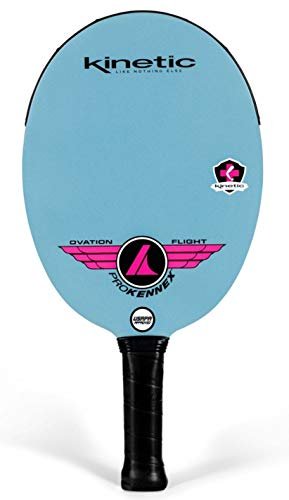
The lightest published spec here — 7.3 to 7.6 ounces around a 4-inch tapered grip, in an oval, edgeless shape.
Two published numbers make this the first card in a seniors guide. The weight range — 7.3 to 7.6 ounces — is the lightest in this guide, full stop. And the grip: ProKennex publishes a 4-inch circumference, tapered, the smallest grip any maker here offers, a full quarter-inch below the standard 4¼. For a player with smaller hands, that is not a detail; it is the difference between a handle that sits in the fingers and one that has to be held onto. Both figures are ProKennex’s own published specifications, and the card stands on them alone.
The rest of the published build is equally distinct. The shape is an oval — 15.43 × 7.6 inches, the most compact here — with an edgeless construction and a replaceable Air-O-Guard edge system, which ProKennex publishes as a guard you can swap if it scuffs. The core is ProKennex’s Cloud Cell polymer, the face carbon with a Diamond Frost finish, and the frame carries ProKennex’s Kinetic system name — reported here as construction only: ProKennex attaches further claims to that system in its own marketing, and this guide reports specifications, not health claims, so those stay with ProKennex. The paddle is USAPA approved for sanctioned tournament play. If light and small-gripped is your brief, the search starts and may well end here.
What we like
- The lightest published weight range in the guide
- A 4″ tapered grip — the smallest circumference any maker here publishes
- Replaceable Air-O-Guard edge, per ProKennex
- Oval, edgeless shape — a genuinely distinct published profile
Worth knowing
- The compact oval face offers less width than the widebody cards
- The 4″ grip is a fixed spec — players wanting 4¼ should look at the Selkirk or Six Zero cards
- ProKennex’s wider marketing claims for its Kinetic system are not specifications and are not repeated here
As an Amazon Associate we earn from qualifying purchases.
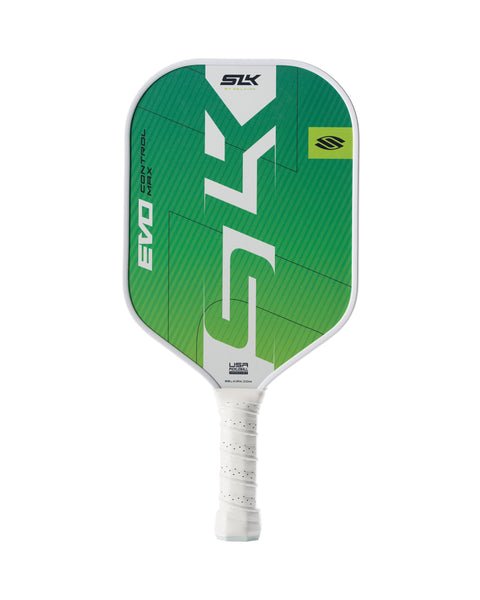
Selkirk SLK Evo Control Max
The control brief in two shapes — a 16 mm Rev-Control core under a T700 CarbonFusion face, at 7.6 to 8.1 ounces.
Selkirk’s SLK line is its accessible range, and the Evo Control is its control brief — carded here in its current generation, the version Selkirk itself lists now: a T700 CarbonFusion face over a 16 mm Rev-Control Polymer Honeycomb core. (Older listings for a previous 2.0 version with a different face still circulate at retailers; the specifications on this card are the current model’s, from Selkirk’s own listing.) Selkirk positions the paddle for advancing players who want control with a touch of power, and the published hardware matches the positioning: the joint-thickest core in this guide, a carbon face, and Selkirk’s SpinFlex+ texture.
The shape choice is the card’s second half. The Max is the standard profile — 16 × 7.85 inches with a 4.85-inch handle — while the XL stretches to 16.4 × 7.4 with a 5.75-inch handle, the joint-longest handle here, which is the version to read if you play a two-handed backhand or simply want the reach. Both publish the same 7.6–8.1 ounce range and the same 4.25-inch SLK Ultra-Comfort grip. For the player whose game is dinks, drops and resets — the soft game played at the kitchen line — this is the most complete control specification in the guide, in either shape.
What we like
- 16 mm core — the joint-thickest here — under a T700 carbon face
- Two published shapes, including a 5.75″-handle XL
- Current-generation specification, verified on Selkirk’s own listing
- A clear control brief, in Selkirk’s own positioning
Worth knowing
- Older 2.0/G8-Flex listings still circulate — check the listing says CarbonFusion
- The grip is a single published size: 4.25″
- The top of the weight band (8.1 oz) is midweight, not light
As an Amazon Associate we earn from qualifying purchases.
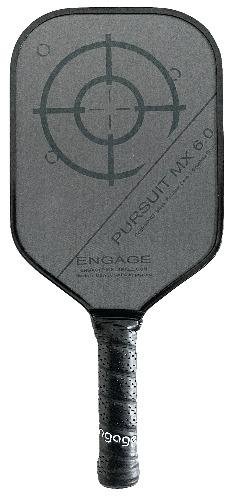
Engage Pursuit MX 6.0
The reach pick — an elongated 16.5-inch MX shape, the longest handle in the guide at 5¾ inches, and a ⅝-inch core in two weight bands.
Engage’s Pursuit line is its flagship, and the MX 6.0 is the elongated, thick-core member: 16.5 × 7.5 inches with a 5¾-inch handle — the longest handle in this guide, published for the reach and the two-handed room it gives. The “6.0” is Engage’s thickness designation: a ⅝-inch core of its Control Pro ‘Black’ polymer, which Engage describes as the softest core it makes, under a proprietary friction-based graphite skin whose texture Engage says is the skin itself rather than an applied overlay. Engage also publishes the paddle as optimised to pass stringent community noise requirements — a specification that matters more than most, in the many communities where pickleball noise rules are a real condition of play.
The weight is published in Engage’s two labelled bands: LITE at 7.5–7.9 ounces and Standard at 8.0–8.4. Senior buyers should shop the LITE band explicitly — it is the same paddle, published lighter, and the band is wide enough that asking a retailer to select within it is reasonable. The grip is a single published 4⅜ inches, the largest here alongside the Tempest’s standard option, so smaller hands should weigh that against the reach. One naming caution, printed plainly: Engage’s Pursuit range contains several models — this is the Pursuit MX 6.0, not the Pursuit Pro EX carded in our women’s guide. Check the full name on the listing. The paddle is USAPA approved and made in the USA, per Engage.
What we like
- The longest published handle here — 5¾″ — on an elongated shape
- A published LITE weight band, 7.5–7.9 oz
- ⅝″ Control Pro ‘Black’ core — Engage’s softest, per Engage
- Published as optimised for community noise requirements
Worth knowing
- The grip is 4⅜″ only — the joint-largest here
- The Standard band runs to 8.4 oz; shop the LITE band by name
- Several Pursuit models exist — verify “MX 6.0” on the listing
As an Amazon Associate we earn from qualifying purchases.
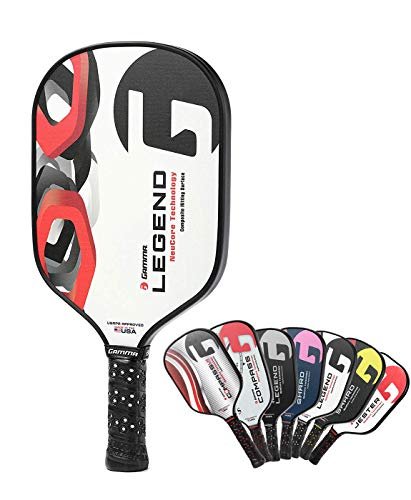
Gamma Legend NeuCore
The big-face, small-grip combination — an 8-inch widebody over a ⅝-inch large-cell core, with a 4⅛-inch Honeycomb grip.
Gamma’s NeuCore idea is published in one sentence: a polypropylene core with larger cells, at ⅝ of an inch thick — a core Gamma describes as 25% thicker than standard — built for a softer, quieter, more responsive feel, in Gamma’s own description. The Legend wraps that core in the joint-widest body in this guide, 15⅞ × 8 inches, with a textured fibreglass face. The combination is the widebody answer to the control brief: the thickest class of core here, spread across the broadest face, for the player whose game is blocking, resetting and placing rather than driving.
The grip completes the card’s logic: Gamma publishes a 4⅛-inch circumference on its Honeycomb grip — the second-smallest grip here, on the joint-biggest face. That pairing is rarer than it should be, and it is exactly the combination a smaller-handed player who wants a forgiving face has to hunt for. The published weight sits at about 8.0 ounces — the middle of this guide, not its light end, which is the honest trade for the core volume and face area. The handle is 4¾ inches, the paddle is USAPA approved, and Gamma publishes it as made in the USA. Buy it for the face-and-grip combination; accept the midweight figure as its price.
What we like
- ⅝″ large-cell NeuCore — Gamma’s published thick-core brief
- The joint-widest face here (8″) with a small 4⅛″ grip — a rare pairing
- Textured fibreglass face, per Gamma
- Made in the USA and USAPA approved, per Gamma
Worth knowing
- ~8.0 oz is midweight — the Ovation Flight is the light answer
- Fibreglass face, where most cards here are carbon — a feel difference, stated plainly
- The 4¾″ handle is the joint-shortest here — not the two-handed pick
As an Amazon Associate we earn from qualifying purchases.
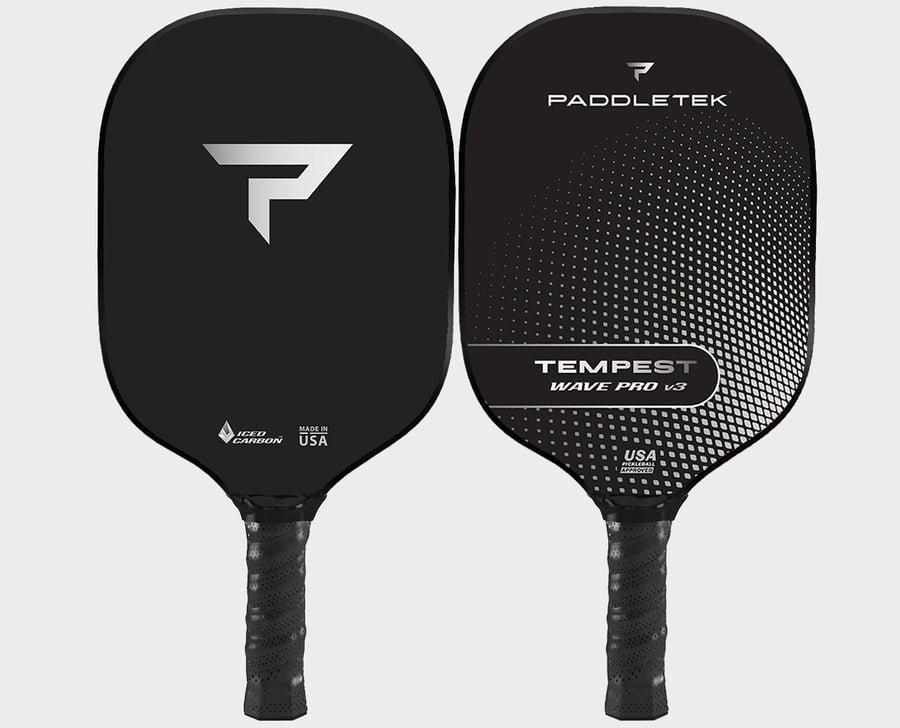
Paddletek Tempest Wave Pro v3
The paddle you order to your hand — a published choice of thin 4⅛-inch or standard 4⅜-inch grip, at 7.6 to 8.0 ounces.
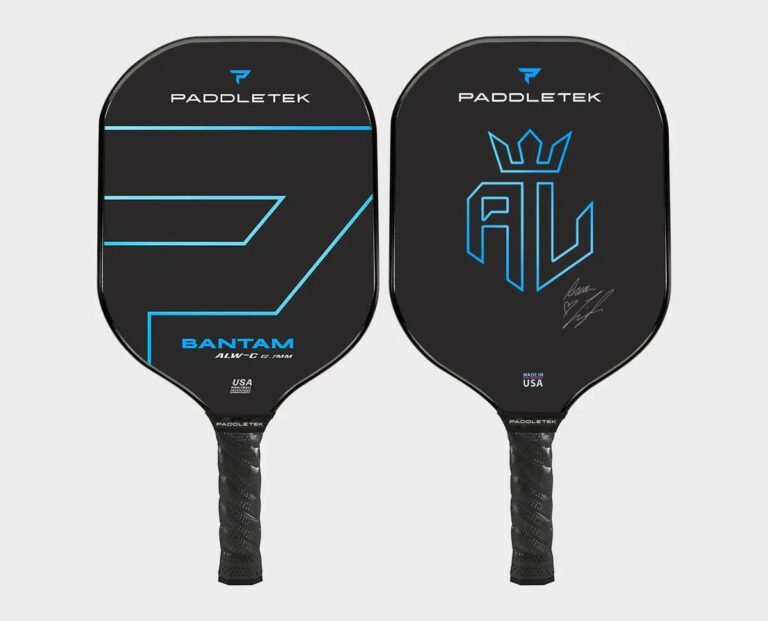
Every other card in this guide publishes one grip circumference. Paddletek publishes two: the Tempest Wave Pro v3 can be ordered with a Thin grip at 4⅛ inches or a Standard grip at 4⅜ inches — a genuine, orderable choice of handle size on the same paddle, which is why this card exists in a seniors guide. Hand size stops being a filter and becomes a selection. The rest of the published build is Paddletek’s long-running control brief: an ICED Carbon Fiber face with its Perma-Spin texture, a Tempest SRT polymer honeycomb core at 14.3 mm, and Paddletek’s own published ratings — control 9.5 of 10, forgiveness 9.5 of 10, in the maker’s rating system, reported as the maker’s ratings.
The dimensions are the standard-shape middle of the guide: 15⅞ × 8 inches, a 5¼-inch handle, and a weight band of 7.6–8.0 ounces. Paddletek also publishes that its weight specifications hold within a tenth of an ounce — a tighter stated tolerance than most — and that thin-grip paddles carry its High Tack grip while standard grips carry the Ultra Cushion version. The paddle is made in the USA. For the player whose one non-negotiable is the handle, this is the only card that lets you specify it at the point of order rather than rebuild it with overgrips afterwards.
What we like
- A published grip choice — thin 4⅛″ or standard 4⅜″ — unique in this guide
- Stated weight tolerance within 0.1 oz, per Paddletek
- ICED carbon face with Perma-Spin texture
- Made in the USA
Worth knowing
- The 14.3 mm core is a step thinner than the 16 mm control cards
- Choose the grip at order — it is a variant, not an adjustment
- Paddletek’s published ratings are the maker’s own, not independent measurements
As an Amazon Associate we earn from qualifying purchases.
Six Zero Quartz 15mm
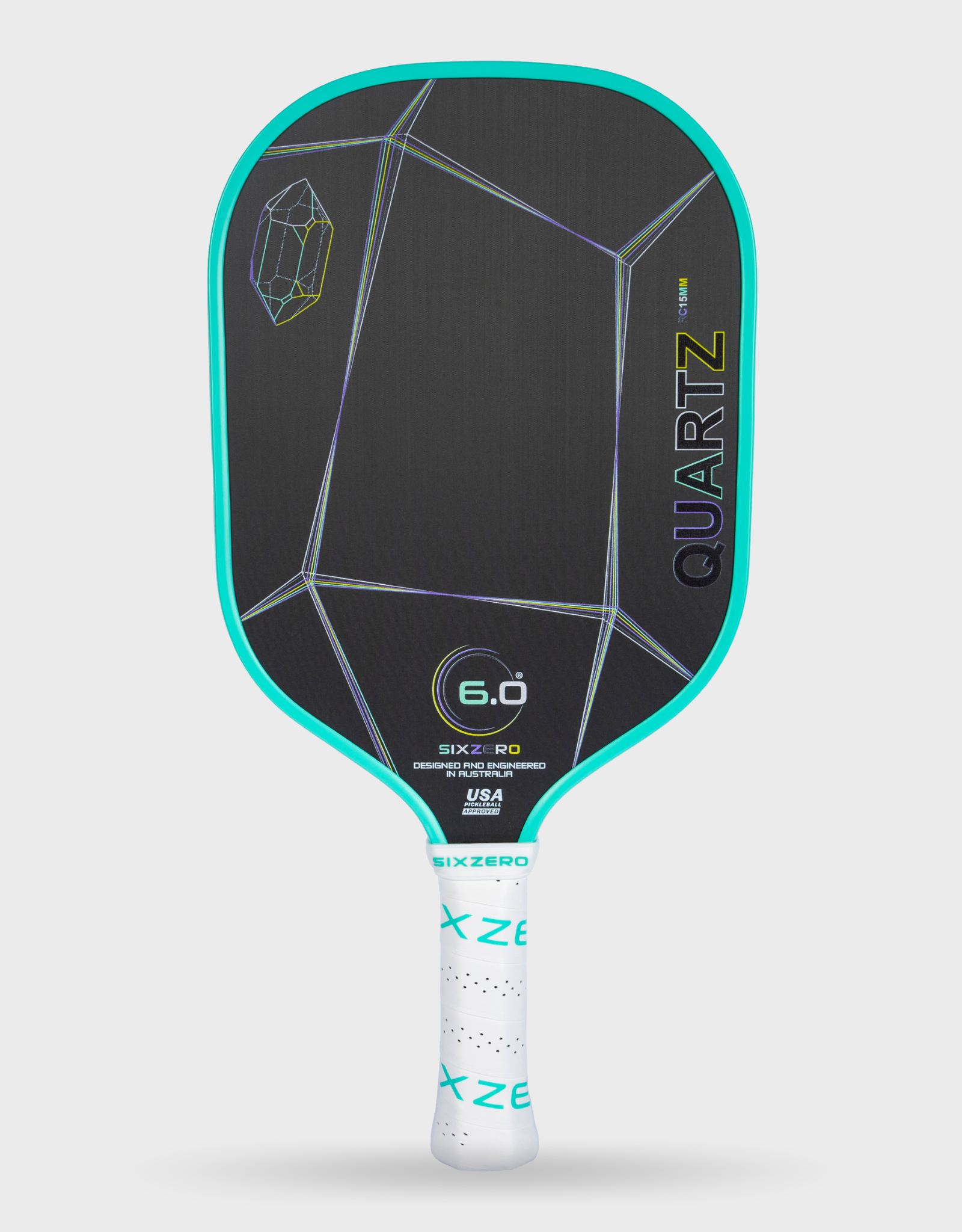
The accessible raw-carbon widebody — a 15 mm core in a 7.9-inch-wide body, at a 7.9-ounce published average.
Six Zero publishes the Quartz as its entry point — and “entry” here describes the position in its range, not a compromise in the published build. The face is a genuine T300 raw carbon, the core a 15 mm polypropylene honeycomb, and the shape a widebody at 16 × 7.9 inches that Six Zero publishes with a swing weight of 108 — a figure few makers publish at all, and one that places the Quartz at the easy-swinging end of its class in Six Zero’s own numbers. The construction is a one-piece unibody, which Six Zero says extends the face material through the handle. For a player stepping up from a starter paddle — or returning to the game and wanting a modern carbon build without a flagship’s demands — this is the most approachable complete specification here.
The remaining published numbers are the standard middle: an average weight of 7.9 ounces (225 g, ±10 g as Six Zero states the tolerance), a 4.25-inch grip and a 5-inch handle. The colour range is published under gemstone names — Amethyst, Citrine, Prasiolite, Rose and others — a small thing that matters not at all to performance and a great deal to some buyers; it is printed because it is published. The paddle is USA Pickleball approved. Against the Gamma card above it, the trade is carbon for fibreglass and a 15 mm core for a ⅝-inch one; against the Selkirk, a wider body for a thinner core. All three are control-leaning; this is the widest and simplest of the three.
What we like
- A published swing weight (108) — rare transparency from Six Zero
- Raw carbon face at the accessible end of the range
- Wide 7.9″ body with a 15 mm core
- One-piece unibody construction, per Six Zero
Worth knowing
- The 5″ handle is the joint-shortest here — two-handed players should read the Selkirk XL or Engage cards
- A single published grip size: 4.25″
- 7.9 oz average is midweight, not light
As an Amazon Associate we earn from qualifying purchases.
JOOLA Simone Jardim Hyperion CFS 14 Swift
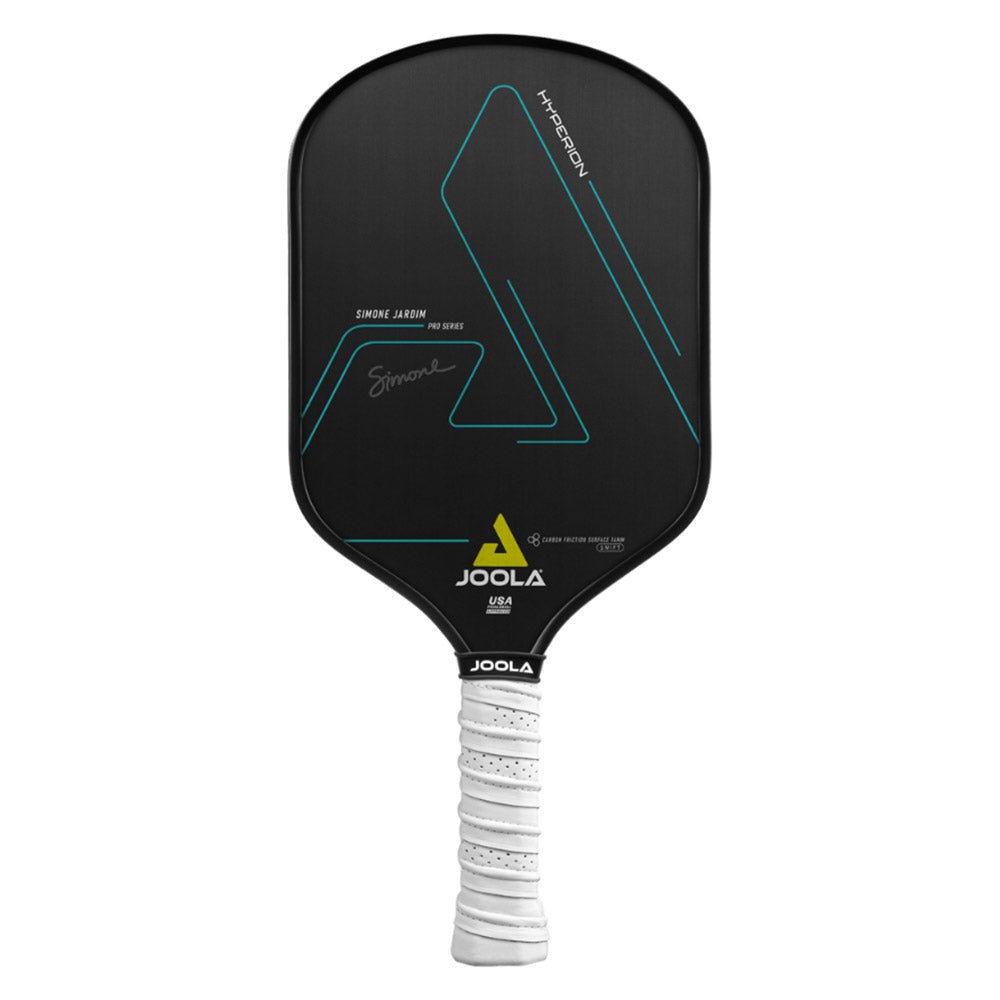
The quick elongated — JOOLA’s lighter Swift build at 7.7 ounces average, with a 4⅛-inch grip and a 5.5-inch handle.
JOOLA’s Hyperion line is its elongated flagship family, and the Swift version of the Simone Jardim signature model is the one built for hand speed: JOOLA publishes Swift as its lighter, faster-swinging construction, and the average weight lands at 7.7 ounces — the second-lightest published figure here, in an elongated 16.5 × 7.5-inch frame. The grip is 4.125 inches, joint-second-smallest in the guide, on a 5.5-inch handle — the combination a smaller-handed player with a two-handed backhand, or a taste for reach, is actually shopping for. The face is JOOLA’s Carbon Friction Surface over a 14 mm Reactive Honeycomb core, with a Hyperfoam Edge Wall that JOOLA says adds perimeter stability and enlarges the sweet spot, and a carbon-forged CX handle.
Context keeps this card honest: it is the crispest build here — the joint-thinnest core (14 mm) in the guide’s most head-forward shape — which makes it the pick for the player whose game is drives, counters and fast exchanges at the net, rather than the soft game the 16 mm cards serve. JOOLA publishes its own control/power/spin ratings for the model (93/94/95 in its system); they are the maker’s ratings and are reported as such. It is also a signature model — Simone Jardim’s name is on it — which explains its positioning at the performance end of JOOLA’s range. Distinct from the JOOLA Graf Pro V carded in our women’s guide: check “Hyperion CFS 14 Swift” on the listing. USAPA approved, per JOOLA.
What we like
- 7.7 oz average in an elongated frame — the fast-hands brief, published
- Small 4.125″ grip with a long 5.5″ handle — a rare combination
- Hyperfoam Edge Wall and CX-Forged handle, per JOOLA
- JOOLA’s Swift build is a distinct, published lighter construction
Worth knowing
- The 14 mm core is the joint-thinnest here — the crispest, least plush brief in the guide
- Elongated 7.5″ width gives less face than the widebodies
- JOOLA’s numeric ratings are the maker’s own system
As an Amazon Associate we earn from qualifying purchases.
Side-by-Side Comparison Table
| Model | Best For | Weight (as maker states it) | Core | Grip | Handle | Shape |
|---|---|---|---|---|---|---|
| ProKennex Ovation Flight | Lightest · smallest grip | 7.3–7.6 oz | Cloud Cell polymer | 4 in, tapered | 4⅞ in | Oval, 15.43 × 7.6 in |
| Selkirk SLK Evo Control Max | Best control | 7.6–8.1 oz | 16 mm Rev-Control | 4.25 in | 4.85 in (XL 5.75 in) | Max 16 × 7.85 in |
| Engage Pursuit MX 6.0 | Elongated · longest handle | LITE 7.5–7.9 oz · Std 8.0–8.4 oz | ⅝ in Control Pro ‘Black’ | 4⅜ in | 5¾ in | Elongated, 16.5 × 7.5 in |
| Gamma Legend NeuCore | Thick-core widebody | ~8.0 oz | ⅝ in NeuCore, larger cells | 4⅛ in | 4¾ in | Widebody, 15⅞ × 8 in |
| Paddletek Tempest Wave Pro v3 | Grip choice | 7.6–8.0 oz | 14.3 mm Tempest SRT | 4⅛ in or 4⅜ in | 5¼ in | 15⅞ × 8 in |
| Six Zero Quartz 15mm | Forgiving widebody | 7.9 oz average | 15 mm polypropylene | 4.25 in | 5 in | Widebody, 16 × 7.9 in |
| JOOLA Hyperion CFS 14 Swift | Fast hands | 7.7 oz average | 14 mm Reactive Honeycomb | 4.125 in | 5.5 in | Elongated, 16.5 × 7.5 in |
The grip column is this table’s reason to exist. Across seven paddles from seven makers, the published circumferences run from 4 inches to 4⅜ — and the two ends of that range are different paddles for different hands, not a rounding difference. The weight column reads honestly alongside it: the lightest card (Ovation Flight) is also the smallest-gripped and most compact; the longest-handled card (Pursuit MX) carries the joint-largest grip. Nobody publishes the whole wish list in one paddle — the table is how you decide which published facts matter most to your game.
Buying Guide: Matching Weight, Grip and Shape to Your Game
1. Weight: shop the band, not the headline
Makers publish ranges because paddles vary. If you want light, shop by the top of the band as well as the bottom: the Ovation Flight’s 7.3–7.6 oz cannot arrive heavy, while an 7.6–8.1 oz band (the Evo Control) can arrive at either character. Where a maker publishes labelled bands — Engage’s LITE and Standard — order the band by name. And where a maker publishes an average (Six Zero’s 7.9 oz, JOOLA’s 7.7 oz), understand it as the centre of a spread, with the stated tolerance where one is published. A reputable retailer will often weigh or select a paddle within the band if you ask — the published range is what makes that request reasonable.
2. Grip circumference: measure, then match the published number
Grip size is sizing — treat it like a shoe size. A common measuring method uses the distance from the tip of your ring finger to the middle crease of your palm; the result, in inches, is your starting circumference. Then shop this guide’s published column deliberately: 4 inches (Ovation Flight) at the small end, 4⅛ (Gamma, JOOLA, and Paddletek’s thin option), 4¼ (Selkirk, Six Zero), 4⅜ (Engage, and Paddletek’s standard option). Between sizes, the standard practice is to take the smaller published grip and build it up with an overgrip — an overgrip adds a small, even layer, while no wrap can make a too-large grip smaller. That is a sizing practice, stated as such.
3. Core thickness: the control-to-crispness dial
The makers’ own positioning is consistent across this guide: the thickest cores — 16 mm on the Selkirk, ⅝ inch on the Gamma and Engage — carry the control descriptions, and Gamma publishes its larger-cell NeuCore as its soft-feel brief. The 15 mm Quartz sits a step firmer; the 14–14.3 mm pair (JOOLA Swift, Tempest Wave Pro) are the crispest builds here. Choose by the game you play most: a dink-and-reset game lives at the kitchen line and belongs on the thick end; a driving, counter-punching game gets its feedback from the thinner end. Neither is a quality ranking — the cores are published at these thicknesses precisely because players differ.
4. Shape and handle: reach, face and the second hand
Widebodies (Gamma at 8 inches wide, Six Zero at 7.9, Paddletek at 8) publish the broadest faces — the margin end of the guide. Elongated shapes (Engage and JOOLA, both 16.5 long) publish reach, and their handles are the two longest here after the spec is read properly: 5¾ inches on the Engage, 5.5 on the JOOLA, with Selkirk’s XL at 5.75 as the third route to a long handle. If you play a two-handed backhand, handle length is your first filter — the 5¾-inch cards. If you play one-handed and live at the net, face width is yours. The Ovation Flight’s compact oval is the fourth answer: the least paddle, published for manoeuvrability, for the quickest hands.
5. Face material: carbon, fibreglass and what makers claim for each
Six of the seven faces here are carbon in some published form — raw (Six Zero), T700 CarbonFusion (Selkirk), ICED (Paddletek), friction graphite (Engage), Carbon Friction Surface (JOOLA), Diamond Frost carbon (ProKennex) — and one is textured fibreglass (Gamma). Makers publish carbon faces with their spin and feel descriptions and fibreglass with a softer, poppier one; those are the makers’ positionings, and the cards attribute them. The practical read: if you already know you like the direct response of carbon, six cards serve you; if you prefer the livelier fibreglass feel, the Legend is the deliberate exception — and its thick core keeps it in the control family regardless.
Frequently Asked Questions
What weight paddle should a senior player use?
Shop the published band this guide is built on: roughly 7.3 to 8.1 ounces covers every card here. The lightest published range is the ProKennex Ovation Flight at 7.3 to 7.6 ounces, followed by Engage’s LITE band at 7.5 to 7.9 ounces on the Pursuit MX 6.0 and JOOLA’s Hyperion CFS 14 Swift at a 7.7-ounce average. Because makers publish ranges, compare the full band rather than a single number — and where a LITE band exists, order it by name.
What grip size should I choose?
Match the published circumference to your hand, the way you would match a shoe size: a common method measures from the tip of your ring finger to the middle crease of your palm. The published options in this guide run from 4 inches on the ProKennex Ovation Flight, through 4⅛ inches on the Gamma Legend, the JOOLA Swift and Paddletek’s thin option, to 4¼ on the Selkirk and Six Zero, and 4⅜ on the Engage and Paddletek’s standard option. Between sizes, take the smaller grip and build it up with an overgrip — grips can be built up, not slimmed down.
Is a thicker core better for control?
That is how the makers publish them. The thickest cores in this guide — Selkirk’s 16 mm Rev-Control, Gamma’s ⅝-inch NeuCore and Engage’s ⅝-inch Control Pro ‘Black’ — all carry their makers’ control and soft-feel descriptions, and Gamma publishes its larger-cell core as 25% thicker than standard. The thinner cards — the 14 mm JOOLA Swift and 14.3 mm Paddletek Tempest Wave Pro — are published as the crisper, faster builds. It is a positioning dial, not a quality ranking: choose the end that matches your game.
Elongated or widebody: which shape suits senior players?
Both are published for this segment, for different games. Widebodies — the Gamma Legend and Paddletek Tempest Wave Pro at 8 inches wide, the Six Zero Quartz at 7.9 — offer the broadest faces and the most margin on off-centre contact. Elongated paddles — the Engage Pursuit MX 6.0 and JOOLA Hyperion CFS 14 Swift, both 16.5 inches long — offer reach and the longest handles, which also suits two-handed backhands. The Selkirk SLK Evo Control splits the difference with its standard Max shape and an elongated XL option in the same model.
What is the lightest pickleball paddle in this guide?
The ProKennex Ovation Flight, on its maker’s published figures: a weight range of 7.3 to 7.6 ounces — the lowest band here — with the smallest published grip, 4 inches tapered, in an oval 15.43 × 7.6-inch shape. The next lightest published figures are Engage’s LITE band (7.5 to 7.9 ounces) on the Pursuit MX 6.0 and the JOOLA Hyperion CFS 14 Swift’s 7.7-ounce average. ProKennex attaches broader claims to its Kinetic frame system in its own marketing; this guide reports the specifications only.
Can I change a paddle’s grip size after buying?
Upward, yes; downward, no. An overgrip adds a thin, even layer over the published circumference, and a replacement grip can add more — our guide to the best pickleball grips covers both. Nothing removes material from a handle that is too large, which is why this guide prints every maker’s published circumference on every card: choose the size at the listing. Paddletek’s Tempest Wave Pro v3 is the one card here with a factory choice — thin 4⅛-inch or standard 4⅜-inch grips on the same paddle.
What is the difference between this guide and the other paddle guides?
Each guide owns one decision. This page owns the senior lightweight and grip-size decision — published weights, core thicknesses and grip circumferences compared across seven current models. The beginners guide owns the first-paddle decision, the women’s guide owns its segment, and the legacy all-player guide owns the full field; none of their models is re-ranked here. For the game itself — getting started, rules and social play — read our pickleball for seniors guide, which this equipment page deliberately does not duplicate.
The Verdict
Buy the published numbers that match your hand and your game. The ProKennex Ovation Flight is the lightest paddle and the smallest grip in this guide — 7.3 to 7.6 ounces and 4 inches, as ProKennex publishes them. The Selkirk SLK Evo Control Max owns control, in two shapes. The Engage Pursuit MX 6.0 owns reach, with the longest handle here. The Gamma Legend NeuCore pairs the widest face with a small grip, the Paddletek Tempest Wave Pro v3 is the one you order to your hand, the Six Zero Quartz 15mm is the forgiving widebody all-rounder, and the JOOLA Hyperion CFS 14 Swift is the fast elongated option. Seven paddles, three honest decisions — weight, core and grip — every one printed as its maker states it.
Affiliate disclosure: AliShuttler is a participant in the Amazon Services LLC Associates Program. Links marked “Check Price on Amazon” are affiliate links — if you buy through them, we may earn a commission at no additional cost to you. Every specification in this guide is taken from the manufacturer’s own published listings, checked at build time in 2026; grip circumferences and handle lengths are reported as sizing information exactly as their makers publish them.