Your second padel shoe is a different decision from your first. The first shoe’s job was coverage — a proper padel outsole, a named cushioning system, enough published structure to learn lateral movement in. By now you know more: how many hours a week you actually play, whether your points are won at the net or from the back glass, how your first shoe’s tread wore, and where it felt slow, loose or finished before the match was. This guide compares seven step-up shoes on exactly what their makers publish — the outsole pattern as each maker states it, pivot features where a maker builds them in, the cushioning and stability systems by the names each maker gives them, the weight exactly as documented (or an honest “not published” where a maker states none), and the fit as each maker or its specialist retailers label it — and nothing else. No prices, no health claims, no invented numbers: just the spec sheets, read the way a player buying their second pair actually needs them.
⚡ TL;DR — The Short Answer
For the best all-round step-up, buy the ASICS Gel-Challenger 15 Padel — the shoe ASICS itself positions as its stability padel shoe, with WINGWALL sidewall support, a customisable DYNALACING system and rearfoot GEL cushioning. The NOX AT10 PRO is the stability-technology pick, stacking NOX’s AGG geometry, Lateral Support and AbraXone reinforcement over a herringbone-and-stud Optimal Grip sole. The Munich Padx is the rotation pick — a Grip Line double herringbone with pivot circles in the forefoot, co-developed with Franco Stupaczuk. The HEAD Revolt Pro 4.5 Clay is the durability pick, with a full herringbone outsole, a T-KORE 360° support package and a six-month outsole guarantee stated for the line. The ASICS Solution Swift FF 2 Padel is the speed pick — the lightest documented shoe here at 302 grams in a US 9, lab-measured on the padel version. The adidas Courtquick Padel is the agility pick, built around adidas’s Slingframe for rotational movement. And the Joma Ace Clay is the structured-support pick, with Joma’s STABILIS system and a carbon stabilizer plate under a phylon midsole.
Quick Picks — Best Padel Shoes for Intermediate Players at a Glance
ASICS’s own stability padel shoe — WINGWALL support, DYNALACING lockdown and GEL cushioning in one balanced spec.
AGG geometry, Lateral Support and AbraXone reinforcement over a herringbone-and-stud sole — NOX’s full tech stack.
A double herringbone with pivot circles built into the forefoot, in a snug fit co-developed with Franco Stupaczuk.
A full herringbone outsole with a T-KORE 360° support package and a six-month outsole guarantee on the line.
302 g in a US 9 as lab-measured on the padel version, with a two-piece Precision-Sole and SPEEDTRUSS support.
A lightweight textile upper on adidas’s Slingframe, built — per adidas — for rotational movements and quick transitions.
Joma’s STABILIS system and a carbon stabilizer plate under phylon, rated by Joma for training and competition.
In This Guide
The Intermediate Step-Up: What Your Second Padel Shoe Must Do Differently
The first-shoe decision is a coverage decision; the second-shoe decision is a specialisation decision, and it starts from evidence your first season has already given you. Your weekly hours have settled into a pattern — and hours are the multiplier on every other spec, because a shoe that plays three or four sessions a week wears its outsole, packs down its midsole and stresses its upper seams three or four times as fast as a once-a-week shoe. Your rally structure has changed too: points at intermediate level run longer, defence happens deeper and faster at the back glass, turns under the bandeja are a stock shot rather than an emergency, and volleys are hit on the move at the net instead of from a static stance. Every one of those changes loads the shoe differently from the way a beginner’s game loads it, and the step-up exists to answer the loads, not the label. The axes that matter are the ones this guide’s cards are built on: grip-versus-slide balance on sand-dressed turf, named stability structure that holds the foot through faster lateral stops, outsole material and toe-zone durability for a heavier weekly schedule, documented weight for the last game of a long evening, and a fit refined from “standard” to the last shape your feet actually need.
Notice what is not on that list: a bigger technology count for its own sake, and other players’ verdicts. At this level the honest way to choose is to read your own first shoe first. Where did the tread go smooth — forefoot, heel, or the pivot zone under the ball of the foot? That wear map tells you which outsole family to buy next. Did the upper stretch until your foot moved inside it on stops? That is a lockdown and lateral-support question, answered by the named structures on these cards — sidewalls, frames, lacing systems and plates. Did the shoe simply feel heavy by the third set? Then the weight column matters, read with its basis and its source, exactly as the cards print it. The step-up guide’s job is to put seven genuinely different published answers in front of you — a stability-led platform, a technology stack, a rotation build, a durability build, a speed build, an agility build and a plated support build — so the wear map of your first shoe can point at one of them.
One boundary before the picks. This page owns the second-shoe decision only. The full all-player field belongs to our pillar guide to the best padel shoes, where the flagship models from every major maker are compared; the first-shoe decision belongs to our guide to the best padel shoes for beginners; the women’s fit and size-range decision belongs to our guide to the best padel shoes for women; and the veteran comfort-and-support decision is covered in our guide to the best padel shoes for seniors. None of their models is re-carded here — every shoe below is a different model, chosen because its published specification answers the step-up axes above. If your footwork itself is the thing being rebuilt this season, our guide on how to play padel covers the movement patterns — the glass defence, the bandeja foot position, the net approach — that these outsoles and support structures are built to serve.
How to Read a Step-Up Spec Sheet: Outsole Families, Stability Vocabularies and Honest Weights
The outsole is still the first spec, but at this level you are choosing a family, not just a pattern. Three families appear in this guide. The full herringbone (clay) family — deep zig-zag grooves across the whole sole, as on the HEAD and Joma cards — channels loose sand out of the tread so the shoe grips and then releases into a controlled slide; it is the classic answer for sand-dressed courts and for players whose defence is built on sliding stops at the glass. The hybrid family — herringbone combined with small studs, as on the NOX card — adds bite through the sand layer for players who want the slide available but not automatic. And the rotation family — circular pivot features under the forefoot, as on the Munich card, and groove layouts cut to turn, as on the second ASICS card — is built around the pivot itself: intermediate padel turns under the ball constantly, and a smooth pivot zone is the makers’ mechanical answer, trading a little straight-line bite for a cleaner turn. None of the three is universally best; the buying guide below matches each to the player profile it serves.
Stability and cushioning are vocabularies, not scores — and at step-up level the vocabulary gets structural. Read what each name physically is. ASICS’s WINGWALL is a sidewall that wraps the midsole edge; HEAD’s T-KORE 360° is a package of a torsional shank, a heel stabiliser and lockdown straps; Joma’s STABILIS works with a carbon stabilizer plate in the midsole; adidas’s Slingframe is a frame construction adidas describes as supporting rotational movement; NOX’s AGG is not a foam at all but a geometry — a heel section built higher relative to the toe — while its Lateral Support is a widened sole contact shape. Cushioning names split the same way: ASICS’s GEL and FLYTEFOAM, adidas’s Cloudfoam Plus, Munich’s X-Lite expanded EVA and NOX’s pairing of popcorn EVA with injected phylon are materials or inserts, each printed on its card as its maker describes it. Compare structures, not slogans: a plate, a wall and a frame are three different mechanical answers to the same lateral load.
Weight is the last spec to interrogate, and this guide is the honest demonstration of why. Not one of the seven makers here publishes a weight for the model carded — so instead of inventing a column of numbers, the cards print the three documented figures that do exist, each with its source and basis attached: a specialist retailer’s figure of 14.1 ounces in a US 10.5 for the HEAD clay version, a review lab’s measurement of 302 grams in a US 9 for the ASICS speed shoe, and a padel retailer’s approximate 350 grams, with no size basis stated, for the ASICS stability shoe. The other four cards print “not published” in plain words. Read any weight you meet elsewhere the same way: whose figure is it, in what size, measured or estimated? A step-up buyer comparing like with like will get more truth out of those three questions than out of any number quoted without them.
The 7 Best Padel Shoes for Intermediate Players, Compared
Seven shoes, one shared brief — a padel outsole, named cushioning and stability systems, and durability and weight read honestly — organised by the step-up decision each one answers. Start with the card that matches the wear map of your first shoe.
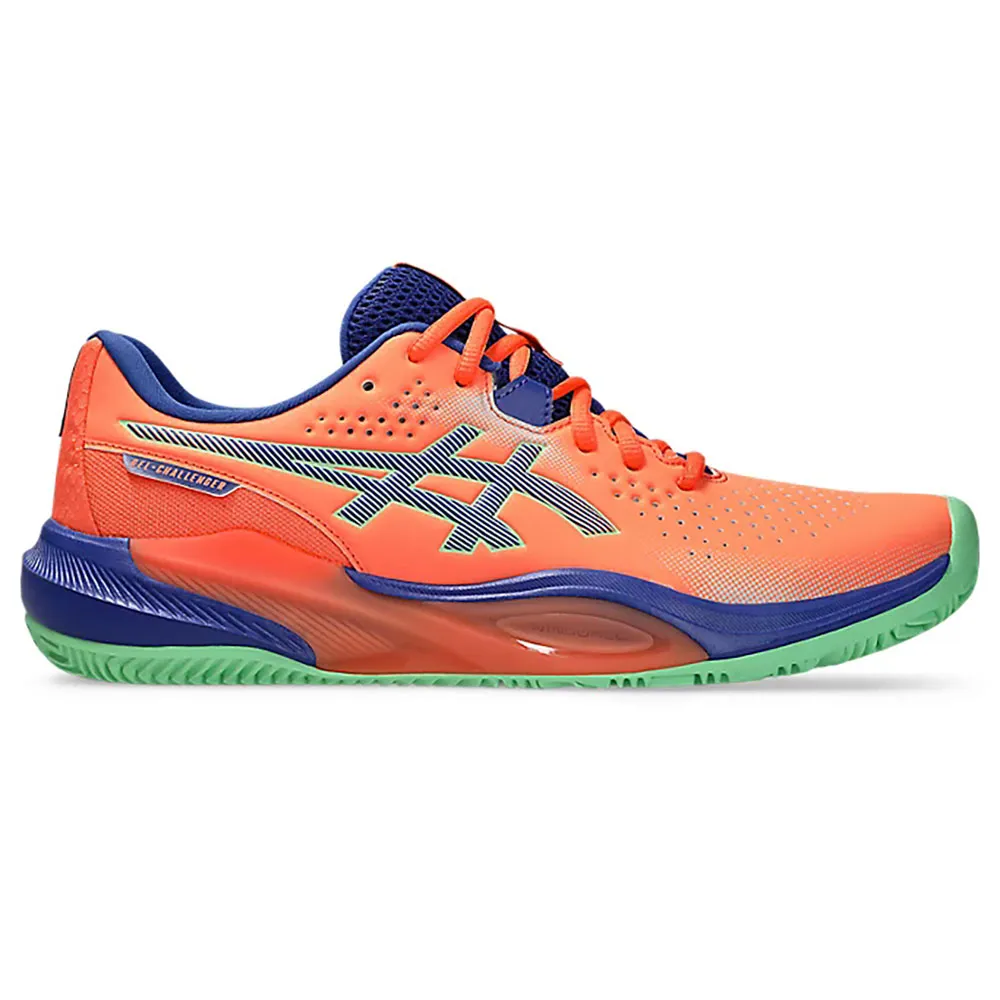
ASICS Gel-Challenger 15 Padel
The balanced step-up — ASICS positions this model as its stability padel shoe, and its published spec answers every step-up axis without specialising away the all-round game.
Start with the maker’s own positioning: ASICS describes the GEL-CHALLENGER 15 PADEL as a shoe that “provides advanced stability and support for confident side-to-side movement” — its dedicated stability entry in the padel range, and a full generation above the Challenger 14 Padel carded in our seniors guide. It earns the #1 card here because its published specification is the most complete all-round answer to the step-up brief: a stability system, a lockdown system, a named cushioning technology and a durability feature, all four stated by ASICS itself rather than inferred. If your first shoe’s lesson was simply “everything needs to be a level better,” this is the card that lesson points to.
The stability half of the spec is structural. WINGWALL technology extends the midsole’s sidewall so the platform wraps up around the foot — ASICS says it works with the full-length outsole to keep you steady during quick side-to-side movement, which is the exact load that faster intermediate rallies multiply. Lockdown is handled separately by the DYNALACING system, a customisable lacing arrangement ASICS describes as holding the foot securely and comfortably: stability from the platform, security from the laces, two different jobs done by two different parts. Cushioning is rearfoot GEL technology, the established ASICS system carried across its court range, and durability is addressed where an improving player’s shoe actually wears — PGUARD technology reinforces the inner forefoot, the zone dragged through low defensive reaches and lunges toward the glass. A padel-specialist retailer describes the outsole as a herringbone pattern built for clay and artificial-grass padel courts, placing it in the slide-friendly family. Two honest notes close the card: ASICS publishes no weight for this model, so the ≈350 g figure printed here is that retailer’s approximation with no size basis stated — treat it as a neighbourhood, not a measurement. And check the listing says Padel: ASICS sells same-named Challenger versions for other surfaces, and only this edition carries the padel-specific outsole.
What we like
- Positioned by ASICS itself as its stability padel shoe — the step-up brief, from the maker
- WINGWALL sidewall and DYNALACING split the stability and lockdown jobs properly
- PGUARD reinforcement targets the inner-forefoot wear zone directly
- Rearfoot GEL is an established ASICS system, not a new-line experiment
Worth knowing
- ASICS publishes no weight — the ≈350 g figure is a retailer’s, with no size basis stated
- Same-named versions exist for other surfaces — check “Padel” in the listing title
As an Amazon Associate we earn from qualifying purchases.
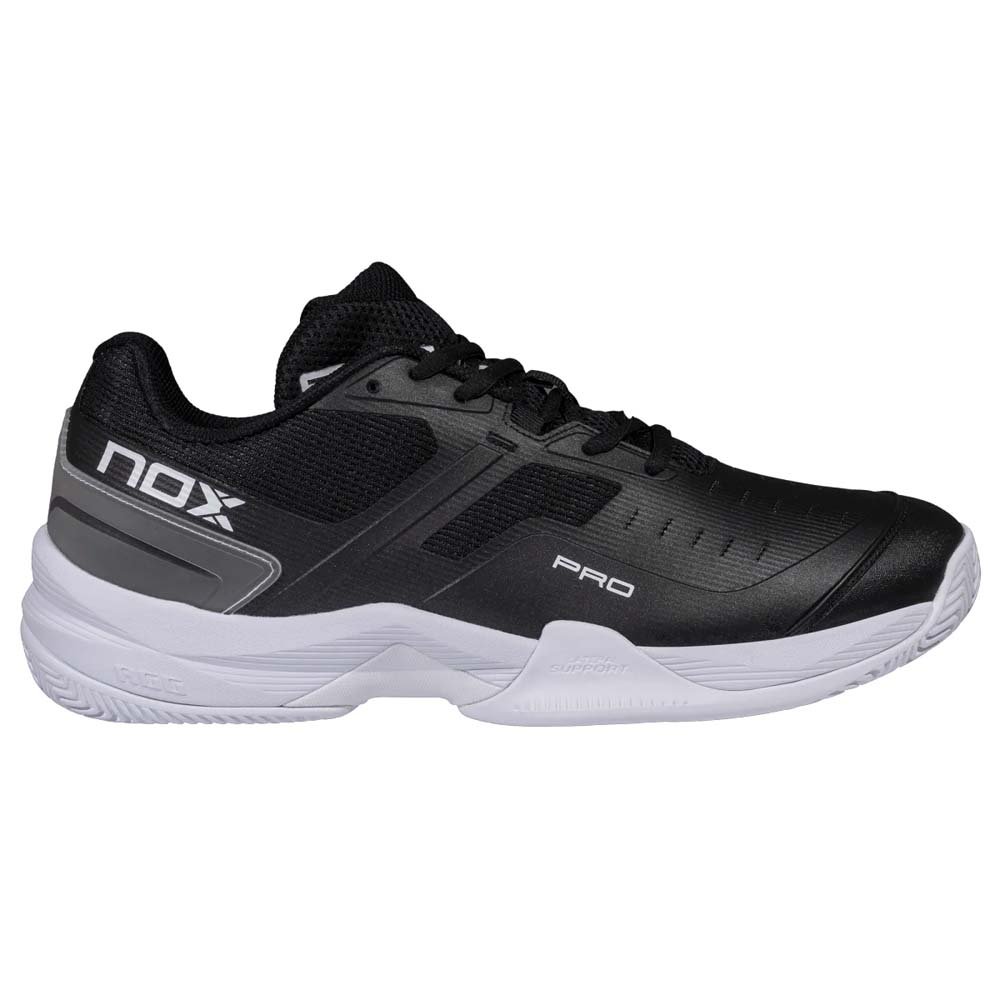
NOX AT10 PRO
The technology stack — NOX’s named systems layered in one shoe: geometry, sole shape, internal reinforcement and a hybrid grip sole, all published under NOX’s own names.
NOX is a padel-native maker, and the AT10 PRO is where its footwear technology set is stacked highest. Where the beginners guide carded NOX’s comfort-line Nerbo, this model layers the brand’s systems as an intermediate package — and the honest way to read it is system by system, as NOX itself publishes them, because each name describes a different physical feature rather than a grade of the same one. The foundation is AGG (Advanced Gravity Geometry): a sole geometry in which the heel section is built higher relative to the toe, the shape NOX’s padel footwear is designed around. Alongside it, Lateral Support widens the sole’s contact geometry on the lateral side — a broader base under exactly the edge a hard sideways stop loads. Neither is a foam or a promise; both are shapes, printed here as shapes.
The upper and sole complete the stack. AbraXone is NOX’s internal reinforcement structure inside the upper, working with a high-resistance rubber toe cap and an external heel reinforcement — the published answer for a player whose first shoe’s upper stretched or scuffed through at the toe. The midsole pairs popcorn-shaped EVA rubber with a low-density injected phylon layer, over an Ortholite insole, and the Optimal Grip outsole combines a herringbone pattern with small integrated studs — the hybrid family, herringbone channels for the slide with stud bite through the sand when you plant. One transparency note, in the spirit of this guide: NOX’s own marketing attaches stronger language to some of these systems than a spec sheet can support, and this card deliberately names the systems and describes their construction only. And NOX publishes no weight for the AT10 PRO in the listings checked, so none is printed — the card stands on the technology set, which is the reason to buy it.
What we like
- The fullest named technology set in the guide — geometry, sole shape and reinforcement in one shoe
- Hybrid herringbone-and-stud sole covers both slide and plant styles of defence
- AbraXone internal structure plus a rubber toe cap and external heel reinforcement
- Two-material midsole (popcorn EVA + injected phylon) with an Ortholite insole
Worth knowing
- NOX publishes no weight for this model — none is claimed here
- The most systems to understand before buying; read the card’s construction notes, not the slogans
As an Amazon Associate we earn from qualifying purchases.
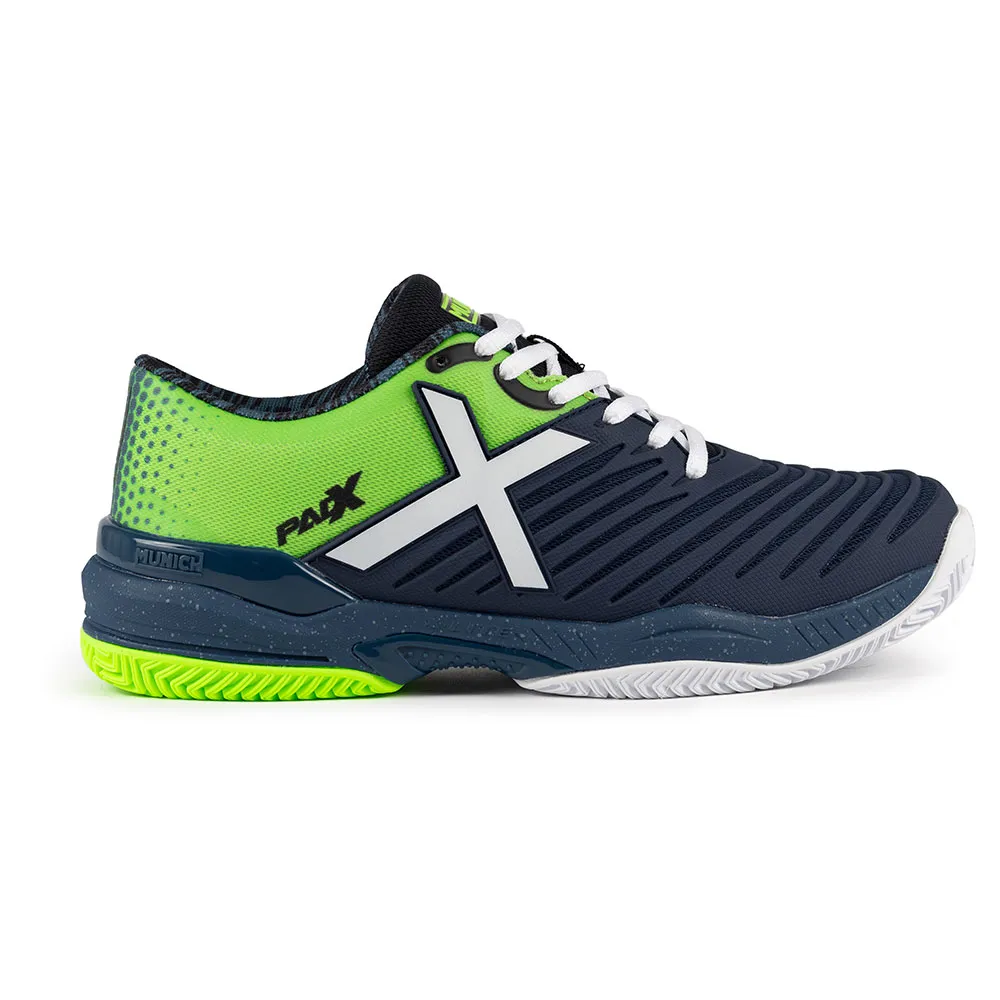
Munich Padx
The rotation build — a double herringbone sole with pivot circles engineered into the forefoot, in a snug fit co-developed with one of the game’s great net players.
Munich is a padel-specialist footwear maker — a Spanish brand whose court shoes are built for this sport rather than adapted to it — and the Padx is its precision model, positioned by its retailers for intermediate-to-advanced players and co-developed with Franco Stupaczuk, whose attacking, net-first game is the design brief written into the shoe. The headline feature answers the movement intermediate padel adds most: the turn. The Grip Line outsole runs a double herringbone pattern for traction in all directions on sand-dressed artificial grass, and set into the forefoot are pivot circles — smooth zones placed, per Munich’s retail breakdown, to allow fluid rotation in defensive situations at the glass and on the approach to the net. Where a full herringbone grips and releases, this sole grips, releases and turns: the pivot is a designed feature, not a worn-smooth accident.
The rest of the build supports that brief. The X-Lite midsole is an expanded EVA tuned — per the same breakdown — slightly firmer and more direct in the Padx than in Munich’s comfort-leaning Atomik, with an Anti-Shock heel insert for landings; a TPU reinforcement runs across the full lateral side and over the instep to hold the shoe’s structure under lateral load; and the KPU mesh upper keeps the build close and technical. Fit is the card’s honest caveat, and it decides who should buy: the Padx is a snug, close fit for players who want the foot held precisely, and Munich’s retailers state plainly that wide feet can find it too narrow — those players are directed by the same retailers to the wider-fitting Atomik in Munich’s own range. Munich publishes no weight for the Padx, so none is printed; the card stands on the pivot design and the fit, which are the reasons to choose it.
What we like
- Pivot circles built into the forefoot — the only card here with rotation as a designed outsole feature
- Double herringbone Grip Line sole keeps slide-and-plant grip around the pivot zones
- TPU reinforcement across the full lateral side, not just a toe cap
- Snug, precise fit brief, co-developed with Franco Stupaczuk per Munich’s retailers
Worth knowing
- Snug fit — wide feet are directed to Munich’s wider Atomik instead, per the brand’s retailers
- Munich publishes no weight for this model — none is claimed here
As an Amazon Associate we earn from qualifying purchases.
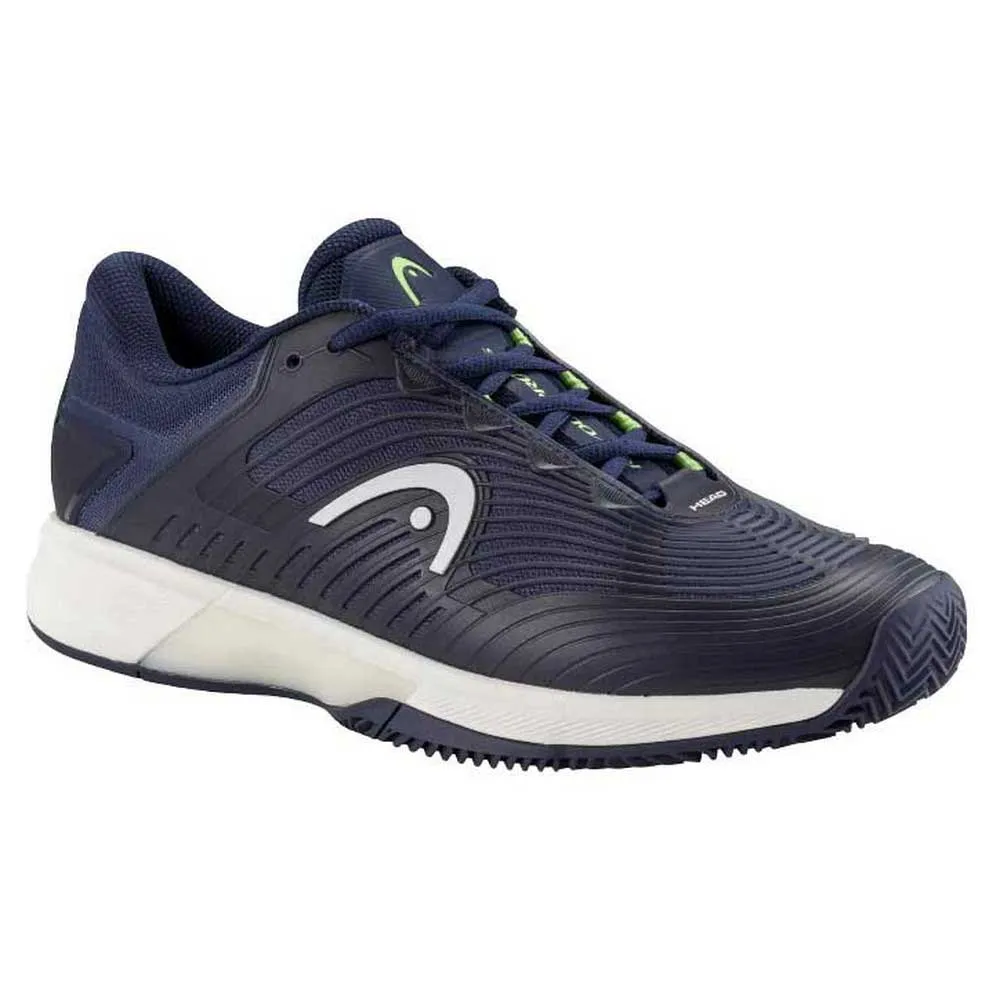
HEAD Revolt Pro 4.5 Clay
The heavy-hours build — a full herringbone outsole, HEAD’s complete 360° support package and an outsole guarantee, carded openly in its clay configuration.
This card needs its positioning stated first, the way this site’s guides always state it: the Revolt Pro 4.5 is HEAD’s flagship court-shoe platform, and the version carded here is its Clay configuration — the full herringbone outsole that belongs to the same pattern family as the padel-specific cards, and the version HEAD’s own retail copy describes as explicitly designed for padel players on clay and artificial-grass padel courts. That is the correct step-up logic for a player whose weekly hours have doubled: the durability question is answered by the platform’s top specification and by a six-month outsole durability guarantee stated for the 4.5 line — a maker’s commitment printed in the listing, not a reviewer estimate, and the only such guarantee in this guide.
The support package is the most completely enumerated in the guide. T-KORE 360° is HEAD’s name for the combination of a torsional shank, a heel stabiliser and integrated lockdown straps; a 3D anti-torsion shank sits in the midfoot; the TRI-NRG midsole uses three densities for the transition from landing to push-off; and HEAD’s copy adds a Lateral Control trigger and Drift Defense around the forefoot and toe for the drag zones. The outsole itself is a deep, full herringbone in Hybrasion+ rubber — maximum sand channelling and the slide-friendly family, in the line’s most abrasion-resistant compound. Weight is printed the honest way: 14.1 ounces in a US 10.5 is Tennis Warehouse’s figure for this clay version, and the same source’s fit notes describe a generous medium last — useful for players whose first shoe pinched. HEAD publishes no weight of its own, and no lighter claim is made: this is the card for hours and wear, and it is specced like it.
What we like
- Six-month outsole durability guarantee stated for the line — unique in this guide
- T-KORE 360° is a complete, enumerated support package: shank, stabiliser and straps
- Full herringbone in Hybrasion+ rubber — the deepest sand-channelling sole here
- Generous medium fit and a documented weight with its size basis printed
Worth knowing
- Carded in its Clay configuration — check the listing says “Clay,” not the all-court version
- The heaviest documented shoe here on its stated basis — durability is the trade it makes
As an Amazon Associate we earn from qualifying purchases.
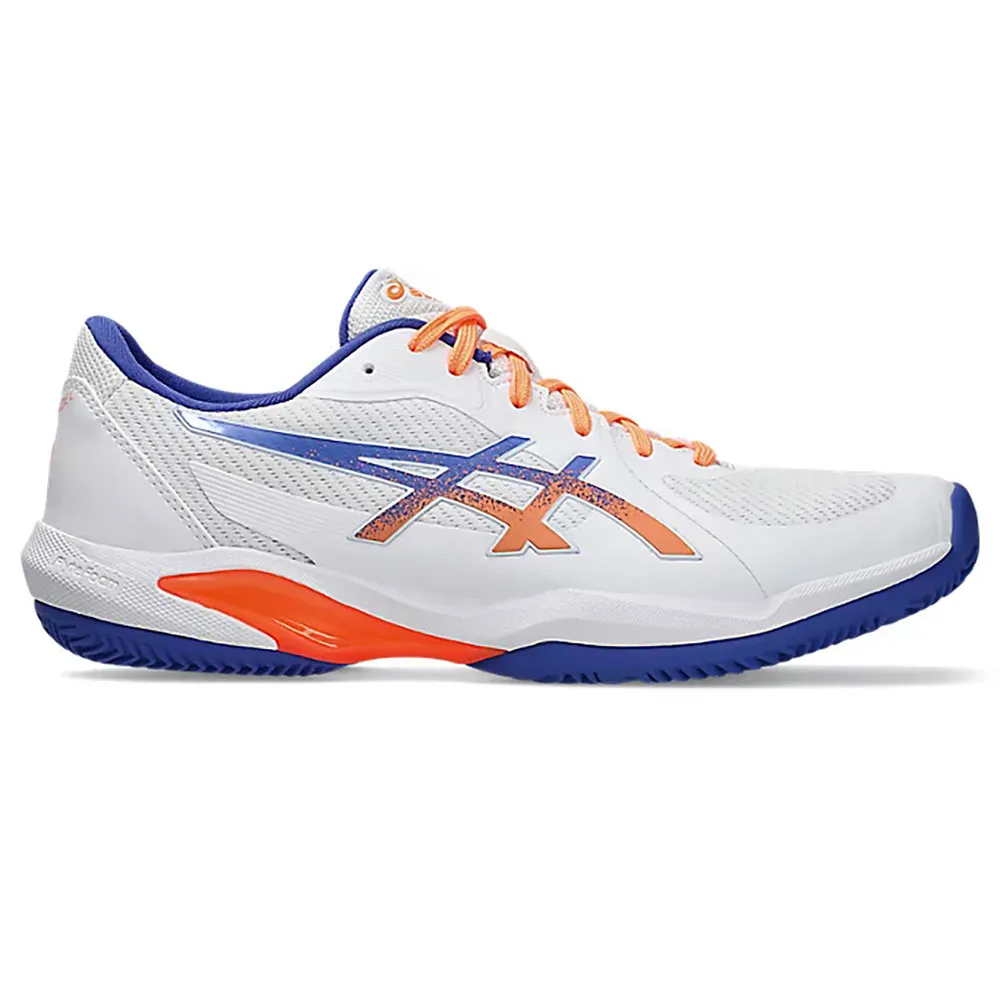
ASICS Solution Swift FF 2 Padel
The speed build — ASICS’s fast padel platform in its second generation, and the lightest documented shoe in this guide on a measured figure.
If the Challenger 15 is ASICS’s stability answer, the Solution Swift FF 2 Padel is its speed answer — a different platform, built around a lower, quicker brief, and carded here as a distinct model from the first-generation women’s Solution Swift FF in our women’s guide: this is the FF 2 generation, in the men’s line. Its outsole is the design statement. The Precision-Sole is a two-piece outsole whose flex grooves are cut in a criss-cross pattern — a layout ASICS describes as designed around how padel players move, bending with the forefoot’s multi-directional work instead of forcing one flex direction the way a running-derived sole does. It is the rotation family’s subtler entry: no pivot disc, but a groove map drawn for turning.
Support comes from the SPEEDTRUSS system — ASICS’s named stability unit for its speed line, a bridge structure under the midfoot — and cushioning from a FLYTEFOAM midsole, ASICS’s lightweight foam, rather than the GEL of the stability card. The weight is where this guide’s sourcing discipline shows most clearly: ASICS publishes no weight, so the figure printed is the 302 grams in a men’s US 9 measured in the RunRepeat review lab on the padel version — a real measurement of this shoe in this configuration, labelled as a lab figure rather than dressed up as a maker’s spec. On that documented basis it is the lightest shoe in the guide, and the card for the player whose first shoe’s lesson was simpler than stability or durability: by the third set, it felt slow. Fit notes from the same test coverage describe a medium width that runs true to size.
What we like
- Lightest documented shoe in the guide — 302 g in a US 9, measured on the padel version
- Precision-Sole flex grooves are cut in a criss-cross map for padel’s turning movements
- SPEEDTRUSS gives the speed platform a named stability structure, not just a light upper
- A genuinely different ASICS platform from the stability card — speed versus support, by design
Worth knowing
- The 302 g figure is a review lab’s measurement, not an ASICS-published spec — labelled as such
- The lightest build is not the durability card — heavy-hours players should read card #4 first
As an Amazon Associate we earn from qualifying purchases.
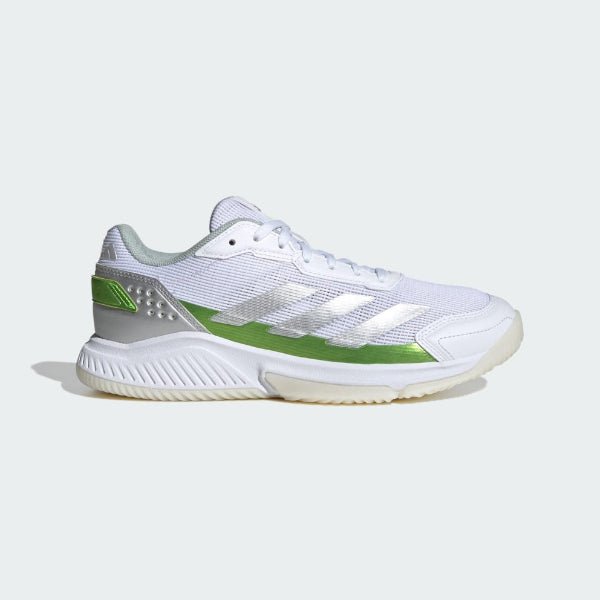
adidas Courtquick Padel
The agility build — a lightweight textile shoe on adidas’s Slingframe, the frame construction adidas describes as supporting rotational movement and quick transitions.
adidas’s dedicated padel range in our pillar guide is headed by the Boost-cushioned Crazyquick; the Courtquick Padel is the line’s agility entry, and its published brief is written in movement language: adidas says the shoe teams a lightweight textile upper with a stabilising Slingframe construction “to support rotational movements and quick transitions” — the two actions an intermediate player’s net game is built from. The Slingframe is the card’s structural story: a frame that wraps the midfoot so the shoe turns and recovers with the foot rather than lagging behind it, the rotational counterpart to the Munich card’s pivot circles and the ASICS speed card’s groove map. Three of this guide’s seven shoes are, in their makers’ own descriptions, rotation answers — this is the lightest-built of the three.
The supporting spec is adidas’s established court vocabulary. The Cloudfoam Plus midsole is the cushioning system — adidas describes it as flexible cushioning that keeps you on the front foot through rapid direction changes — and durability is handled by an Adituff toe, the abrasion-resistant toe treatment adidas fits across its court range, over an Adiwear outsole, its durability-compound rubber. The fit is adidas’s regular fit with a standard lace closure — the least exotic fit brief in the guide, which for many step-up buyers is precisely the point: no snug race last to gamble on, no generous last to size down through. The upper is textile and synthetic, and adidas states the shoe contains at least 20% recycled content. adidas publishes no weight for this model, so none is printed — the agility claim rests on the published construction, and the card is honest about standing on that alone.
What we like
- Slingframe is a named rotational-support construction, stated by adidas in movement terms
- Regular fit is the lowest-risk fit brief in the guide for a step-up purchase
- Adituff toe and Adiwear outsole bring adidas’s durability vocabulary to the agility tier
- At least 20% recycled content, as adidas states
Worth knowing
- adidas publishes no weight — the lightweight brief rests on the published construction
- Cloudfoam Plus is a comfort-tuned foam — players wanting a plated or walled platform should read cards #1 and #7
As an Amazon Associate we earn from qualifying purchases.
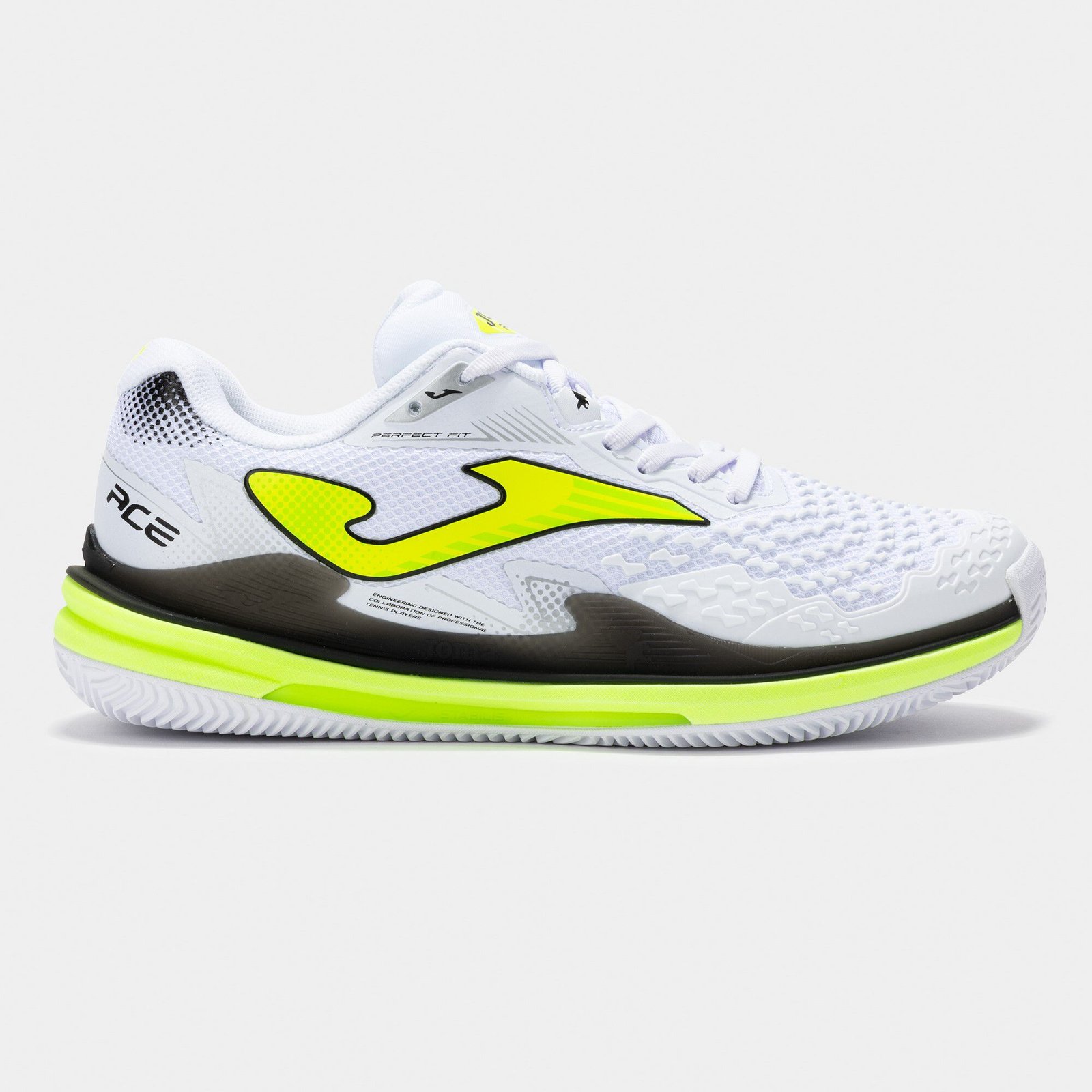
Joma Ace Clay
The plated build — Joma’s STABILIS system working with a carbon stabilizer plate, in the model Joma itself rates for training and competition.
Joma appears in three of our earlier padel shoe guides with three different models — the Slam in the pillar, the Slam Lady in the women’s guide, the Master 1000 in the beginners guide — and the Ace is the Spanish maker’s structured entry for the step-up decision, carded here in its current clay generation. Its maker’s rating frames the card before any technology does: Joma lists the Ace for training and competition at its high premium performance level — the positioning language of a second shoe, stated by the maker itself. The headline structure is the pairing underneath: a phylon midsole carrying Joma’s STABILIS stability system and a CARBON STABILIZER plate — a rigid plate in the midsole is the firmest mechanical answer to midfoot twist in this guide, the plated counterpart to ASICS’s sidewall and HEAD’s shank package.
The rest of the spec is Joma’s established systems, each named on its own product page. The outsole is DURABILITY rubber in the clay pattern — the herringbone configuration Joma’s catalogue describes as expelling sand and allowing smooth slides, placing this shoe in the slide-friendly family with the deepest-structure midsole in the guide. The upper is a VTS breathable mesh with the SPORTECH heat-sealed adjustment system shaping the fit without stitched seams, and a PROTECTION injected reinforcement guards the toe — Joma’s published answer for the drag wear an improving player’s shoe accumulates. Joma publishes no weight for the Ace, so none is printed; and as with the HEAD card, check the listing configuration: the clay version is the padel-court configuration of the model, and it is the one this card describes.
What we like
- A carbon stabilizer plate is the firmest midfoot structure published in this guide
- Joma itself rates the model for training and competition — maker-stated step-up positioning
- DURABILITY rubber in the sand-expelling clay pattern Joma describes
- SPORTECH heat-sealed adjustment and PROTECTION toe complete a fully named spec
Worth knowing
- Joma publishes no weight for this model — none is claimed here
- Carded in its Clay configuration — check the listing before ordering
As an Amazon Associate we earn from qualifying purchases.
Side-by-Side Comparison Table
| Shoe | Weight, As Documented | Outsole, As Maker States | Stability Tech | Cushioning | Fit |
|---|---|---|---|---|---|
| ASICS Gel-Challenger 15 Padel Best Overall Step-Up | Not published — ≈350 g per retailer (basis not stated) | Padel-specific · Herringbone (retailer spec) | WINGWALL · DYNALACING | Rearfoot GEL | Supportive (maker description) |
| NOX AT10 PRO Best Stability Technology | Not published | Optimal Grip — herringbone + small studs | AGG geometry · Lateral Support · AbraXone | Popcorn EVA + injected phylon · Ortholite insole | Structured (per NOX copy) |
| Munich Padx Best for Rotation & Net Play | Not published | Grip Line double herringbone · Pivot circles | TPU lateral + instep reinforcement | X-Lite EVA · Anti-Shock heel | Snug (retailer notes) |
| HEAD Revolt Pro 4.5 Clay Best Durability | 14.1 oz (US 10.5) — retailer figure | Full herringbone · Hybrasion+ | T-KORE 360° · Anti-torsion shank | TRI-NRG triple-density | Generous medium (retailer notes) |
| ASICS Solution Swift FF 2 Padel Best Lightweight Speed | ≈302 g (US 9) — lab-measured | Precision-Sole two-piece · Criss-cross grooves | SPEEDTRUSS | FLYTEFOAM | Medium, true to size (tester notes) |
| adidas Courtquick Padel Best Agility Step-Up | Not published | Adiwear outsole | Slingframe | Cloudfoam Plus | Regular fit (per adidas) |
| Joma Ace Clay Best Structured Support | Not published | DURABILITY rubber · Clay herringbone | STABILIS · Carbon stabilizer plate | Phylon | SPORTECH heat-sealed fit (per Joma) |
Read honestly, the table teaches the step-up market’s real shape. The weight column is the lesson: not one of the seven makers publishes a weight for its model, so the column holds exactly three documented figures — a retailer’s 14.1 ounces with its US 10.5 basis printed, a lab’s 302-gram measurement with its US 9 basis printed, and a retailer’s approximate 350 grams with no basis at all — plus four plain “not published” entries. Any comparison elsewhere that shows a precise weight for every row of this market is filling gaps this guide refuses to fill; ask of every figure whose it is and in what size it was taken. The outsole column is where the playing choice lives: full herringbone on the HEAD and Joma, herringbone-plus-studs on the NOX, a pivot-circle design on the Munich, a criss-cross groove map on the ASICS speed shoe, and ASICS’s padel-specific sole on the stability shoe. And the stability column shows three different mechanical philosophies — walls and plates that stiffen the platform (WINGWALL, the carbon plate, T-KORE 360°), geometries that widen or reshape it (AGG, Lateral Support), and frames that wrap it (Slingframe, SPEEDTRUSS) — which is why the buying guide below matches the structure to the way your first shoe actually failed you.
Buying Guide: Matching the Step-Up to Your Game
You play three or more sessions a week. Hours are your multiplier, so durability leads: the HEAD Revolt Pro 4.5 Clay, with the only outsole guarantee stated in this guide and HEAD’s most complete support package, or the ASICS Gel-Challenger 15 Padel, whose PGUARD reinforcement targets the inner-forefoot wear zone. Whichever you choose, rotate nothing and expect the outsole — not the calendar — to tell you when the next pair is due.
Your points are won at the net. Your shoe’s job is the turn and the first step forward: the Munich Padx, whose pivot circles are a designed forefoot feature, or the adidas Courtquick Padel, whose Slingframe adidas describes in rotational terms. If your feet run narrow and you like a held, precise fit, the Padx’s snug last is the brief written for you; if they do not, read the next paragraph before ordering it.
You defend deep, at the glass, and you slide. Your outsole family is full herringbone: the HEAD for maximum sand channelling with a support package behind it, or the Joma Ace Clay, whose clay pattern Joma’s catalogue describes as expelling sand and allowing smooth slides — with the firmest midfoot structure in the guide under it. The NOX AT10 PRO is your hybrid alternative if you want the slide available but studded bite when you plant instead.
Your first shoe felt slow by the third set. The documented answer is the ASICS Solution Swift FF 2 Padel — 302 grams in a US 9 as measured on the padel version, with a SPEEDTRUSS structure so the light build is not an unstructured one. The adidas Courtquick is the alternative if ASICS’s fit has never suited you: a lightweight textile construction on a regular last.
Fit was your first shoe’s real problem. Read the fit column before the technology columns. Snug and precise: the Munich Padx — with its retailers’ wide-foot caveat noted, and Munich’s wider Atomik named as the in-range alternative. Generous medium: the HEAD Revolt Pro 4.5 Clay. Regular and unexotic: the adidas Courtquick Padel. Structured and held by a lacing system you can re-tension zone by zone: the Challenger 15 Padel’s DYNALACING. Try step-up shoes with your match socks, late in the day, and use the maker’s size chart for the version you are buying.
You are not sure which weakness to fix first. Buy the balanced card: the ASICS Gel-Challenger 15 Padel publishes a named answer in every column — outsole, stability, lockdown, cushioning, durability — and a balanced second shoe teaches you, over its life, which column your third shoe should specialise in. That is how a shoe wardrobe gets built at this level: one honest specialisation at a time, each chosen from the wear map of the last.
Frequently Asked Questions
What makes a padel shoe an intermediate shoe rather than a beginner shoe?
Not a label — a specification. Beginner guides, including ours, prioritise coverage: a proper padel outsole, a named cushioning system and enough published structure to learn lateral movement in. The step-up shoes in this guide add what a heavier schedule and a faster game demand: enumerated stability packages (a sidewall and lacing system, a 360° shank-and-strap set, a carbon plate), durability features aimed at specific wear zones, rotation-specific outsole design such as pivot circles and criss-cross groove maps, and documented weights read with their basis and source. Each card prints its maker’s own positioning where the maker states one.
Herringbone, hybrid or pivot-circle outsole — which suits an improving player?
Match the family to your game and your courts. Full herringbone soles, like the HEAD Revolt Pro 4.5 Clay and the Joma Ace Clay, channel loose sand out of the tread and release into a controlled slide — the choice for sand-heavy courts and glass defence. Hybrid soles, like the NOX AT10 PRO’s herringbone with small studs, add bite through the sand for players who plant more than they slide. Rotation designs — the Munich Padx’s forefoot pivot circles and the ASICS Solution Swift FF 2 Padel’s criss-cross groove map — are built around the turn itself, suiting net-first players who pivot under the ball constantly.
How much do intermediate padel shoes weigh?
Honestly: the makers in this guide do not publish weights for these models, and this guide prints none on their behalf. Three documented figures exist, each printed with its source and basis: the HEAD Revolt Pro 4.5 Clay at 14.1 ounces in a US 10.5 (Tennis Warehouse’s figure for the clay version), the ASICS Solution Swift FF 2 Padel at about 302 grams in a US 9 (lab-measured by RunRepeat on the padel version), and the ASICS Gel-Challenger 15 Padel at approximately 350 grams (a padel retailer’s figure, with no size basis stated). ASICS, NOX, Munich, adidas and Joma publish no weight for the Challenger, AT10 PRO, Padx, Courtquick or Ace in the listings checked.
Can I keep playing in my beginner padel shoes?
Yes — while they remain the shoe their spec sheet describes. The step-up moment is written on the shoe itself: herringbone or stud tread worn smooth in the forefoot can no longer channel or bite through sand; an upper that has stretched until the foot moves inside it on stops no longer delivers the support structure it was bought for; a midsole that has packed down no longer feels like its named system. When one of those is true, your second shoe should be chosen against the wear map of the first — which is exactly how this guide’s seven cards are organised.
Are clay-court shoes a good step-up for padel?
Some are retailed for padel in their clay configuration, and two cards in this guide are presented exactly that way, openly: the HEAD Revolt Pro 4.5 Clay, whose clay version HEAD’s retail copy describes as designed for padel players on clay and artificial-grass padel courts, and the Joma Ace Clay, in the clay pattern Joma describes as expelling sand and allowing slides. The test is the maker’s own published data — a full herringbone or clay-pattern outsole, a named stability structure, a stated fit — not the retailer’s shelf label. A hard-court outsole is a different pattern family from anything carded here, and a same-named shoe in the wrong version is the most common step-up buying mistake.
How does this guide relate to your other padel shoe guides?
This page owns the second-shoe decision only: step-up models read on maker-published outsoles, stability systems, cushioning names, documented weights and fits. The all-player field is covered in our best padel shoes pillar guide, the first-shoe decision in our best padel shoes for beginners guide, the women’s fit decision in our best padel shoes for women guide, and the senior decision in our best padel shoes for seniors guide. None of their models is re-carded here — all seven shoes in this guide are different models.
When is it time to step up from a beginner padel shoe?
When your schedule or your shoe tells you. The schedule signal: your weekly hours have settled at two, three or more sessions, so wear accumulates faster than a first shoe’s build brief assumes. The shoe signals: tread worn smooth where your game loads it, an upper that no longer holds the foot centred, or a shoe that feels slow across a full evening’s play. Any one of them means the next purchase should be a specialisation — stability, durability, rotation or speed — chosen from the cards above, rather than a like-for-like replacement of the first shoe.
The Verdict
Buy the ASICS Gel-Challenger 15 Padel if you want the balanced step-up: ASICS’s own stability padel shoe, with a WINGWALL sidewall, DYNALACING lockdown, rearfoot GEL and a PGUARD-reinforced forefoot covering every step-up axis in one card. Buy the NOX AT10 PRO if you want the fullest technology stack — AGG geometry, Lateral Support and AbraXone reinforcement over a herringbone-and-stud sole. Buy the Munich Padx if your game turns at the net: pivot circles in the forefoot and a snug, precise fit, with the wide-foot caveat read before you order. Buy the HEAD Revolt Pro 4.5 Clay if your hours have doubled: the deepest herringbone here, a T-KORE 360° support package and the line’s six-month outsole guarantee. Buy the ASICS Solution Swift FF 2 Padel if your first shoe felt slow: the lightest documented build in the guide, measured at 302 grams in a US 9 on the padel version. Buy the adidas Courtquick Padel if you want adidas’s rotational Slingframe brief on an unexotic regular fit. Buy the Joma Ace Clay if you want the firmest structure: STABILIS with a carbon stabilizer plate, in the model Joma rates for training and competition. Seven step-ups, seven different second-shoe filters: read the wear map of your first pair, match it to a card, check the version before you order — and your second shoe will be a specialisation, not a repeat.
Affiliate disclosure: Ali Shuttler is a participant in the Amazon Associates Program. Product links on this page are affiliate links — if you buy through them we may earn a commission, at no additional cost to you. Rankings are editorial: they follow the manufacturers’ published specifications checked at build time, not commission rates. Specifications, weights and fit options can change between model years; always confirm the current listing’s spec sheet before buying. This guide reports construction and specification facts only and makes no health claims of any kind.
Similar Posts
Best Padel Rackets for Intermediate Players 2026
Step-Up Guide Best Padel Rackets for Intermediate Players 2026 Your beginner racket taught you the…
Best Padel Shoes for Kids: Junior Court Picks
Padel Gear · Junior Shoes · 2026 Best Padel Shoes for Kids: Junior Court Picks…
Padel for Beginners: First Game Tips That Actually Work
First Games Playbook Padel for Beginners: First Game Tips That Actually Work You already know…
Best Padel Shoes for Seniors: Stable Lightweight Picks
Padel Gear · Shoes · 2026 Best Padel Shoes for Seniors: Stable Lightweight Picks The…
Best Padel Rackets for Kids: Junior Picks by Age
Padel Gear · Junior Rackets · 2026 Best Padel Rackets for Kids: Junior Picks by…
Best Padel Balls 2026: Pressurised vs Pressureless
Balls Guide Best Padel Balls 2026: Pressurised vs Pressureless Same racket, same court, same four…