Quick Picks — Best Badminton Rackets for Advanced Players at a Glance
In This Guide
The Advanced Decision: Power, All-Court or Speed
An advanced racket does not make power for you — it assumes you already have it. That single assumption reorganises the whole market. Below this level, makers soften shafts and add flex so the racket contributes energy a developing swing cannot yet produce. At this level the shafts go stiff and extra stiff, the tension ceilings climb towards and past 30 lbs, and the design question becomes directional instead of developmental: given a complete technique, where should a frame spend its mass? Every flagship in this guide is one maker’s answer to that question, and the answers sort into three families that the makers themselves name and describe.
Head-heavy power builds put the mass towards the head so a full overhead swing carries momentum into clears and smashes. Three cards live here: the Astrox 99 Pro, Yonex’s flagship singles-attacking frame; the Astrox 88D Pro, its doubles-specific sibling, built for the back-court partner; and Victor’s Thruster Ryuga II, from the Thruster series Victor positions for attack. Even-balance all-court builds refuse to favour either end of the court: the Arcsaber 11 Pro, designed around shuttle hold and placement, and Li-Ning’s Halbertec 9000, which Li-Ning’s own store format lists under the player type Balanced. Head-light speed builds keep mass away from the head for defence, drives and rapid exchanges: the Nanoflare 1000 Z is the purest expression here, and Victor’s Auraspeed 100X — a speed-series frame whose balance sits at the centre of Victor’s scale, slightly towards head-heavy in its retailers’ description — is the moderated version of the same idea.
The boundaries of this page matter as much as its picks, because this site keeps its decisions separated. If you are still building the technique these frames assume, start lower: our guide to the best badminton rackets for beginners owns the first-racket decision, our guide to the best badminton rackets for intermediate players owns the step-up from flexible and medium shafts, and our guide to the best badminton rackets for women owns the lighter-frame and smaller-grip decision. None of their models is re-carded here — the Arcsaber 11 Pro in this guide, for example, is a different racket from the Arcsaber 11 Play in the beginners guide, just as the Astrox 99 Pro and 88D Pro are different rackets from the Astrox Smash and Astrox Nextage. This page assumes a grooved, full-speed swing and answers only which flagship family it should be spent on.
Stiffness, Balance, Weight Class and Tension — As Makers State Them
Shaft stiffness is the advanced gatekeeper. Five of the seven cards below are graded stiff by their makers and one — the Nanoflare 1000 Z — is graded extra stiff; only the Halbertec 9000 sits lower, at the medium grade in Li-Ning’s spec format. Those labels are each brand’s internal scale and cannot be converted honestly between brands, so every card quotes its maker’s own wording, including Victor’s scale positions. What travels across brands is the meaning: a stiff shaft bends less and returns faster, and it rewards a player who can load it with a fast, complete swing — and gives very little to a player who cannot. That is the honest dividing line between this guide and the intermediate one below it, where medium is the centre of gravity.
Balance is stated two ways, and both appear below. Makers describe balance as a character — head-heavy, even balance, head-light — and Victor additionally publishes a five-point scale position for its frames, which the Victor cards quote as published. A balance point in millimetres is carded only where a verified spec table states one: 300 mm ±3 on the Astrox 88D Pro. Where tables disagree on a figure — as they do on the Halbertec 9000, where 295 mm and 302 mm both appear — no figure is carded at all, and the disagreement is recorded in this file’s build notes rather than resolved by preference. Weight is graded in U classes — 3U is roughly 85–89 grams, 4U roughly 80–84 grams — and unusually for a buying guide, every flagship here is published in both classes, so the 3U-versus-4U choice is a real decision on every card: 3U for the heavier, more stable swing, 4U for handling speed. Several cards are also listed in more than one grip grade; the tables print the grades as published.
Maximum tension is the quiet readiness test. The ceilings in this guide run from 27 lbs on the 4U Arcsaber 11 Pro to 32 lbs on the 3U Thruster Ryuga II, stated as stringing advice on the Yonex cards and as maximum tension on the Victor and Li-Ning cards — each card uses its maker’s own term. A high ceiling is not an instruction to string there; it is the maker’s published statement of what the frame is built to hold, and it only becomes usable when contact is consistently central enough to keep a tight bed under control. The buying guide below returns to that point, because at this level the string bed is half the instrument.
The 7 Best Badminton Rackets for Advanced Players, Compared
Seven flagships, three frame families, three makers. Read the card from your family first — then check its neighbour, because at this level the second-best fit is usually one family over, not one rank down.
Yonex Astrox 99 Pro
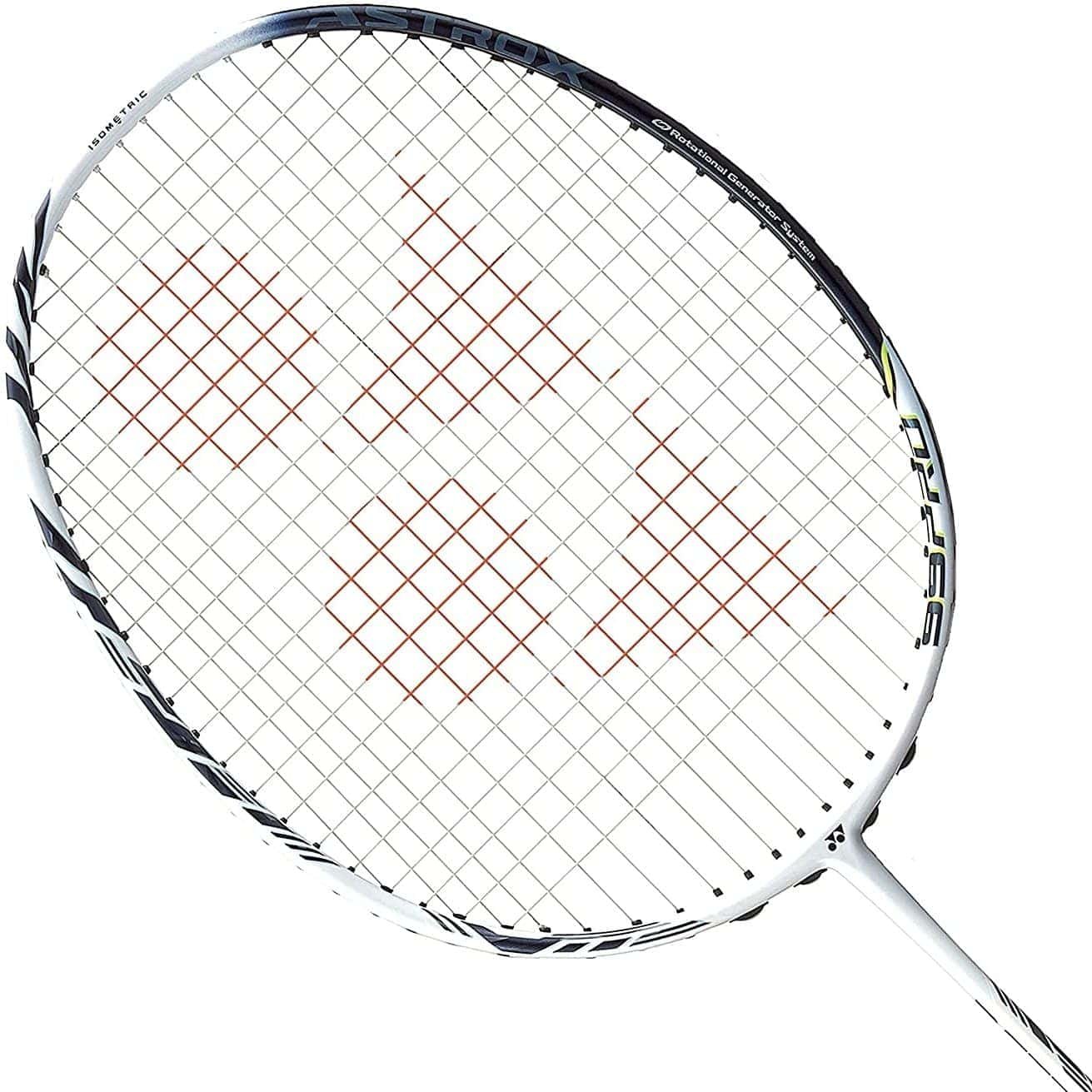
If one racket defines the advanced power decision, it is this one. The Astrox 99 Pro is the head of Yonex’s Astrox attacking line, and the third-generation specification carded here is the family’s brief in full: a head-heavy balance, a stiff shaft, a length 10 mm longer than standard, and a genuine weight choice — 4U at an average 83 grams for handling speed, or 3U at an average 88 grams for the heavier swing. Yonex publishes the model for advanced and professional players, and the frame is built for the rear court: this is the racket for the singles player, or the doubles back-court partner, whose points are constructed to end with an overhead shot hit at full stretch and full speed.
The technology list is Yonex’s current Astrox stack, described as Yonex describes it. 2G-Namd Flex Force, a graphite Yonex characterises by quick flex and snapback, runs through frame and shaft; the Rotational Generator System distributes counterweight through the grip end, frame top and joint, which Yonex says enables smooth transitions between successive attacking shots; and a tungsten-infused Power Assist Bumper adds weight at the frame top. Yonex also describes a concentrated sweet spot in this generation’s frame shape, aimed at focusing power on central contact. None of that is a test result — it is the maker’s published account of its own flagship, and the specification underneath it (stiff, head-heavy, two weight classes, stringing advice to 28 and 29 lbs) is what the ranking stands on. Choose the 3U if your swing is strong enough to keep it moving all match; choose the 4U if your game mixes attack with faster mid-court work.
Check Price on Amazon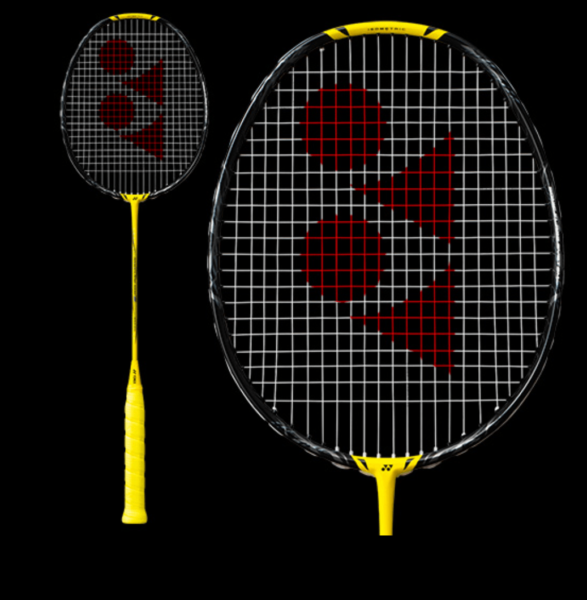
Yonex Nanoflare 1000 Z
Every other card in this guide spends mass somewhere. The Nanoflare 1000 Z is defined by where it refuses to spend it. The balance is head-light, the shaft is extra stiff — the only extra-stiff grade in this guide — and the frame pairs a wide aero profile with a compact head shape, which Yonex describes as its AERO COMPACT design for the Nanoflare 1000 series: a smaller frame area, intended to cut air resistance while concentrating the hitting zone. This is the racket for the advanced player whose game is won in the first three shots and the flat exchanges between them — drives, interceptions, defensive blocks turned into counter-attacks — and who generates racket-head speed quickly enough that an extra-stiff shaft is a tool rather than a tax.
The materials are the flagship end of the Nanoflare recipe: the frame combines HM Graphite with NANOMETRIC DR, M40X — a strong, elastic carbon fibre developed by Toray — and EX-HYPER MG, while the Sonic Flare System places high-modulus graphite at the frame’s top and bottom, which Yonex says is designed for shuttle acceleration and stability at contact. The published specification matches the brief: 4U and 3U versions, stringing advice of 20–28 lbs in 4U and 21–29 lbs in 3U, made in Japan. One carding note, stated plainly: a specialist retailer lists a measured balance point of 295 mm ±2 for the 4U, but that is a retailer’s measurement rather than a Yonex-published figure, so this card leads with the maker’s head-light character. Speed this specialised lives or dies on the string bed, too — our guide to the best badminton strings covers the gauges and tensions that suit a stiff, head-light frame.
Check Price on Amazon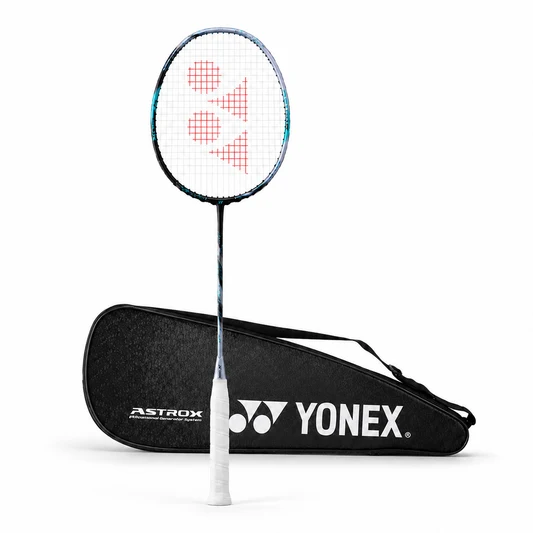
Yonex Astrox 88D Pro
Yonex built the Astrox 88 pair as a doubles system rather than two separate rackets: the 88S is the front-court concept, and the 88D — the D is Yonex’s back-court, dominating concept — is the partner who finishes rallies from behind. The third-generation Pro specification is that role written in numbers. The balance is head-heavy with a balance point stated at 300 mm ±3 in the verified spec table — the only published balance-point figure among the Yonex cards here — the shaft is stiff, the length is 10 mm longer, and the weight choice runs 4U to 3U with stringing advice of 20–28 and 21–29 lbs. Against the Astrox 99 Pro at #1, the difference is assignment: the 99 is the singles attacker’s flagship, the 88D is tuned for repeated back-court attack inside the faster rhythm of doubles, where the next shot arrives sooner.
The construction follows the assignment. 2G-Namd Flex Force in the shaft is the same quick-flex graphite as the 99 Pro’s, and the enhanced Rotational Generator System — with the Power Assist Bumper at the frame top — is described by Yonex as supporting continuous, successive attacks, which is precisely the back-court doubles workload: smash, recover, drive, smash again. Yonex also describes added weight distribution on the sides of the frame in this model, intended to hold the face stable through the swing. In most pairs the honest split is positional: the front-court player reads the speed and control cards, the back-court player starts here — and a pair that both play from the back in rotation should read the 99 Pro card alongside this one before deciding.
Check Price on Amazon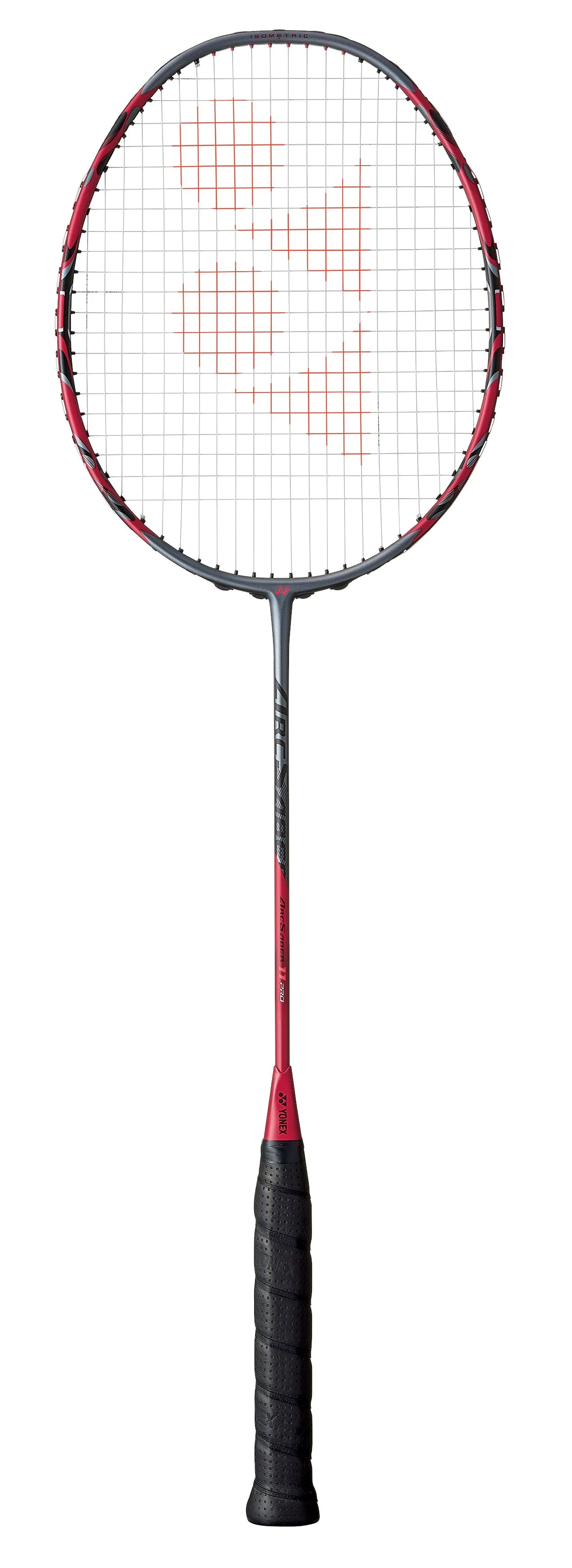
Yonex Arcsaber 11 Pro
Not every advanced player wins by hitting through people. The Arcsaber 11 Pro is the flagship for the player who wins by putting the shuttle where the rally cannot survive — and its specification is the control brief without dilution. The balance is even, favouring neither end of the court. The shaft is stiff, so the response is direct rather than assisted. And the Arcsaber concept itself, as Yonex describes the family, is built around holding the shuttle on the string bed at impact — storing and releasing energy for precise shot-making rather than instant repulsion. In a guide of specialists, this is the all-court instrument: singles players who construct points, and doubles players who play both positions in rotation, are its natural owners.
Two construction details carry the concept at Pro level. POCKETING BOOSTER, the rubber-like material in the frame, is described by Yonex as emphasising elasticity in the frame’s flex — part of how this generation achieves its hold — while the CONTROL-ASSIST BUMPER at the top of the frame contains T-ANCHOR tetrapods that Yonex says lock in the vertical strings for accuracy, and the T-ANCHOR composite in the built-in T-joint is aimed at reducing excess torque on off-centre contact. The stringing advice is the most measured in this guide — 19–27 lbs in 4U, 20–28 lbs in 3U — consistent with a frame tuned for hold rather than maximum bed tightness. One carding note: a single retailer lists higher “up to” tension figures for this model; the ranges carded here are the Yonex stringing-advice figures that the verified spec tables agree on. And to be explicit, because the names invite confusion: this Arcsaber 11 Pro shares nothing but a family name with the Arcsaber 11 Play carded for beginners elsewhere on this site.
Check Price on Amazon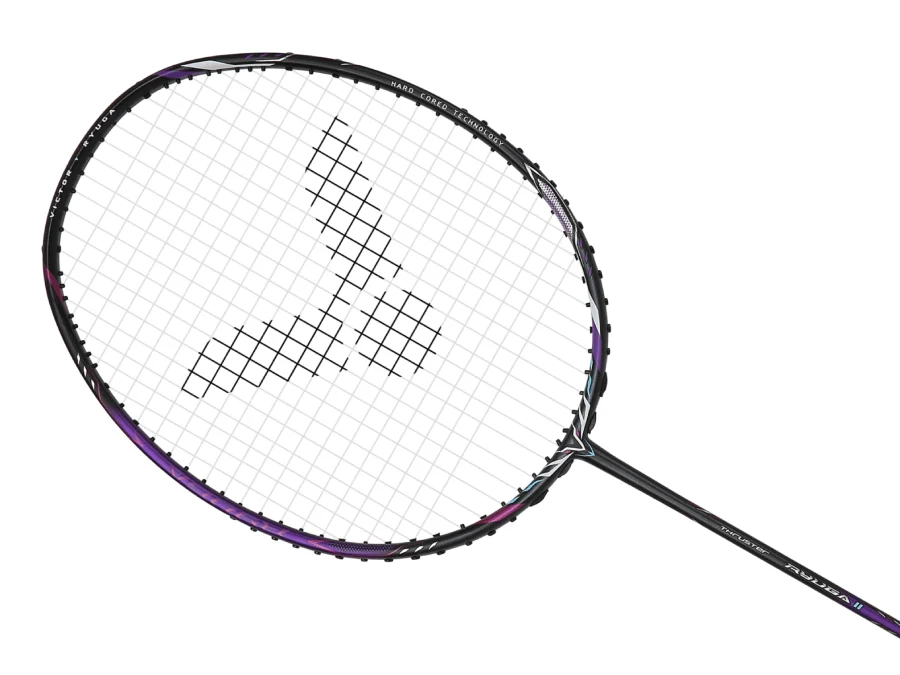
Victor Thruster Ryuga II
The Thruster line is Victor’s power family, and the Ryuga II is its flagship attacking frame — the card for the advanced player who has read the Astrox power cards and wants the same decision answered by the other great power house. The published brief is unambiguous: head-heavy balance, a stiff position on Victor’s own stiffness scale, a slim 6.6 mm shaft, and maximum tensions of ≤32 lbs in 3U and ≤31 lbs in 4U — the highest ceilings carded in this guide. Those numbers describe a frame built to be strung tight and swung hard by a player whose contact quality can use both, in 3U or 4U with a G5 grip. Victor’s regional store listing and its specialist retailers publish the same table, which is what this card stands on.
The technology list is Victor’s attacking stack, in Victor’s own descriptions. The POWER BOX frame profile is a box-shaped structure Victor describes as increasing stability and anti-torque at higher string tensions — the engineering counterpart to that 32 lbs ceiling. WES 2.0, its whipping-effect system, is described as a carbon layering design that improves anti-torsion performance and lets the shaft flex and recover faster for downward attacking angles. The FREE CORE synthetic handle is designed to let the shaft move more freely for smoother handling, and PYROFIL carbon in the shaft is Victor’s Japanese high-performance fibre, described for its shock absorption and control. One version note: the Ryuga II Pro B variant adds Metallic Carbon Fiber to the frame recipe — a variant of this model, not the base Ryuga II carded here, so check which one a listing is actually selling. Technique still has to arrive with the frame — our guide on how to play badminton covers the overhead mechanics a head-heavy, stiff frame rewards.
Check Price on Amazon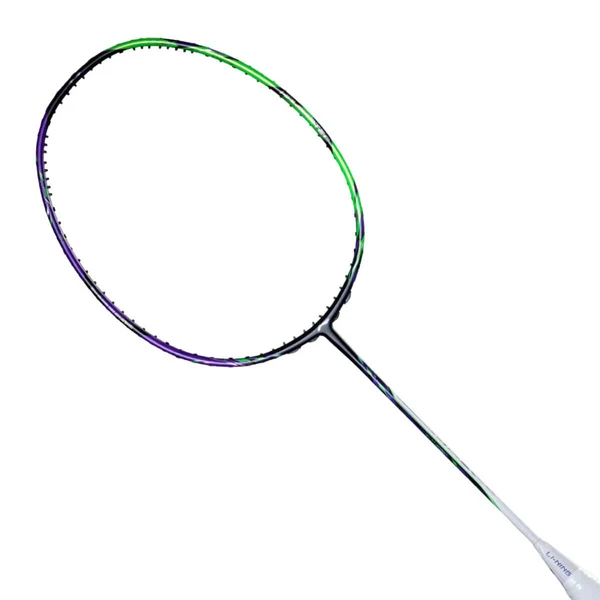
Li-Ning Halbertec 9000
The Halbertec series is Li-Ning’s control family — the name sits over the balanced end of its catalogue — and the 9000 is its flagship. The brief, as Li-Ning’s spec format states it, is unusually direct: player type Balanced, player level Professional, balance even, and a medium shaft-flexibility grade — the only sub-stiff shaft in this guide, and a deliberate one. Read that combination correctly: this is not a softer option for weaker players, it is a control flagship for advanced players whose game is built on precision in every third of the court, and who want the shaft to contribute feel rather than demand to be loaded at maximum speed. Alongside the Arcsaber 11 Pro, it is the second answer to the all-court decision — Li-Ning’s, with a slimmer shaft and a higher tension ceiling.
The build is Li-Ning’s flagship recipe as its listings publish it: T1100 and ultra-high elastic carbon fibre in frame and shaft, a 6.6 mm slim shaft, the Dynamic Optimum Frame shape, ACC-Riftech in the frame, which Li-Ning describes as optimising energy transfer, and the HDF Shock Absorption System, described as absorbing shock for control. Maximum tension is ≤31 lbs in 3U and ≤30 lbs in 4U. This card also carries the guide’s most honest verification note, printed here rather than buried: retailer tables disagree on this model’s balance-point figure (295 mm and 302 mm both appear) and render its shaft wording in several ways, so the card prints no balance-point millimetres at all, and cards the medium grade and the 31 / 30 lbs split that the maker’s-format tables agree on. The character — even, balanced, professional — is consistent everywhere; only the decimal-level details wobble, and at this level you deserve to know that before you order.
Check Price on Amazon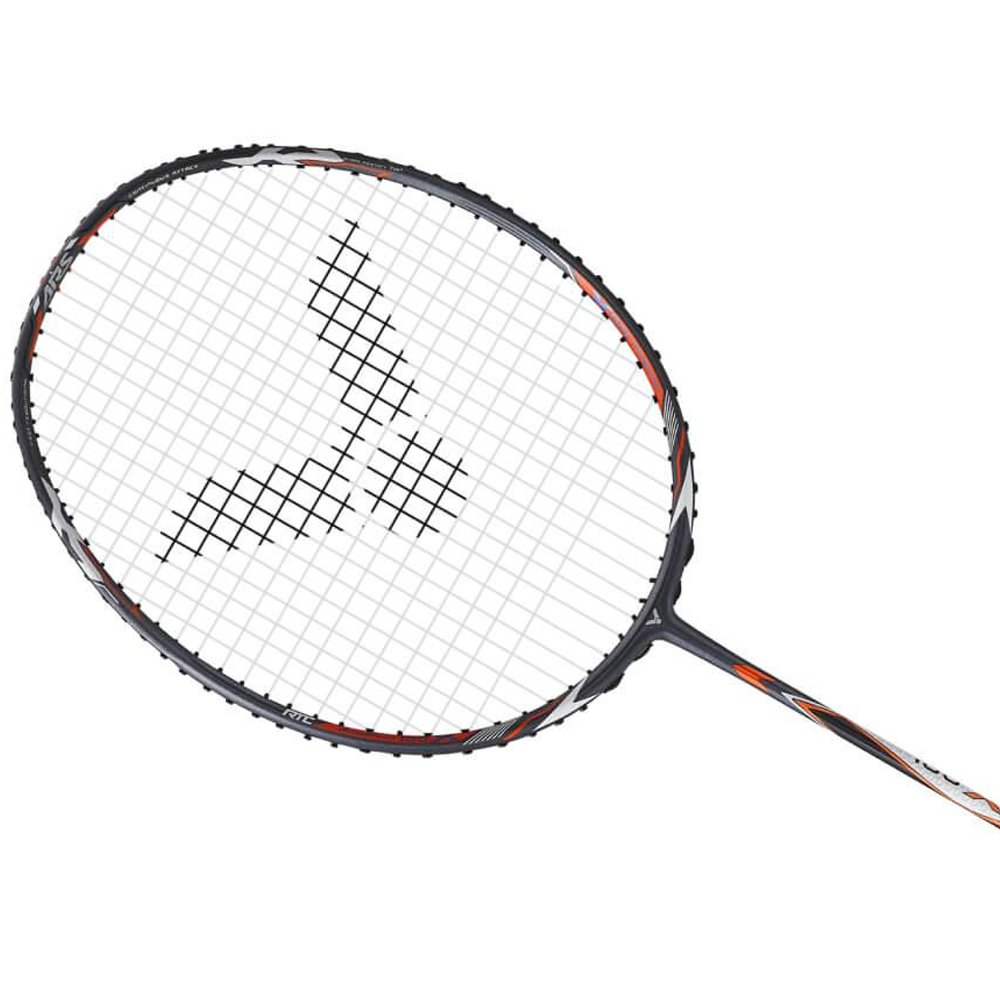
Victor Auraspeed 100X
The Auraspeed family is Victor’s speed series, and the original 100X is the card for the advanced player who liked the Nanoflare 1000 Z’s argument but wants it moderated. The published balance tells the story precisely: on Victor’s five-point scale the 100X sits at the centre position, which its retailers describe as slightly head-heavy, towards even balance — not the committed head-light brief of the Nanoflare, but a speed frame that keeps a measure of head mass for the rear court. The shaft is stiff on Victor’s scale, in 3U and 4U versions with a G5 grip and tension ceilings of ≤29 lbs (3U) and ≤28 lbs (4U). For the all-court doubles player who defends, drives and counter-attacks first and smashes second, this is the most balanced version of the speed decision in the guide.
Victor builds the speed brief around recovery. Its Shaft Recovery System uses high-modulus carbon fibre in the shaft, which Victor says supports faster shaft recovery after contact, and the FREE CORE handle is designed to let the shaft move more freely for smoother, faster swings; PYROFIL in the 6.8 mm shaft and Nano Fortify TR+ in the frame complete the published recipe, with Victor’s rebound-transition construction described as maximising rebound at contact. Retailers summarise the result as fast handling with genuine power on tap — Victor’s positioning, reported as such. One naming caution closes the card: the later 100X Ultra is a different model, with a slimmer 5.8 mm shaft and higher tension ceilings. It is not the racket carded here, and its specifications should not be read across to this one — confirm the listing says 100X, not 100X Ultra, before you buy.
Check Price on AmazonSide-by-Side Comparison Table
| Model | Best For | Family (Maker-Stated) | Weight / Grip | Shaft Flex (Maker-Stated) | Max Tension / Stringing Advice |
|---|---|---|---|---|---|
| Yonex Astrox 99 Pro | Best overall | Head-heavy power | 4U (Avg. 83g) · 3U (Avg. 88g), G5,6 / G4,5,6 | Stiff | 4U 20–28 lbs · 3U 21–29 lbs |
| Yonex Nanoflare 1000 Z | Speed | Head-light speed | 4U (Avg. 83g) · 3U (Avg. 88g), G5,6 / G4,5,6 | Extra Stiff | 4U 20–28 lbs · 3U 21–29 lbs |
| Yonex Astrox 88D Pro | Doubles power | Head-heavy power, 300 mm ±3 | 4U (Avg. 83g) · 3U (Avg. 88g), G5,6 / G4,5,6 | Stiff | 4U 20–28 lbs · 3U 21–29 lbs |
| Yonex Arcsaber 11 Pro | Control | Even-balance all-court | 4U (Avg. 83g) · 3U (Avg. 88g), G5,6 / G4,5,6 | Stiff | 4U 19–27 lbs · 3U 20–28 lbs |
| Victor Thruster Ryuga II | Attacking ceiling | Head-heavy power | 3U · 4U, G5 | Stiff (Victor scale) | 3U ≤32 lbs · 4U ≤31 lbs |
| Li-Ning Halbertec 9000 | Balanced control | Even-balance all-court | 3U (85–89g) · 4U (80–84g), G5 | Medium (Li-Ning format) | 3U ≤31 lbs · 4U ≤30 lbs |
| Victor Auraspeed 100X | Speed all-rounder | Centre-scale speed | 3U · 4U, G5 | Stiff (Victor scale) | 3U ≤29 lbs · 4U ≤28 lbs |
Read the family column first and the flex column second — that is the order the decision actually runs in. Three cards spend their mass at the head (the two Astrox Pro models and the Ryuga II), two hold it even (the Arcsaber 11 Pro and the Halbertec 9000), and two keep it central-to-light for speed (the Nanoflare 1000 Z committed, the Auraspeed 100X moderated). The flex column then shows how uniform the advanced gate is: stiff everywhere except the Nanoflare’s extra stiff and the Halbertec’s deliberate medium. The tension column is the sleeper: a 5 lbs spread between the Arcsaber 4U’s 27 lbs advice and the Ryuga II 3U’s 32 lbs ceiling is the makers’ own map of how each frame expects to be played — hold and placement at one end, a tight bed and a full swing at the other.
Buying Guide: Committing to a Flagship
1. Family first: power, all-court or speed
Do not start with a model name — start with where your points are won. Rear-court attackers shortlist the head-heavy cards: Astrox 99 Pro, Astrox 88D Pro and Thruster Ryuga II. All-court and placement players shortlist the even-balance pair: Arcsaber 11 Pro and Halbertec 9000. Defence, drives and front-court players shortlist the speed cards: Nanoflare 1000 Z for the committed version, Auraspeed 100X for the moderated one. In doubles, decide by position, not by pair: the back-court and front-court partners in the same team should usually be holding different families from this table.
2. Stiffness: buy the grade your swing can load
Stiff is the advanced default for a reason — a fast, complete swing bends a stiff shaft briefly and gets a direct, predictable response — but it is a default with an honesty clause. If your contact is still late under pressure, a stiff flagship will not fix it; it will publish it, shot after shot. The two exceptions in this guide mark the edges honestly: the Nanoflare 1000 Z’s extra-stiff shaft is for players who generate exceptional racket-head speed of their own, and the Halbertec 9000’s medium grade shows that even at professional level, a maker will spec a softer shaft when the brief is hold and feel rather than load and release.
3. Weight class: 3U for momentum, 4U for handling — per model, not per ego
Every card here is published in both 3U and 4U, so this is a decision you make seven times over, not once. The pattern that holds across all seven: 3U adds swing momentum and stability, suiting singles and strong rear-court games; 4U handles faster, suiting doubles, defence and longer sessions. Decide it by your dominant format and by the third game of a session, not the first rally. A 3U that feels commanding in minute five and heavy in minute fifty was the wrong class, however good the first smash felt.
4. Tension: treat the ceiling as headroom, not a target
The published ceilings in this guide — from the Arcsaber 11 Pro’s 19–27 lbs advice in 4U to the Ryuga II’s ≤32 lbs in 3U — are what each frame is built to hold, stated by its maker. String inside your frame’s range, and only move up when your contact is consistently central: a tighter bed rewards centre contact and punishes everything else, shrinking the effective hitting area you paid a flagship price to enlarge. Never exceed the published figure for your weight class — on the Yonex cards the 3U and 4U advices differ by a pound, and that difference is printed for a reason.
5. Variant discipline: the name is not the spec
Advanced ranges are where naming traps concentrate, and three appear in this guide alone. The Arcsaber 11 Pro is not the Arcsaber 11 Play. The Auraspeed 100X is not the 100X Ultra. The Thruster Ryuga II is not automatically the Ryuga II Pro B, and the Astrox 99 Pro’s materials changed between generations under the same name. Before ordering, confirm four things on the listing itself: the full model name and any suffix, the generation or item code where one is published, the exact weight class and grip grade, and the spec table against the card above. A flagship bought one variant off is an expensive way to own the wrong racket.