Advanced players do not buy adjectives — they buy a build and the figures behind it. This guide compares seven performance paddles exactly the way their makers publish them: power-oriented thermoformed builds against control-oriented raw-carbon builds, core thickness as each maker states it, swing weight and twist weight only where a maker actually publishes them, and shape and grip length as the makers market and measure them. Where a figure is not published, the card says so. Where a maker makes a claim, the claim is attributed to the maker. Seven paddles, six brands, one decision: which published build matches the game you already play.
⚡ TL;DR — The Short Answer
For the complete all-court specification, buy the JOOLA Agassi Pro 16mm — a 16 mm foam-walled core, a textured carbon face and full certification, at an 8.1-ounce average. For published power, the Selkirk SLK ERA Power Elongated prints the guide’s highest swing weight (118) on a 16 mm foam-ringed core. The control pole is the Six Zero Double Black Diamond Control 16mm, sold in three published weight editions; its sibling, the Six Zero Black Diamond Power 16mm, keeps the chassis and swaps in a raw composite face. The Paddletek Bantam TKO-C 14.3 is the thinner-core all-court card, the Franklin C45 Dynasty 14mm the lightest thermoformed power build at 7.5 to 7.9 ounces, and the Engage Pursuit Pro1 6.0 the reach card, with the longest handle here at 5.875 inches.
Quick Picks — Best Pickleball Paddles for Advanced Players at a Glance
A 16 mm foam-walled core and textured carbon face in the tapered Agassi shape, at 8.1 oz average.
Published swing weight 118 and twist weight 6.6, on a 16 mm Dynamic Fusion core with a 5.8″ handle.
T700 raw carbon over a 16 mm honeycomb, in Light, Standard and Pro weight editions.
The same chassis with a proprietary raw composite face, at an 8.1 oz average, swing weight 114.
A 14.3 mm Bantam core under PT-700 raw carbon, with selectable published weights from 7.7 oz.
Double-thermoformed, 7.5–7.9 oz, with a 45° T700 carbon face and published swing weight 114.
A 5.875″ handle on a ⅝″ MachPro core under raw Toray T700 carbon — the two-hander’s card.
In This Guide
The Advanced Decision: Power Builds vs Control Builds
The beginner’s question is which paddle is good. The advanced player’s question is narrower and harder: which build philosophy, published in which numbers, matches the way you already win points? At this level the makers split their flagship lines into two camps, and they describe the camps themselves. In one camp sit the power-oriented builds — thermoformed unibody constructions and foam-walled cores that their makers market in the language of pop, plow-through and pace. In the other sit the control-oriented builds — raw-carbon faces over honeycomb cores that their makers market in the language of placement, dwell and resets. This guide is organised on that split because the makers organise their catalogues on it: four of the seven cards lean power by their makers’ own descriptions, one leans control outright, and two sit deliberately between the camps as all-court builds.
What makes the decision advanced is that the usual shortcuts stop working. Core thickness, the beginner’s dial, does not separate the camps here: the thickest cores in this guide — 16 mm — include a control build, two power builds and an all-court signature model, while the crispest power brief is a 14 mm thermoformed core. Weight does not separate them either: the lightest published band in the guide belongs to a power paddle. What does separate them is the construction and the face — thermoformed and foam-walled against raw-carbon honeycomb — and, where makers publish them, the swing weight and twist weight figures that describe how a paddle’s mass actually behaves. Those figures are printed on the cards that publish them and marked as not published on the cards that do not. Nothing in between is invented.
One boundary before the picks. This page owns the advanced player’s equipment decision only. The full field — every level, every budget — belongs to our guide to the best pickleball paddles. First paddles belong to the best pickleball paddles for beginners, that segment’s own picks to the best pickleball paddles for women, and the lightweight, grip-size decision to the best pickleball paddles for seniors. None of their models is re-carded here. And if the decision is not equipment but the game itself, start with how to play pickleball.

Cores, Faces and the Figures Makers Publish
Thermoforming is the power camp’s signature construction. Franklin describes its C45 as double-thermoformed — the unibody structure formed twice — with an inner foam layer inside its PowerFlex core. Selkirk’s ERA Power wraps its polypropylene core in a low-density EVA foam perimeter and calls the result its Dynamic Fusion Core. JOOLA builds an EVA foam wall into the Agassi Pro’s core and markets the package as TechFlex Power. Three makers, three names, one published idea: foam and formed structure around the honeycomb, marketed for stability and pace. The control camp’s construction is plainer by design: Six Zero’s pair run a premium honeycomb polymer core with a carbon seam at the edge, and the face — raw carbon on the Control — does the positioning work.
Faces divide the guide as cleanly as cores. Raw carbon, in its makers’ own descriptions, is the control-and-spin surface: Six Zero’s T700 raw carbon, Engage’s raw Toray T700, Paddletek’s PT-700 unidirectional raw carbon. The power camp’s faces are blends and treatments: Selkirk layers woven fiberglass with T700 raw carbon in a 3-layered face, Six Zero’s Power model uses a proprietary raw composite, Franklin applies its T700 carbon as a peel ply texture at a 45-degree angle, and JOOLA textures its carbon fiber surface. None of those descriptions is this guide’s testing — each is its maker’s published account of its own face, and the cards keep the attribution attached.
Swing weight and twist weight are published unevenly — and that unevenness is reported, not repaired. Selkirk publishes both figures for the ERA Power (118 and 6.6 in elongated form). Six Zero publishes both for each Black Diamond, noting they are estimated from its internal lab testing. Franklin publishes both for the C45 Dynasty (114 and 6.2). Paddletek publishes ranges for the TKO-C (115–123 and 6.7–7.5). JOOLA and Engage publish neither for the models carded here, and their cards say exactly that. A retailer-measured figure borrowed into a maker’s spec row would be a different kind of number wearing the wrong label, so this guide prints the gap instead. Shape, finally, is the quiet consensus: six of the seven cards are elongated shapes between 16.3 and 16.5 inches, because that is where the makers aim their advanced lines — the widebody alternatives several of them publish are noted on the cards where they exist.
The 7 Best Pickleball Paddles for Advanced Players, Compared
Seven paddles, two build philosophies, one shared standard — every specification below is its maker’s own published figure, checked at build time. Read the card whose build matches your game first.
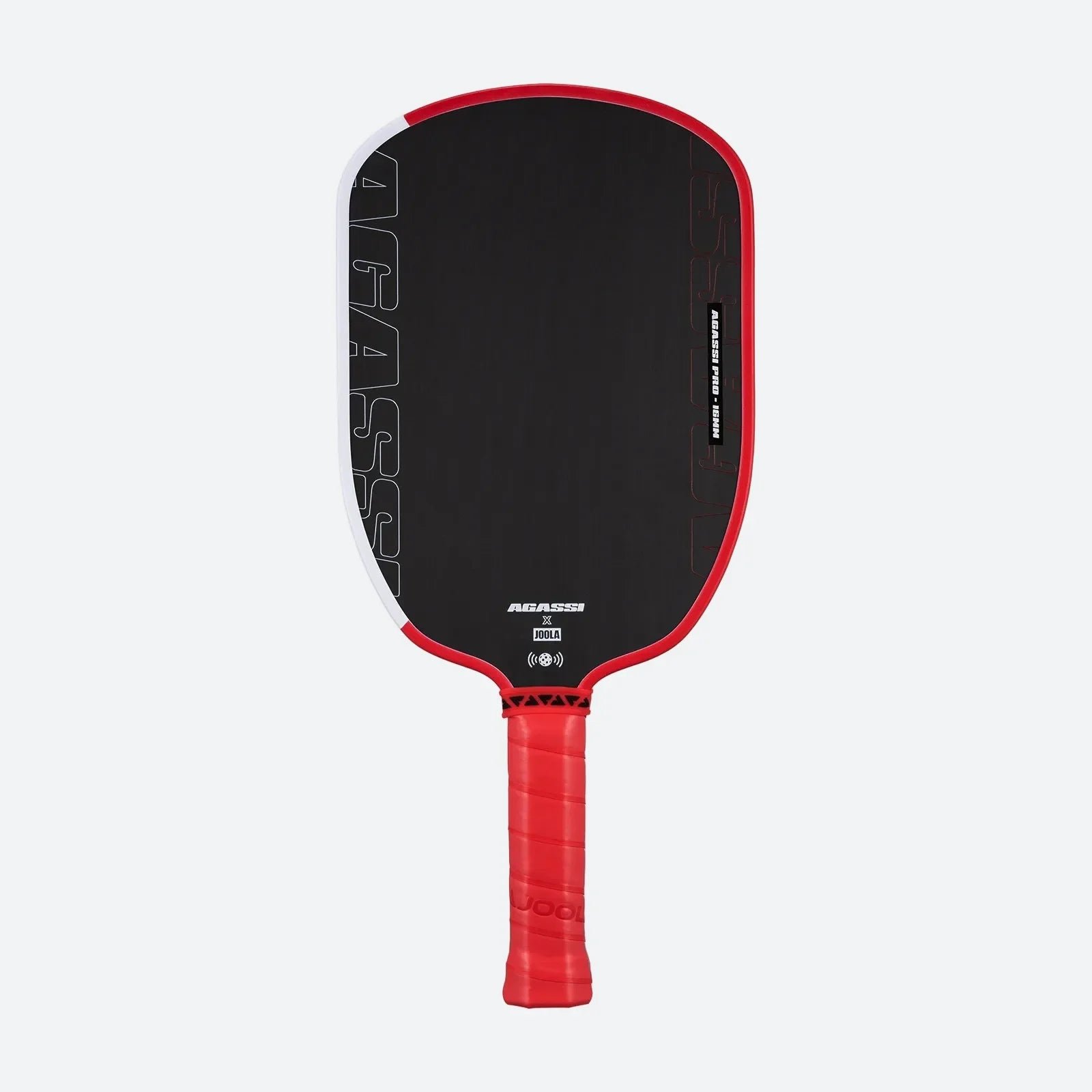
JOOLA Agassi Pro 16mm
The signature all-court brief — a 16 mm foam-walled core under a textured carbon face, in JOOLA’s tapered Agassi shape at an 8.1-ounce average.
JOOLA built this paddle with Andre Agassi, and its published brief is the most balanced in this guide: an extended sweet spot that JOOLA describes as reaching the upper edges and lower corners of the face, in the tapered Agassi shape — 16.5 by 7.5 inches — that JOOLA markets to players who strike the ball toward the top of the paddle. The core is a 16 mm polypropylene core with an EVA foam wall, the face a textured carbon fiber surface, and the published average weight is 8.1 ounces. JOOLA calls its construction TechFlex Power (TFP) and describes it as distributing weight for control and forgiveness; that is JOOLA’s own positioning, and the card reports it as such.
The published handle figures are a 5.5-inch grip length and a 4.25-inch circumference in JOOLA’s Feel-Tec grip — long enough, on the published numbers, for an overlapping two-handed backhand, and the standard circumference most of this guide shares. The paddle is UPA-A certified and USAP PBCoR .43 certified on JOOLA’s listing. Two honest gaps complete the card: JOOLA does not publish swing weight or twist weight for this model, so none is printed here — if those figures drive your buying, the Selkirk and Six Zero cards below publish theirs. As an overall advanced brief — power language, control language, a signature shape and a full certification line — this is the most complete single specification in the guide, which is why it leads it.
What we like
- A genuinely two-way brief: power and control language on one published spec sheet
- 16 mm foam-walled core under a textured carbon face
- UPA-A and USAP PBCoR .43 certified, per JOOLA
- The tapered Agassi shape — a distinct published profile, not a generic elongated
Worth knowing
- JOOLA publishes no swing weight or twist weight for this model
- A single published grip circumference: 4.25 in
- The 8.1 oz average is a point figure, not a selectable weight band
As an Amazon Associate we earn from qualifying purchases.
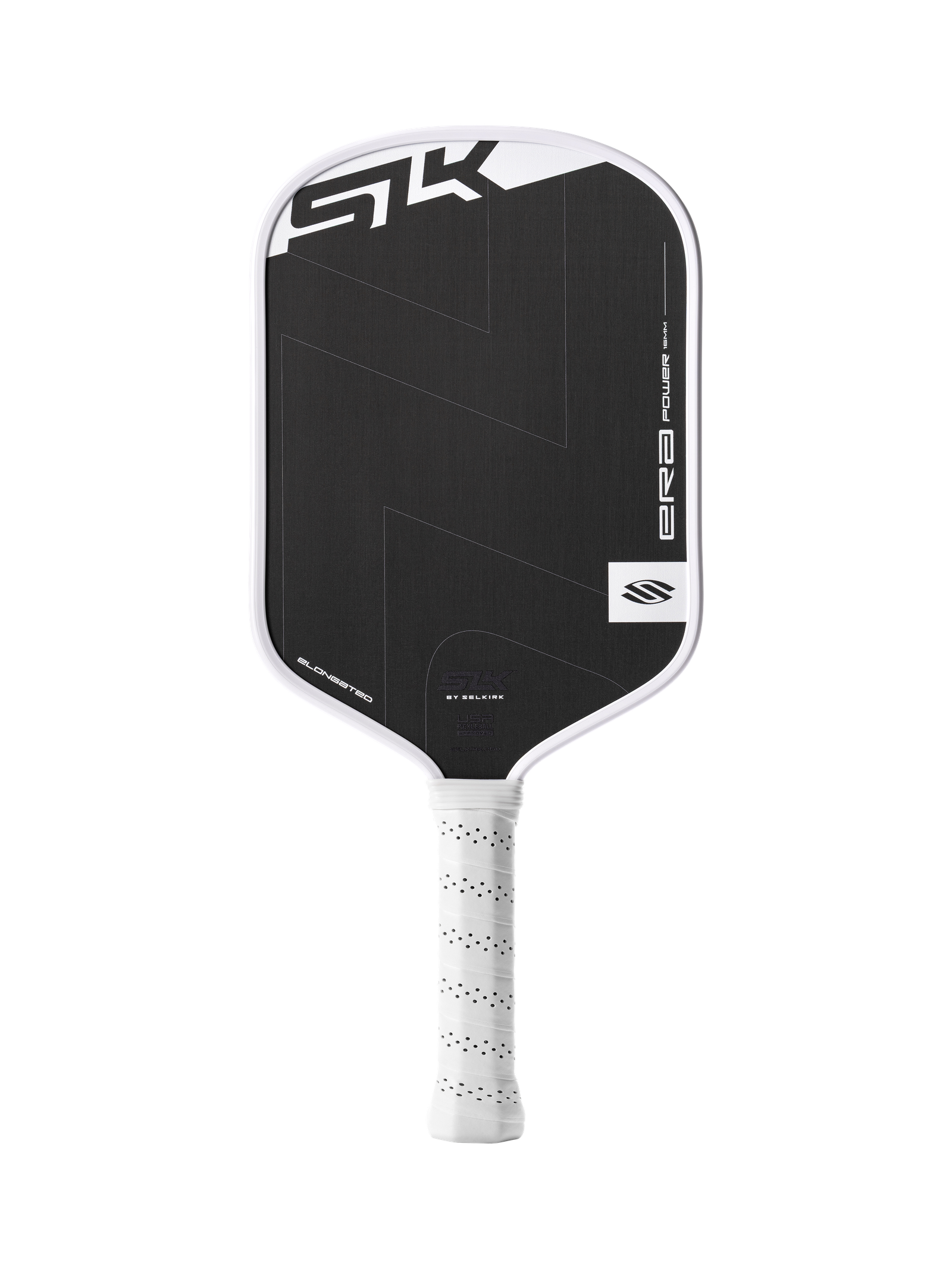
Selkirk SLK ERA Power Elongated
The power brief with the paperwork — the highest published swing weight in this guide, on a 16 mm foam-ringed core with a 5.8-inch handle.
Selkirk markets the ERA Power as its power paddle you can trust, and it is the rare power card that publishes the full measurement set. The average swing weight is 118 — the highest figure in this guide — with an average twist weight of 6.6, both printed on Selkirk’s own specification. The core is Selkirk’s Dynamic Fusion Core: a polypropylene honeycomb surrounded by a low-density EVA foam perimeter with composite edge reinforcements, which Selkirk describes as distributing mass toward the edges for stability and a more forgiving sweet spot. The face is a 3-layered blend of woven fiberglass and T700 raw carbon fiber, finished with Selkirk’s Raw Spin Technology surface.
The shape completes the power brief. At 16.5 by 7.45 inches the Elongated is the joint-longest paddle here, and its 5.8-inch handle is the second longest in the guide — Selkirk describes it as giving ample room for two-handed backhands and greater plow-through, in Selkirk’s words. The published weight band is 7.9 to 8.4 ounces, the grip circumference 4.25 inches on an octagonal handle, and Selkirk rates the paddle’s skill level as intermediate to advanced on its own spec sheet. Selkirk also publishes a widebody version of the same model — 15.95 by 8 inches, swing weight 109, twist weight 7.3 — so the ERA Power is the one card here where the shape decision can be made inside a single model line, on published figures for both.
What we like
- The highest published swing weight in the guide: 118
- A full published measurement set — swing, twist, both shapes
- Dynamic Fusion foam-ringed core, as Selkirk describes it
- A 5.8″ handle on a 16 mm power core — a rare published combination
Worth knowing
- The top of the weight band (8.4 oz) is the joint-heaviest standard spec here
- Selkirk’s own ratings put control below its power and spin ratings
- The widebody version’s figures differ — check which shape a listing is selling
As an Amazon Associate we earn from qualifying purchases.
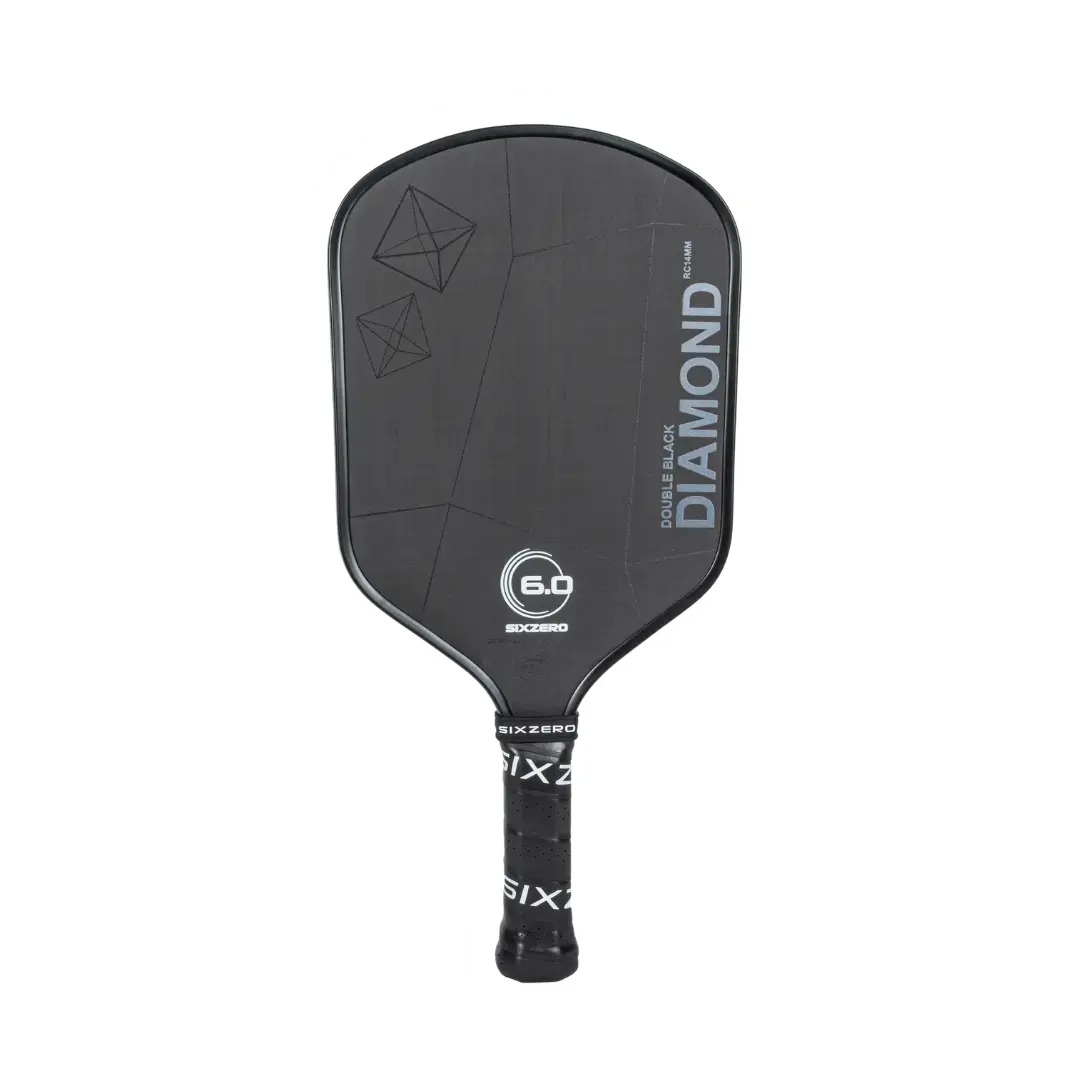
Six Zero Double Black Diamond Control 16mm
The control brief, published in three weight editions — a 16 mm raw-carbon honeycomb with a 6.8 twist weight in its standard build.
This is the control pole of the guide, and Six Zero publishes it like one. The face is T700 raw carbon with a textured surface that Six Zero describes as nano-engineered for grip and feel; the core is a 16 mm premium honeycomb polymer that Six Zero positions as giving the best power-to-control ratio in its line. The shape is a slightly flared 16.3 by 7.5 to 7.7 inches, which Six Zero describes as aerodynamically engineered to boost the sweet spot in the core hitting zone. Around the edge sits Six Zero’s Carbon Fusion Edge Technology — a lightweight carbon seam fusing the faces — and the handle is a 3D carbon forged elongated handle, per Six Zero’s construction description.
What makes the card an advanced player’s card is the published choice. Six Zero sells this paddle in three weight editions — Light-weight at 7.7 to 7.9 ounces, Standard at 8.0 to 8.2, and Pro-weight at 8.3 to 8.5 — and publishes swing and twist weights for each: the Standard build prints 114 swing weight and 6.8 twist weight, figures Six Zero notes are estimated from its internal lab testing. The grip length is 5.5 inches and the published circumference 4.125 inches, the joint-smallest in this guide. No other card here lets you order the same control build at three published weights with the measurement set attached to each — for the advanced player whose game is resets, rolls and placement, this is the most configurable control specification in the guide.
What we like
- Three published weight editions of one control build
- Swing and twist weights published per edition
- T700 raw carbon over a 16 mm honeycomb — the classic control recipe, as Six Zero publishes it
- The joint-smallest published grip here: 4.125 in
Worth knowing
- Six Zero notes its swing/twist figures are estimates from internal lab testing
- The flared shape’s width is published as a range (7.5–7.7 in), not a point
- The Pro-weight edition changes the character — order the edition by name
As an Amazon Associate we earn from qualifying purchases.
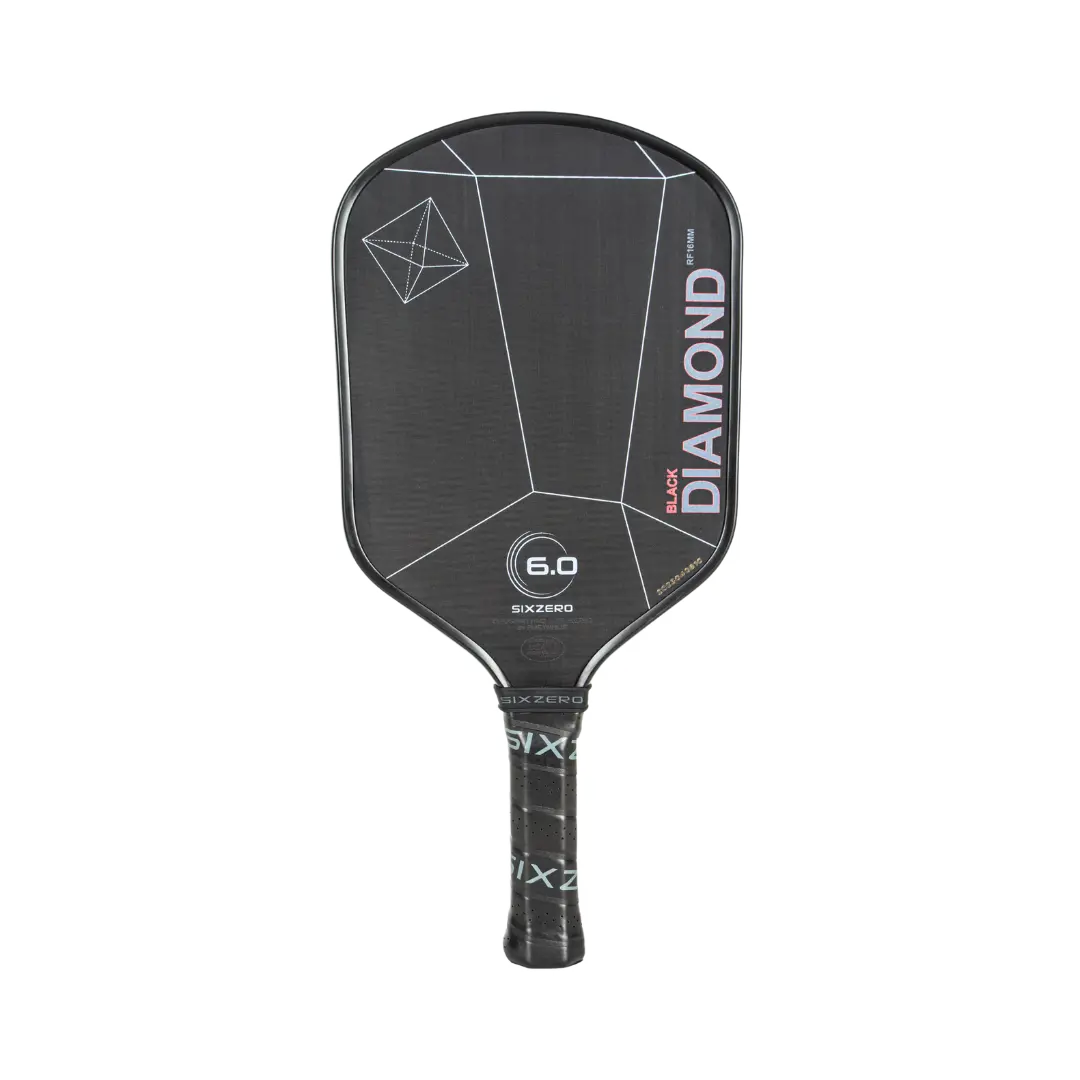
Six Zero Black Diamond Power 16mm
The same Black Diamond chassis, the other face — Six Zero’s proprietary raw composite over the 16 mm honeycomb, at 8.1 ounces.
Carding two Six Zero paddles back to back is deliberate, because the pair isolates the advanced player’s cleanest experiment: same published chassis, different face. The Black Diamond Power shares the Control model’s dimensions — 16.3 inches long, 7.5 to 7.7 wide, a 16 mm premium honeycomb polymer core, a 5.5-inch grip length — but its face is Six Zero’s proprietary Japanese raw composite material rather than raw carbon. Six Zero markets the Power as the line’s attacking build and the Control as its placement build; the face material is the published difference the positioning hangs on, and this guide reports the pairing exactly that way rather than inventing a feel verdict of its own.
The published figures are equally complete. The average weight is 8.1 ounces, plus or minus 0.2, the grip circumference is published as a 4.125 to 4.25-inch range — the only card here whose maker publishes the circumference itself as a range — and the measurement set prints a 114 swing weight and 6.8 twist weight, again noted by Six Zero as estimated from its internal testing. A Pro-weight 16 mm edition is also published, at 8.4 ounces with a 115 swing weight and 6.95 twist weight. Read against its sibling, the lesson of the pair is the guide’s thesis in miniature: at the advanced level, the face material and the weight edition are the decision — the core thickness, at 16 mm on both, is not.
What we like
- The power counterpart to the guide’s control card — a clean face-material comparison
- A published grip circumference range (4.125–4.25 in), unique here
- Full published measurement set, plus a Pro-weight edition
- Same flared chassis and Carbon Fusion edge family as the Control
Worth knowing
- The composite face is proprietary — Six Zero does not publish its exact composition
- Swing/twist figures are maker estimates from internal testing, per Six Zero
- Two near-identical model names in one line — confirm Control vs Power on the listing
As an Amazon Associate we earn from qualifying purchases.
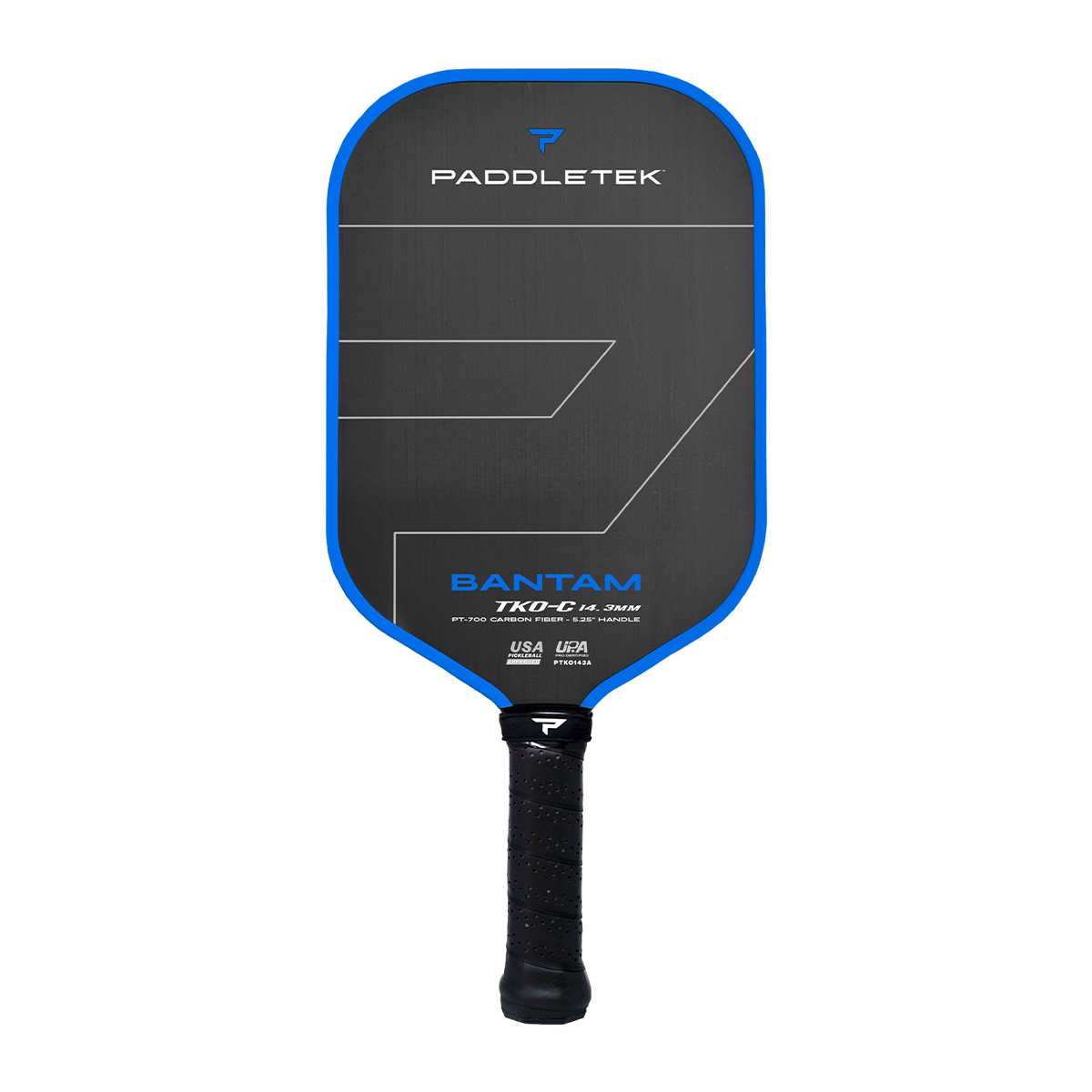
Paddletek Bantam TKO-C 14.3
The thinner-core all-court card — a 14.3 mm Bantam core under PT-700 raw carbon, co-designed with a touring pro, made in the USA.
Paddletek designed the Bantam TKO-C with top professional Christian Alshon, and publishes it as a combination of power, spin and reach. The carded version is the 14.3 mm — the thicker of the two TKO-C cores, which Paddletek’s retailers describe, following Paddletek, as the more forgiving, control-leaning of the pair next to the 12.7 mm power version. The core is Paddletek’s Bantam PolyCore with Quick Response Technology, an advanced high-grade polymer composite honeycomb; the face is PT-700 unidirectional raw carbon fiber — Toray 700 carbon, per Paddletek — and the published static weight band is 7.7 to 8.1 ounces in an elongated 16.5 by 7.5-inch shape.
Paddletek is also one of the few makers here to publish stability figures: its performance panel prints swing weight 115 to 123 and twist weight 6.7 to 7.5 as ranges for the model — the widest swing-weight range in the guide, which is itself information: individual paddles in this line vary, and Paddletek sells the model at selectable static weights from 7.7 to 8.1 ounces, so the weight you order is a real choice on this card. The handle is the shortest here at 5.25 inches, with a 4.25-inch Ultra Cushion High Tack grip — the one specification that will rule this card out for committed two-handers, and rule it in for players who want the face, not the handle, doing the work. The paddle is made in the USA and USAPA approved, per Paddletek.
What we like
- Selectable published static weights (7.7–8.1 oz) at order
- Maker-published swing and twist weight ranges — rare honesty about variation
- The 14.3 mm core: the control-leaning version of a power line
- PT-700 raw carbon face; made in the USA, per Paddletek
Worth knowing
- The 5.25″ handle is the shortest in this guide
- The published swing-weight range is wide — your individual paddle sits somewhere inside it
- A 12.7 mm sibling exists — confirm the listing says 14.3
As an Amazon Associate we earn from qualifying purchases.
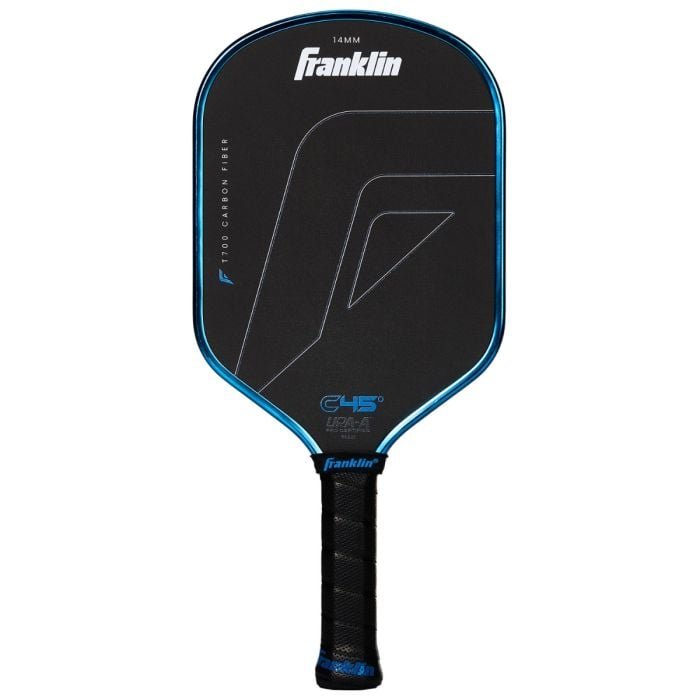
Franklin C45 Dynasty 14mm
The thermoformed power brief at the lightest published weight here — a double-thermoformed unibody, a 45-degree carbon face, and a 114 swing weight.
Franklin publishes the C45 Dynasty as its pro-design elongated paddle, and its construction is the guide’s clearest thermoformed brief: a double-thermoformed unibody frame — Franklin describes the process as thermoforming the structure twice to maximise its integrity — around a 14 mm PowerFlex polymer core with an inner foam layer, which Franklin describes as giving the paddle its pop while keeping the core intact. The face is the model’s signature: T700 carbon fiber peel ply texture applied at a 45-degree angle, which Franklin describes as giving a natural, consistent texture across the whole face. Every one of those claims is Franklin’s own published description, reported here as the maker’s positioning.
The numbers around the build are just as complete, and one of them leads the guide: the published weight band, 7.5 to 7.9 ounces, is the lightest in this field — a power build you do not have to swing heavy. Franklin publishes a 114 swing weight and a 6.2 twist weight, a 16.4 by 7.6-inch elongated Dynasty shape, a 5.6-inch handle and a 4.3-inch handle circumference — the largest grip in the guide, a genuine differentiator for bigger hands. The paddle is approved by both USA Pickleball and the United Pickleball Association for competitive play, per Franklin. Note the shape discipline: Franklin also publishes Tempo and Hybrid C45 shapes with different dimensions and figures — this card is the Dynasty only, on the Dynasty’s numbers.
What we like
- The lightest published weight band in the guide: 7.5–7.9 oz
- Double-thermoformed unibody — the fullest thermoformed brief here, as Franklin describes it
- Published swing and twist weights on a power card
- The largest published grip here: 4.3 in
Worth knowing
- The 6.2 twist weight is the lowest published figure in the guide
- Sibling C45 shapes (Tempo, Hybrid) carry different specs — order the Dynasty by name
- The 45° face texture is Franklin’s positioning — reported, not tested here
As an Amazon Associate we earn from qualifying purchases.
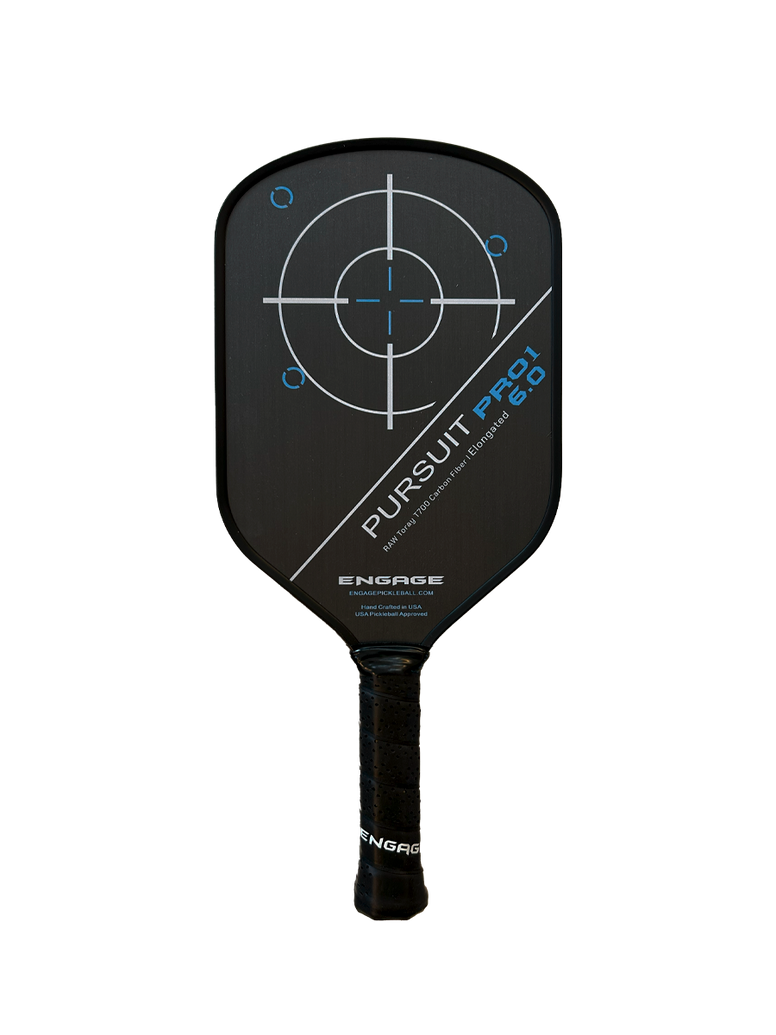
Engage Pursuit Pro1 6.0 Elongated
The reach card — the longest handle in this guide at 5.875 inches, on a ⅝-inch MachPro core under raw Toray T700 carbon.
Engage publishes the Pursuit Pro1 6.0 as its most advanced paddle, and the specification that earns its card is at the bottom of the paddle: a 5.875-inch handle, the longest published grip length in this guide, on an elongated 16.5 by 7.5-inch shape. For the advanced player who plays a genuine two-handed backhand — both hands on the grip, not a finger of support — handle length is not a preference, it is the filter, and this is the card that passes it furthest. The core is Engage’s proprietary MachPro Polymer at ⅝ inch thick, which Engage describes as its thick-core brief for control and ball feel while maximising power in a thick-core paddle — Engage’s positioning, reported as such.
The face is raw Toray T700 carbon fiber with what Engage calls its next-generation inner application layer, and Engage’s published construction list adds its Vortex Barrier edge, Uniform Guard bonding and Counter Balance technologies — the last of which Engage describes as lowering the paddle’s balance point for quicker hand speed. The published weight band on Engage’s current specification is 7.8 to 8.2 ounces with a 4.25-inch grip circumference, and the paddle is USAPA listed and approved for tournament play. The honest gap mirrors the JOOLA card: Engage does not publish swing weight or twist weight for this model, so none is printed — the card stands on its handle, its core and its face, which for its buyer is the whole argument.
What we like
- The longest published handle in the guide: 5.875 in
- A ⅝″ thick-core brief under raw Toray T700 carbon
- Engage’s Counter Balance positioning for hand speed, as Engage describes it
- USAPA listed and approved, per Engage
Worth knowing
- Engage publishes no swing weight or twist weight for this model
- Older listings show split Standard/LITE weight bands — check the current listing’s band
- The elongated-only shape here: the line’s hybrid and widebody versions carry different dimensions
As an Amazon Associate we earn from qualifying purchases.
Side-by-Side Comparison Table
| Model | Best For | Weight (as maker states it) | Core | Face | Grip | Handle | Swing / Twist (as published) |
|---|---|---|---|---|---|---|---|
| JOOLA Agassi Pro 16mm | Best overall | 8.1 oz average | 16 mm PP + EVA foam wall | Textured carbon fiber | 4.25 in | 5.5 in | Not published |
| Selkirk SLK ERA Power Elongated | Power build | 7.9–8.4 oz | 16 mm Dynamic Fusion | 3-layer T700 carbon + fiberglass | 4.25 in | 5.8 in | 118 / 6.6 |
| Six Zero Double Black Diamond Control 16mm | Control build | Std 8.0–8.2 oz | 16 mm honeycomb polymer | T700 raw carbon | 4.125 in | 5.5 in | 114 / 6.8 (Standard) |
| Six Zero Black Diamond Power 16mm | Composite-face power | 8.1 oz ± 0.2 oz | 16 mm honeycomb polymer | Proprietary raw composite | 4.125–4.25 in | 5.5 in | 114 / 6.8 |
| Paddletek Bantam TKO-C 14.3 | Elongated all-court | 7.7–8.1 oz | 14.3 mm Bantam PolyCore | PT-700 raw carbon fiber | 4.25 in | 5.25 in | 115–123 / 6.7–7.5 (ranges) |
| Franklin C45 Dynasty 14mm | Lightest power band | 7.5–7.9 oz | 14 mm PowerFlex + foam layer | T700 carbon, 45° peel ply | 4.3 in | 5.6 in | 114 / 6.2 |
| Engage Pursuit Pro1 6.0 Elongated | Longest handle | 7.8–8.2 oz | ⅝ in MachPro Polymer | Raw Toray T700 carbon | 4.25 in | 5.875 in | Not published |
The table’s most honest column is its last. Five of the seven makers publish swing and twist figures for these models; two — JOOLA and Engage — do not, and the table prints the gap rather than filling it from a retailer’s lab. Read the published figures comparatively, not absolutely: Selkirk’s 118 is the guide’s highest swing weight and sits on its power card; the control card publishes 114 in its standard edition and reserves its higher figures for its Pro-weight edition; Franklin’s 6.2 twist weight is the lowest here, on the lightest power build. And read the core column with the framing sections in mind: 16 mm appears in both camps, 14 and 14.3 mm in the power and all-court cards — thickness is a character note, not a camp badge.
Buying Guide: Matching the Published Build to Your Game
1. Name your camp first: power build or control build
Every other choice in this guide is downstream of this one. If your points are won by pace — drives, speed-ups, put-aways — your shortlist is the makers’ power builds: the thermoformed Franklin C45 Dynasty, the foam-ringed Selkirk ERA Power, the foam-walled JOOLA Agassi Pro and the raw-composite Six Zero Black Diamond Power. If your points are won by placement — resets, rolls, dinks that die at the net — your shortlist starts with the raw-carbon Six Zero Double Black Diamond Control. The all-court cards, the Paddletek TKO-C 14.3 and the Engage Pro1 6.0, are for the player who genuinely plays both games in the same match. Use the makers’ own positioning to sort the cards, as this guide does — then use the published figures to choose inside your camp.
2. Read swing weight and twist weight where — and only where — they are published
A published swing weight is a maker’s own statement about how its paddle’s mass behaves; a twist weight is its statement about stability on off-centre contact. Compare them like-for-like: the ERA Power’s 118 against the Black Diamond pair’s and the C45’s 114s, Paddletek’s 115–123 range read as a range. Where a maker publishes nothing — the Agassi Pro and the Pursuit Pro1 — treat the absence as a fact about the listing, not a defect in the paddle, and decide those cards on what is published: construction, face, shape and grip figures. What you should not do is import a number measured by someone else into the comparison as if the maker had printed it.
3. Core thickness: read it with the construction, never alone
This guide’s field runs from 14 mm to 16 mm, and both camps live at both ends. A 14 mm core inside a double-thermoformed, foam-layered build (the C45 Dynasty) is published as a power brief; a 16 mm raw-carbon honeycomb (the Double Black Diamond Control) is published as a control brief. The useful reading is pairs: thickness plus construction. Foam walls, foam rings and foam layers are the power camp’s published vocabulary; plain premium honeycomb under raw carbon is the control camp’s. Engage’s ⅝-inch MachPro sits between the vocabularies, which matches its all-court card. Choose the pair that matches your camp from step one.
4. Shape and handle: the elongated consensus, and the two-hander’s filter
Six of the seven cards are elongated, from 16.3 to 16.5 inches — the makers aim their advanced lines at reach and leverage, and widebody versions, where they exist, are published as the alternative shape inside the same line (Selkirk publishes the ERA Power both ways, with different figures for each). Handle length is the sharper filter. If you play a two-handed backhand, shop the published grip lengths in order: 5.875 inches (Engage), 5.8 (Selkirk Elongated), 5.6 (Franklin), 5.5 (JOOLA and both Six Zero cards), 5.25 (Paddletek). If you play one-handed and live on hand speed, the shorter handles stop being a compromise and become the point. Grip circumference varies less here — 4.125 to 4.3 inches — with Franklin’s 4.3 the outlier for larger hands and the Double Black Diamond Control’s 4.125 the smallest published.
5. Face material: the camp badge you can read at a glance
Raw carbon faces cluster on the control and all-court cards: Six Zero’s T700, Engage’s raw Toray T700, Paddletek’s PT-700 unidirectional. Treated and blended faces cluster on the power cards: Selkirk’s 3-layer carbon-and-fiberglass, Franklin’s 45-degree peel ply T700, JOOLA’s textured carbon fiber, Six Zero Power’s proprietary raw composite. The makers describe raw carbon in grip-and-feel language and the blends in pace language; those are their descriptions, and the cards attribute them. The practical use is sorting: if you already know which face family your game is built on, the face column of the comparison table cuts the field to three or four cards before you read a single specification.
Frequently Asked Questions
What makes a paddle an advanced player’s paddle?
On the makers’ own listings, it is the combination of a published performance build and the figures to back it: thermoformed or foam-walled cores, raw-carbon or composite faces, and — on the cards that publish them — swing weights from 114 to 118 and twist weights from 6.2 to 6.8. Every paddle in this guide is a maker’s performance model: the JOOLA Agassi Pro, the Selkirk SLK ERA Power, the two Six Zero Black Diamond builds, the Paddletek Bantam TKO-C, the Franklin C45 Dynasty and the Engage Pursuit Pro1 6.0.
Thermoformed power build or raw-carbon control build: which should I choose?
Choose by the game you actually play. The thermoformed and foam-walled power builds here — the Franklin C45 Dynasty, the Selkirk SLK ERA Power and JOOLA’s TechFlex Power Agassi Pro — are the ones their makers describe in power and pop language. The raw-carbon control builds — the Six Zero Double Black Diamond Control above all — are the ones their makers describe in placement and reset language. The Paddletek Bantam TKO-C 14.3 and the Engage Pursuit Pro1 6.0 sit between the camps, which is exactly why they are carded as all-court options.
Does core thickness decide power or control?
Not on its own, and this guide is the proof: the thickest cores here include both a control build (the Six Zero Double Black Diamond Control at 16 mm) and power builds (the Selkirk SLK ERA Power and Six Zero Black Diamond Power, also at 16 mm). Read thickness together with the face and the core construction the maker publishes — a 14 mm foam-walled thermoformed core (the Franklin C45 Dynasty) is a power brief, while a 16 mm raw-carbon honeycomb can be a control brief.
What swing weight should an advanced player look for?
Start from what makers publish. In this guide the published figures run from 114 (the Six Zero pair and the Franklin C45 Dynasty) to 118 on the Selkirk SLK ERA Power Elongated, with Paddletek publishing a 115 to 123 range across the Bantam TKO-C’s performance panel. Higher published swing weights sit on the power cards; the control card publishes 114 in its standard weight. Two cards — the JOOLA Agassi Pro and the Engage Pursuit Pro1 6.0 — do not publish swing weight at all, and this guide prints that rather than borrowing a retailer’s measurement.
Elongated, standard or widebody: which shape do advanced players use?
All three, for different jobs — but this guide’s field is heavily elongated, because that is where the makers aim their advanced lines: six of the seven cards are elongated shapes from 16.3 to 16.5 inches long. Elongated shapes publish reach and leverage; the widebody versions several makers offer alongside (Selkirk publishes the ERA Power in a widebody shape too) publish the broader face. Choose the shape by the published dimensions on the card, not by habit.
How long a handle do I need for a two-handed backhand?
Shop the published grip lengths. The longest handles in this guide are the Engage Pursuit Pro1 6.0 at 5.875 inches and the Selkirk SLK ERA Power Elongated at 5.8 inches, followed by the Franklin C45 Dynasty at 5.6 inches and the 5.5-inch pair from JOOLA and Six Zero. The Paddletek Bantam TKO-C’s 5.25-inch handle is the shortest here — the card to read carefully if both of your hands need to fit on the grip.
How is this guide different from the other pickleball paddle guides on this site?
Each guide owns one decision. This page owns the advanced player’s decision only: power-oriented thermoformed builds against control-oriented raw-carbon builds, compared on the specifications their makers publish. The all-player guide owns the full field, the beginners guide owns the first-paddle decision, and the women’s and seniors guides own their segments’ picks and sizing decisions. None of their models is re-carded here, and none of these seven is presented as a substitute for them.
The Verdict
Buy the build your game already is. The JOOLA Agassi Pro 16mm is the most complete all-court specification here — foam-walled 16 mm core, textured carbon face, full certification — and it leads the guide. The Selkirk SLK ERA Power Elongated owns published power, with the highest swing weight in the field and a handle built for two hands. The Six Zero Double Black Diamond Control 16mm owns control, in three orderable weights; the Six Zero Black Diamond Power 16mm is its composite-faced counterpart. The Paddletek Bantam TKO-C 14.3 is the thinner-core all-court card, the Franklin C45 Dynasty 14mm the lightest thermoformed power build, and the Engage Pursuit Pro1 6.0 the reach pick with the longest handle here. Two camps, seven published builds — every figure as its maker states it, and every gap printed as a gap.
Affiliate disclosure: AliShuttler is a participant in the Amazon Services LLC Associates Program. Links marked “Check Price on Amazon” are affiliate links — if you buy through them, we may earn a commission at no additional cost to you. Every specification in this guide is taken from the manufacturer’s own published listings, checked at build time in 2026; where a manufacturer does not publish a figure, this guide says so rather than substituting another source’s measurement.