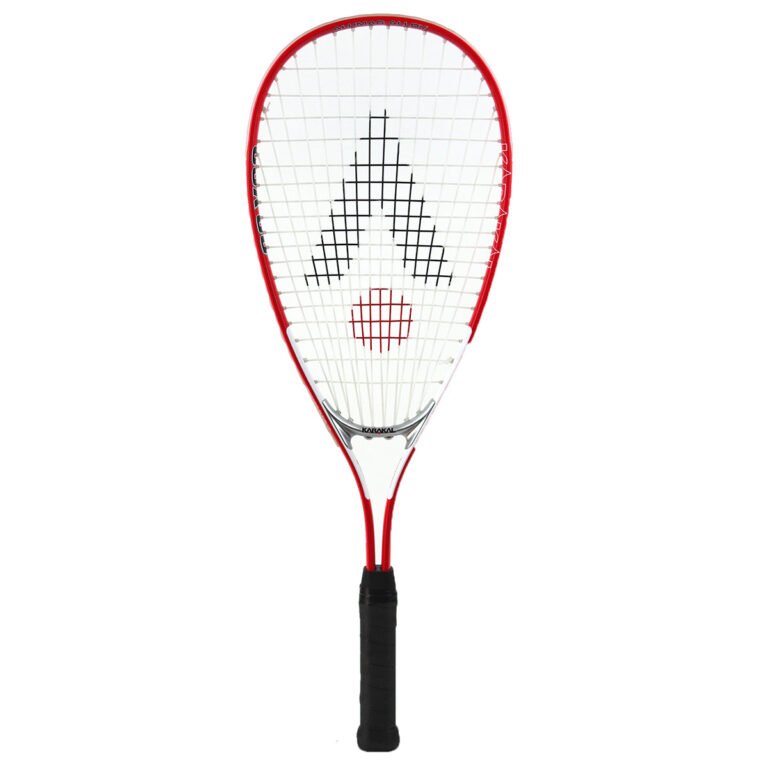
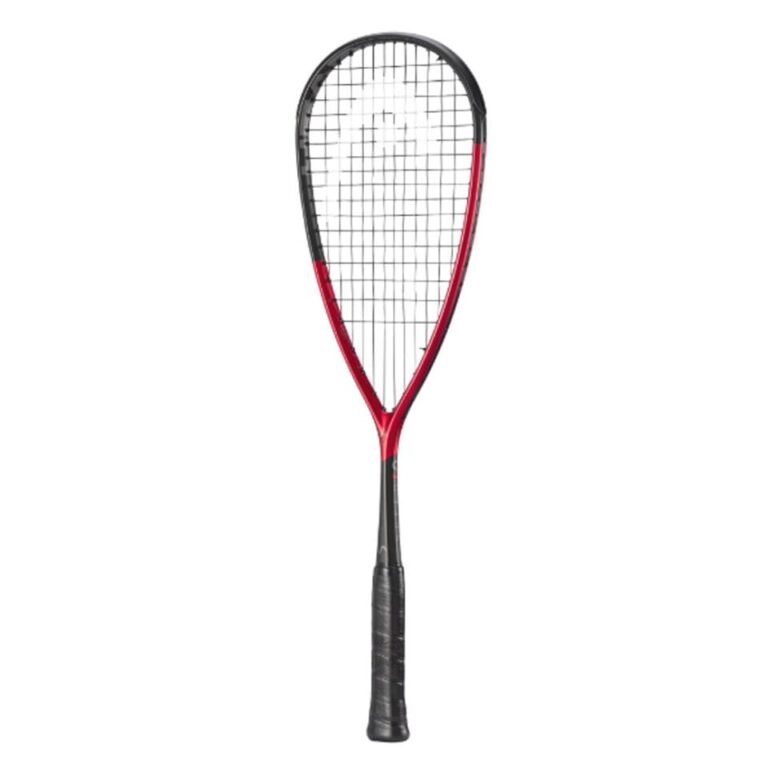
Your racket frame gets the attention, but the string bed is the only part that ever touches the ball. These are the seven strings worth restringing with — the tour benchmarks, the power options and the durable workhorses — compared by gauge, construction and the player each one suits.
In this guide
- Why your strings matter more than your next racket
- The 7 best squash strings, reviewed
- Comparison table: all seven at a glance
- Gauge explained: thin for power, thick for durability
- Natural gut vs multifilament vs Zyex vs synthetic core
- Factory strings vs your first restring
- Matching a string to your frame
- Squash string FAQs
Why Your Strings Matter More Than Your Next Racket
Here is the cheapest performance upgrade in squash, and most club players walk straight past it: the strings. A racket frame is a lever. It never touches the ball. The string bed does — every drive, every drop, every boast is filtered through roughly ten metres of filament thinner than a match head is wide. Change the string and you change how the ball leaves the racket: how deep your drives land, how much cut you can put on a drop, how a dying length in the back corner feels off the strings. Change the frame and, for most players, you change far less than the marketing suggests.
Yet the typical club racket lives its whole life on whatever string the factory fitted — often a basic nylon chosen to survive shipping and shelf time rather than to play well — and its owner blames the frame, the ball or their own technique when shots feel dead. The professionals take the opposite view. In our guide to the rackets the pros actually play with, one pattern stands out: tour frames ship with named premium strings — Tecnifibre’s 305 and Dynamix V.P., Karakal’s Hot Zone — because the string bed is treated as a component to be chosen, not a packing material to be endured.
This guide owns one decision only: which string goes in your racket, at what gauge, and why. It will not re-teach you how to hit the ball — that is what our beginner’s guide to the essential squash shots is for — and it will not sell you a new frame. It assumes your current racket is fine and your strings are the bottleneck, which at club level is true far more often than not. Every string below is a current model, verified against manufacturer and retailer listings, with its gauge and construction stated exactly as the maker publishes them. Where a performance claim comes from the manufacturer, we say so. Where advice is general club practice, we say that too.
One more thing before the picks: strings are a consumable, like the squash balls in your bag. They fray, they notch where mains cross crosses, and they slowly lose the elasticity that makes them feel alive. A string choice is therefore never just about the first match — it is about how the bed plays in week six, and how often you are willing to pay a stringer to refresh it. Keep that in mind as you read the durability notes in each card.
The 7 Best Squash Strings for Power & Control
Seven strings, three brands, every realistic playing need covered — from the 1.10 mm feel string a touch player will burn through happily, to the 1.25 mm Zyex-layered bed built for players who snap strings and hate baggy tension. Read the cards in order for the full picture, or jump straight to the one whose “best for” line sounds like you.
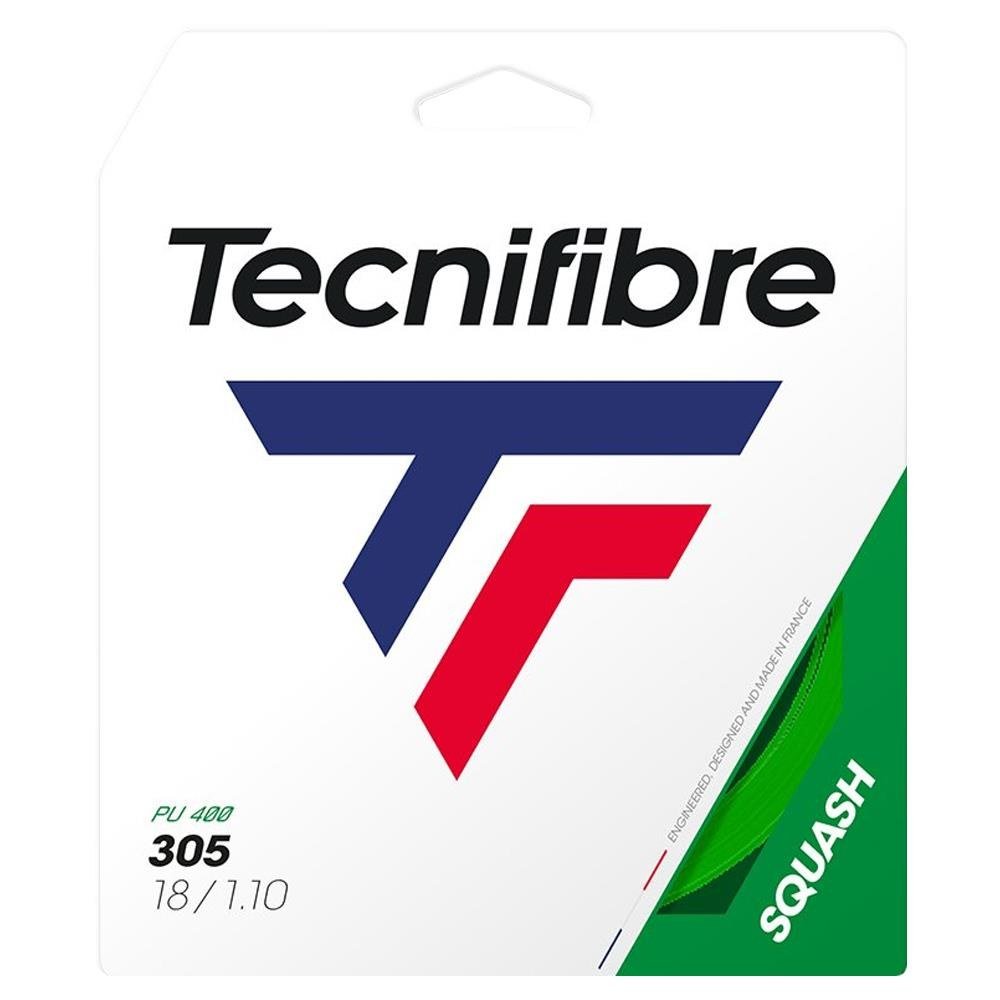
Tecnifibre 305
Best for: control players, touch players, and anyone making their first serious restring.
If one string defines squash, it is this one. The 305 has been the reference squash string for decades — the fluorescent green bed you see in club rackets, pro rackets and restringing shops everywhere. Its construction explains the reputation: hundreds of fine polyamide microfibres saturated in polyurethane — Tecnifibre states a 45% PU concentration, the highest in its own range — and finished with an SPL (Silicon Pyrogene Lubritec) anti-abrasion coating. The result is a multifilament that pockets the ball, returns clear feedback at impact, and holds its shape of play better than basic nylons. Retailers describe it, in Tecnifibre’s own positioning, as the closest feel to natural gut in the range — and at the front of the court, where a drop shot is decided by millimetres of dwell, that soft, connected feel is exactly what control players are buying.
The 305 also ships as a factory string where it matters: it is the fitted string in Mostafa Asal’s Tecnifibre Slash 120 Control, the frame in our pro rackets guide chosen by the most physical player on tour for feel and control rather than durability. Choose your gauge by honesty about your game. The 1.10 mm is the connoisseur’s pick — maximum bite and feel, and the fastest to fray. The 1.20 mm is the reference set most club players should start with. The 1.25 mm trades a little liveliness for a bed that survives heavier hitting and longer intervals between restrings. None of the three is a power trampoline; the 305 rewards a full, clean swing with precision rather than giving pace away free, which is precisely why it tops this list for the guide’s power-and-control brief: it delivers control in full and power on request.
What we like
- The benchmark feel — soft, connected, confidence-building at the front wall
- Three gauges let you tune the same familiar string to your durability needs
- SPL anti-abrasion coating helps the bed resist early notching and fray
- Tour-proven: a factory string in elite control frames, not just an aftermarket pick
Consider
- The 1.10 mm gauge frays quickly under hard, frequent play
- Players wanting effortless power will find it firmer than the Dynamix VP
- Premium positioning — reels make sense if you restring often
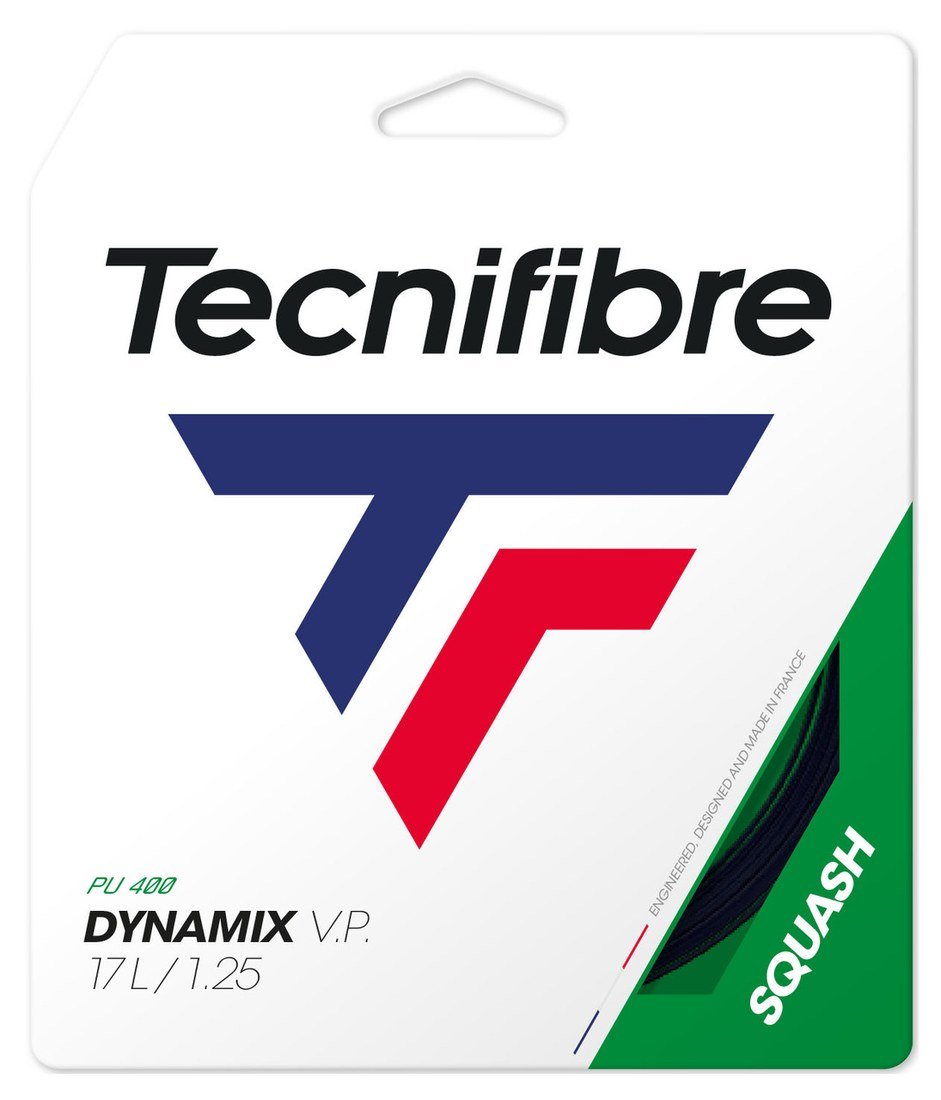
Tecnifibre Dynamix VP
Best for: players who want easy depth and length without swinging out of their shoes.
Dynamix VP is Tecnifibre’s power answer, built on the same multifilament idea as the 305 but processed for elasticity. The VP stands for Vapor Process: the polyamide fibres are treated to add stretch and rebound, so the bed deforms a fraction more at impact and fires the ball back with less effort from the swing. Tecnifibre and its retailers position it for maximum power and shock absorption, and as a noticeably softer string than the firm’s DNAMX — the same easy pace, with more comfort and, in their words, better control as a result. For the club player whose drives keep dying a foot short of the back wall, that extra elasticity is the most direct fix a restring can offer.
There is a strong factory-fit endorsement behind it, too: Dynamix V.P. is the string Tecnifibre fits as standard across its Carboflex line — the best-known racket family in the modern game — which means the frames in our pro guide reach their players strung with this exact string. Gauges run 1.15, 1.20 and 1.25 mm. Take the 1.15 if your swing is compact and you want every bit of help with length; the 1.20 is the all-round set; the 1.25 keeps most of the pop with a sturdier bed for players who also value a longer restringing interval. If the 305 is the scalpel, Dynamix VP is the catapult — pick it when your problem is pace, not placement.
What we like
- The easiest power on this list — helps drives carry to the back wall
- Soft, shock-absorbing feel that is kind over long sessions
- Factory string across the Carboflex range — a proven frame pairing
- Three gauges, including a durability-leaning 1.25 mm
Consider
- Elastic beds feel less crisp than the 305 on delicate front-court shots
- The liveliest 1.15 mm gauge is not the longest-lived option here
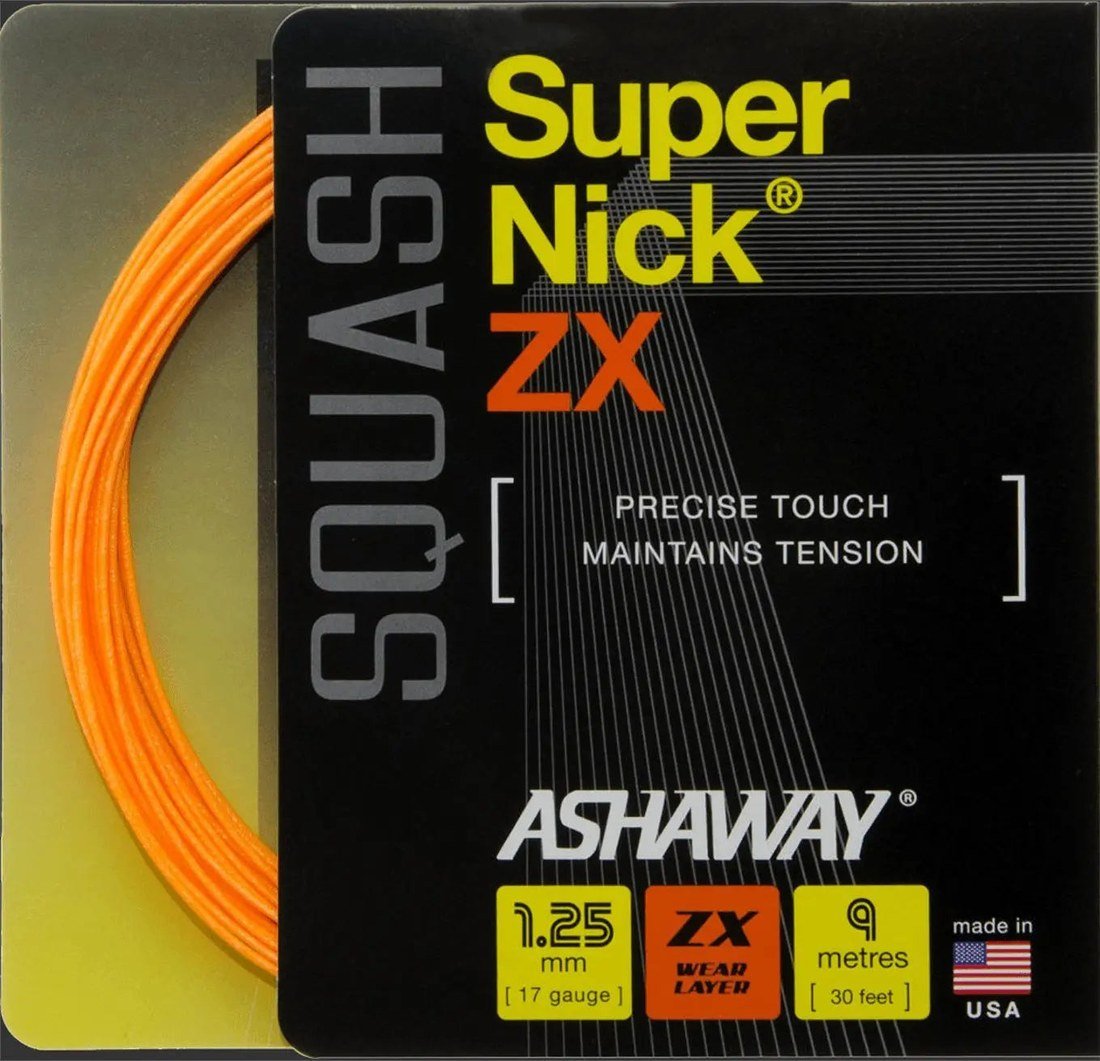
Ashaway SuperNick ZX
Best for: hard hitters, frequent players, and anyone whose string bed goes baggy before it breaks.
Ashaway built the SuperNick ZX to solve two problems at once: strings that snap, and strings that survive but go loose and lifeless. The construction is a hybrid — a multifilament nylon core for ball feel, wrapped in a ZX wear layer woven with Zyex filaments, the high-tensile fibre Ashaway uses across its premium lines for stiffness and durability. The surface is textured to bite the ball for cut and spin, and the whole string comes in a hi-visibility orange that is easy to spot against the front wall. Ashaway says it spent more than a year developing the string to combine the playability of its long-running SuperNick XL with the tension-holding character of its Zyex strings — and the published specification supports the intent: a single 1.25 mm gauge, rated by the maker for stringing tensions up to 40 lb, higher than most strings on this page.
Who is it for? The player who restrings because the bed feels dead rather than because a string snapped will notice the difference a Zyex layer makes to how long the bed keeps its snap — and the player who does snap strings gets a 1.25 mm multifilament that does not feel like a rope. It is the firmest, most controlled-feeling Ashaway here: less free power than the two Nicks below it, more precision and a longer useful life. If your game is built on hard, flat hitting several times a week, this is the card to circle.
What we like
- Zyex wear layer targets the two club-player killers: breakage and tension loss
- Substantial 1.25 mm gauge with a textured, grippy surface for cut
- Rated to 40 lb — suits players who like a tight, controlled bed
- Still a multifilament at heart, so feel stays lively rather than boardy
Consider
- One gauge only — no thinner option if you want more trampoline
- Firmer character than the PowerNick and UltraNick below
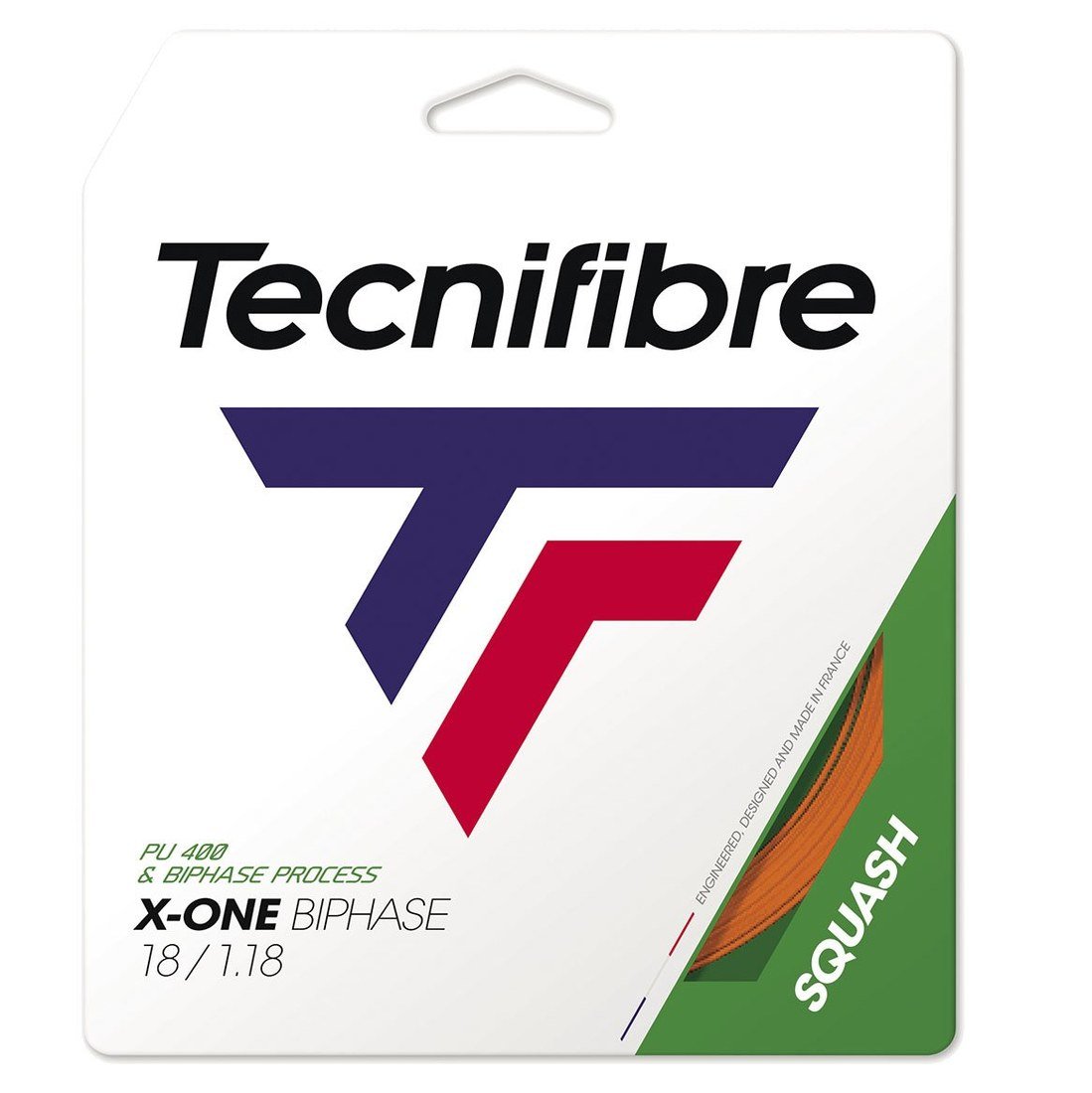
Tecnifibre X-One Biphase
Best for: touch players who want the most refined, gut-like response Tecnifibre makes.
X-One Biphase is the technology flagship of Tecnifibre’s squash line — the string the company builds when it is showing off. Three technologies share the work. Elastyl fibres supply the elasticity behind its power. H2C fibres — processed through a patented Trimerization treatment developed to keep the fibre links stable through extreme temperature swings — are there for tension maintenance and control. And the Biphase process itself, a post-production treatment that strengthens the bond between the thousands of microfilaments, is credited by Tecnifibre with extending string life by around 20% over a standard multifilament. The fibres sit in PU 400 polyurethane, and the playing character follows the recipe: maximum efficiency off the strings, a refined, connected feel, and comfort that flatters delicate shots.
So how does it differ from the 305 at number one? Think of the 305 as the benchmark all-rounder and the X-One as the connoisseur’s refinement of the same idea: a touch more elasticity, a touch more process technology, in gauges of 1.18 and 1.24 mm and a choice of orange or natural. Players who live at the front of the court — who win points with hold, deception and drops that die in the nick — are the ones who will appreciate what the extra engineering buys. Everyone else should start with the 305 and arrive here when they know exactly what they are looking for.
What we like
- The most refined feel in the Tecnifibre range — built for touch and deception
- Elastyl fibres add easy power the 305 does not offer
- Biphase process is maker-rated to extend string life over standard multifilaments
Consider
- The flagship of the range — priced and positioned accordingly
- Its subtleties are wasted on beginners, who should start with the 305 or Hot Zone
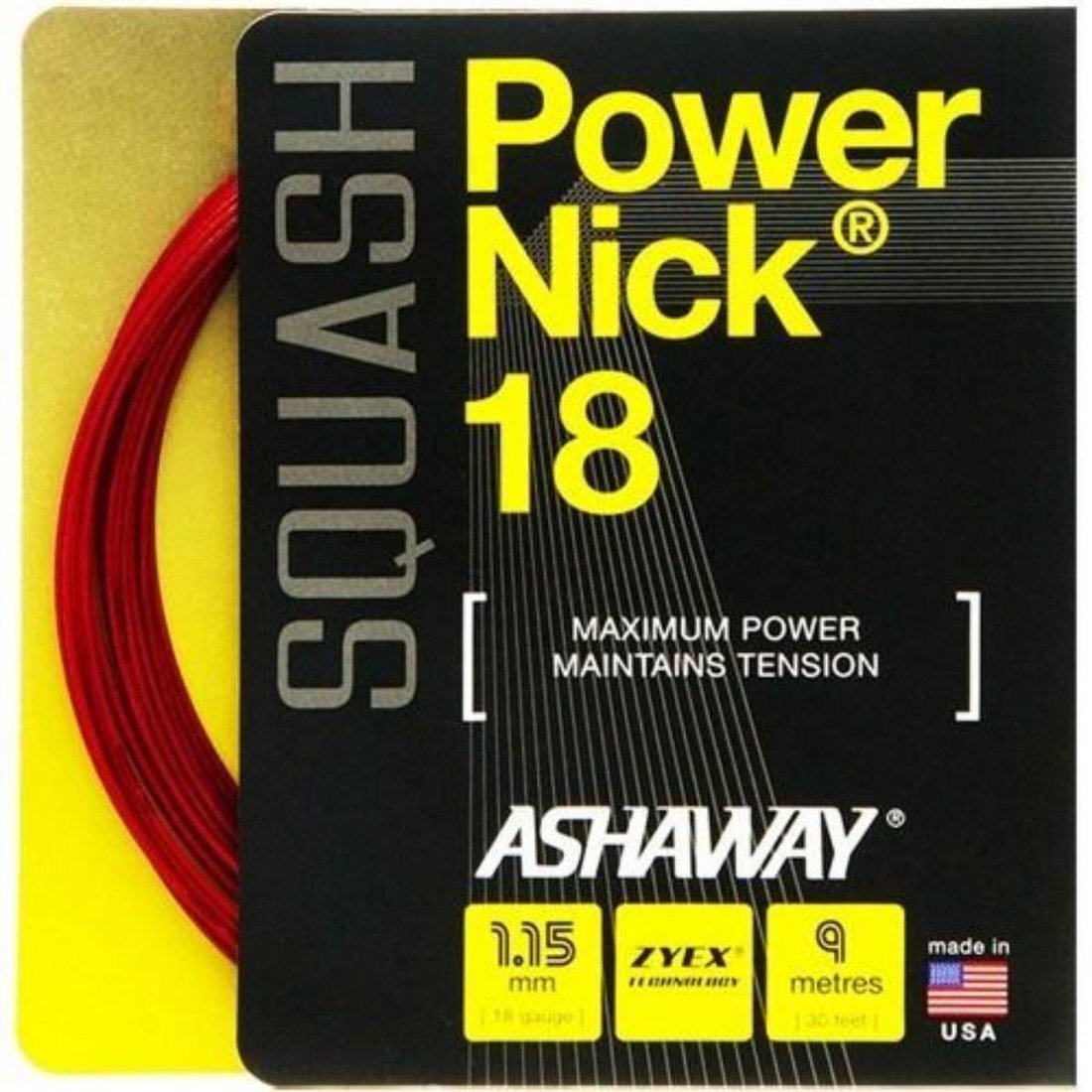
Ashaway PowerNick 18
Best for: attacking players who want a thin string’s bite with a Zyex core’s durability.
PowerNick 18 is Ashaway’s answer to a classic dilemma: thin strings play beautifully and break rudely. Its three-layer construction puts a core of multi-stranded Zyex filaments — a fibre with very high tensile strength — inside an outer spiral braid, finished with a proprietary coating that Ashaway says eases stringing and adds durability. At 1.15 mm it sits in the thin, lively class, but the Zyex heart means it holds tension and survives knocks far better than a plain nylon of the same diameter. Ashaway positions it bluntly as the optimum combination of power and durability, and the string has form at the top of the game — it has even been fitted as standard in some Black Knight tour frames.
The textured spiral surface is the other half of the story: it grips the ball, so players who cut their drops and slice their boasts get extra bite to work with. One instruction matters if you choose it: Zyex plays stiffer than nylon, so Ashaway directs stringers to fit PowerNick at roughly 10–20% lower tension than a conventional nylon string to reach the same playing feel — tell your stringer, because a PowerNick bed strung at your usual nylon tension will feel tighter and less forgiving than you expect. There is also an even thinner 1.05 mm PowerNick 19 in black for specialists; the 18 is the one to buy first.
What we like
- Thin-gauge liveliness without the usual thin-gauge fragility
- Spiral braid surface adds real grip for cut drops and sliced boasts
- Zyex core holds tension well across the bed’s life
Consider
- Must be strung 10–20% lower than nylon (maker guidance) to feel right
- Still a 1.15 mm string — miss-hitters who catch the frame will shorten its life
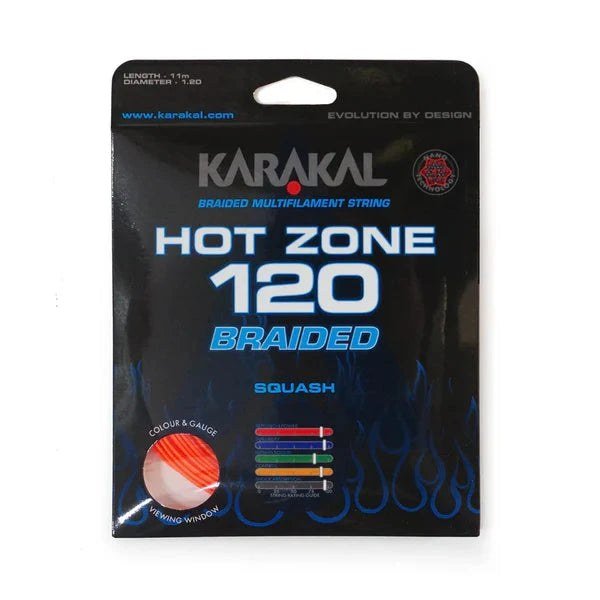
Karakal Hot Zone Braided 120
Best for: club players who want one string that does everything well — and budget racket upgrades.
Karakal’s Hot Zone Braided 120 is the string on this list that asks the least of your wallet and gives back the most balance. The recipe is a hi-tensile multifilament core wrapped in a braided outer twist of response filaments, finished with a textured nano elastomer resin coating that Karakal credits with shock absorption, feel and durability. At 1.20 mm it sits exactly in the middle of the gauge range — thin enough to stay lively, thick enough to last — and Karakal’s own billing, an excellent combination of power and control with limited drop-off even on off-centre hits, matches how an all-rounder should behave. It also has tour credibility of the most practical kind: the Hot Zone 120 is the factory string in Joel Makin’s Karakal Raw Pro 2.2 from our pro rackets guide.
The value case deserves spelling out, because it is where this string beats the premium names for a big group of players. If your racket came from the budget end of the market — the frames in our guide to the best squash rackets under $100 ship with serviceable but ordinary strings — then a Hot Zone restring is the single biggest playing upgrade available to you, transforming a dead factory bed into a responsive multifilament for the cost of a string set plus your stringer’s labour. Five colours (black, blue, green, orange and red) and availability in 11 m sets or 110 m and 220 m coils for home stringers round out a thoroughly practical package.
What we like
- Genuine power-and-control balance at a club-friendly position in the range
- Braided wrap and nano resin coat target durability and shock absorption
- The ideal first restring for a budget frame’s factory nylon
- Five colours; sets and long coils for players who restring at home
Consider
- Less ultimate feel than the 305, less raw power than the Dynamix VP
- Single gauge — no thinner or thicker Hot Zone Braided variant in this line
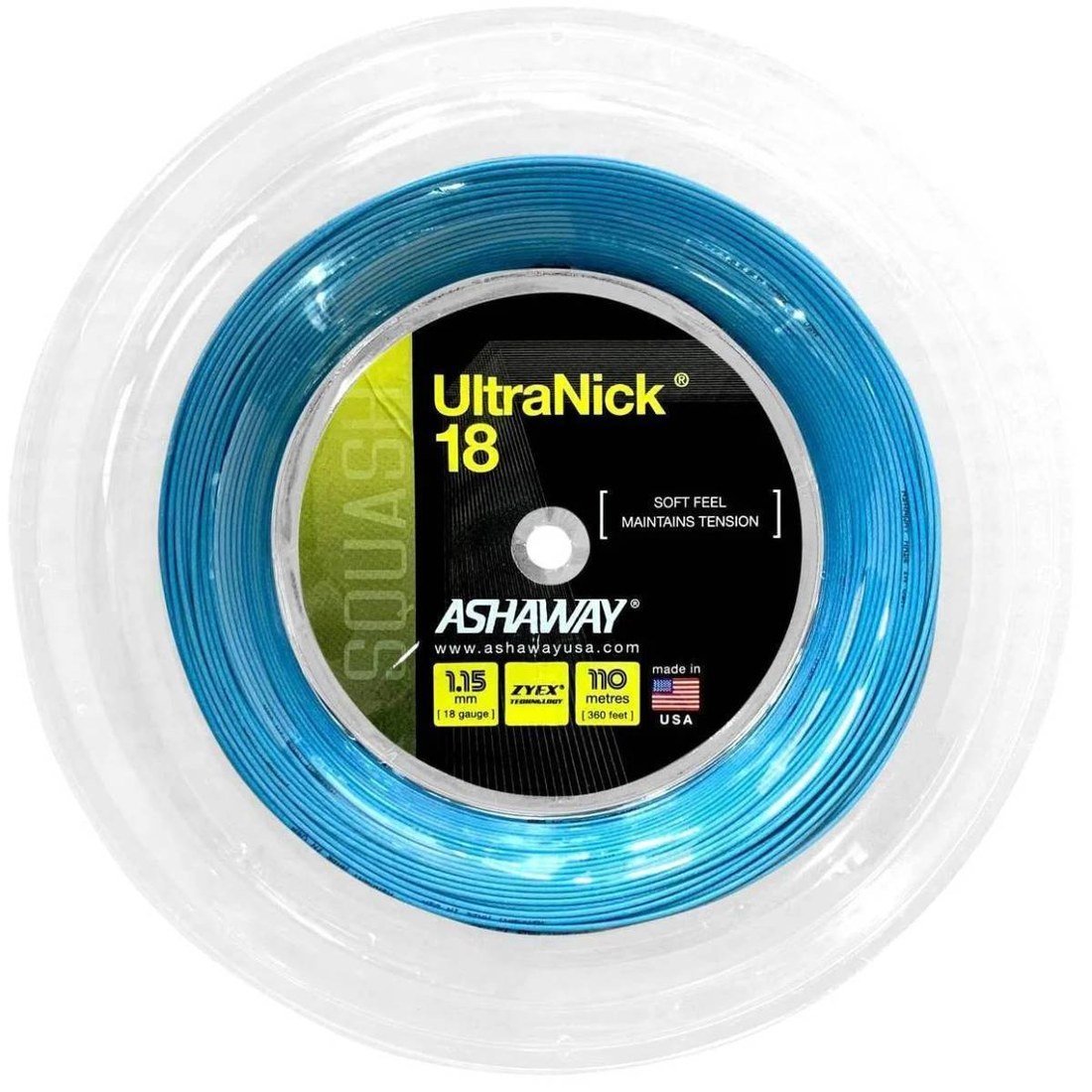
Ashaway UltraNick 18
Best for: players who want Zyex tension stability in a softer, more comfortable package.
UltraNick 18 is the gentle sibling in Ashaway’s Zyex family. Where the PowerNick builds its core from Zyex filaments for tensile strength and bite, the UltraNick uses a Zyex multifilament construction — finer strands, a softer layup — that Ashaway explicitly positions as the softer-feeling alternative, delivering what it calls tremendous power and resilience with a more forgiving touch. The braided surface keeps the family’s grip for control and spin, and Ashaway rates the string’s tension stability highly, which is the practical Zyex dividend: the bed you play in month two feels much closer to the bed you paid for in week one.
Choose it if the PowerNick’s spec sheet appeals but its firm, bite-first character does not — or if you simply prefer a cushioned impact feel over long sessions. At 30 lb maximum recommended tension (maker guidance, and again with the instruction to string Zyex 10–20% lower than an equivalent nylon), it suits a medium-tension setup rather than a board-tight control bed. A thicker 1.25 mm UltraNick 17 in optic green exists for players who want the same soft Zyex character with maximum durability. Sets run 9 m, reels 110 m, in a distinctive blue that stands out in the stringer’s tray and on court alike.
What we like
- The softest Zyex feel Ashaway makes — power with a cushioned impact
- Strong tension stability means fewer “dead bed” restrings
- Braided surface preserves grip and spin despite the soft character
Consider
- 30 lb maker maximum rules out very tight control setups
- Touch players chasing maximum bite may still prefer the PowerNick or 305
Comparison Table: All Seven Strings at a Glance
Every string above, reduced to the four facts that decide a purchase: what it is made of, how thick it is, and who should buy it. Gauges and constructions are as published by the manufacturers.
| String | Construction | Gauge(s) | Character | Best for |
|---|---|---|---|---|
| Tecnifibre 305 | Polyamide multifilament, 45% PU, SPL coat | 1.10 / 1.20 / 1.25 mm | Control & feel | All-round first restring; touch players |
| Tecnifibre Dynamix VP | Multifilament, Vapor Process elasticity | 1.15 / 1.20 / 1.25 mm | Power & comfort | Easy depth; compact swings |
| Ashaway SuperNick ZX | Nylon multifilament core, Zyex wear layer | 1.25 mm | Durability & control | Hard hitters; frequent players |
| Tecnifibre X-One Biphase | Multifilament, Elastyl + H2C fibres, PU 400 | 1.18 / 1.24 mm | Premium feel & power | Front-court touch players |
| Ashaway PowerNick 18 | Zyex filament core, spiral braid | 1.15 mm | Power & bite | Attackers who cut the ball |
| Karakal Hot Zone Braided 120 | Hi-tensile multifilament core, braided wrap, nano resin coat | 1.20 mm | Balanced all-round | Value pick; budget frame upgrades |
| Ashaway UltraNick 18 | Zyex multifilament, braided surface | 1.15 mm | Soft power & comfort | Players wanting a cushioned Zyex bed |
Maker-specified maximum stringing tensions: SuperNick ZX up to 40 lb; PowerNick 18 up to 32 lb; UltraNick 18 up to 30 lb — always stay inside your frame maker’s recommended range as well, and note Ashaway’s guidance to string its Zyex strings 10–20% lower than an equivalent nylon.
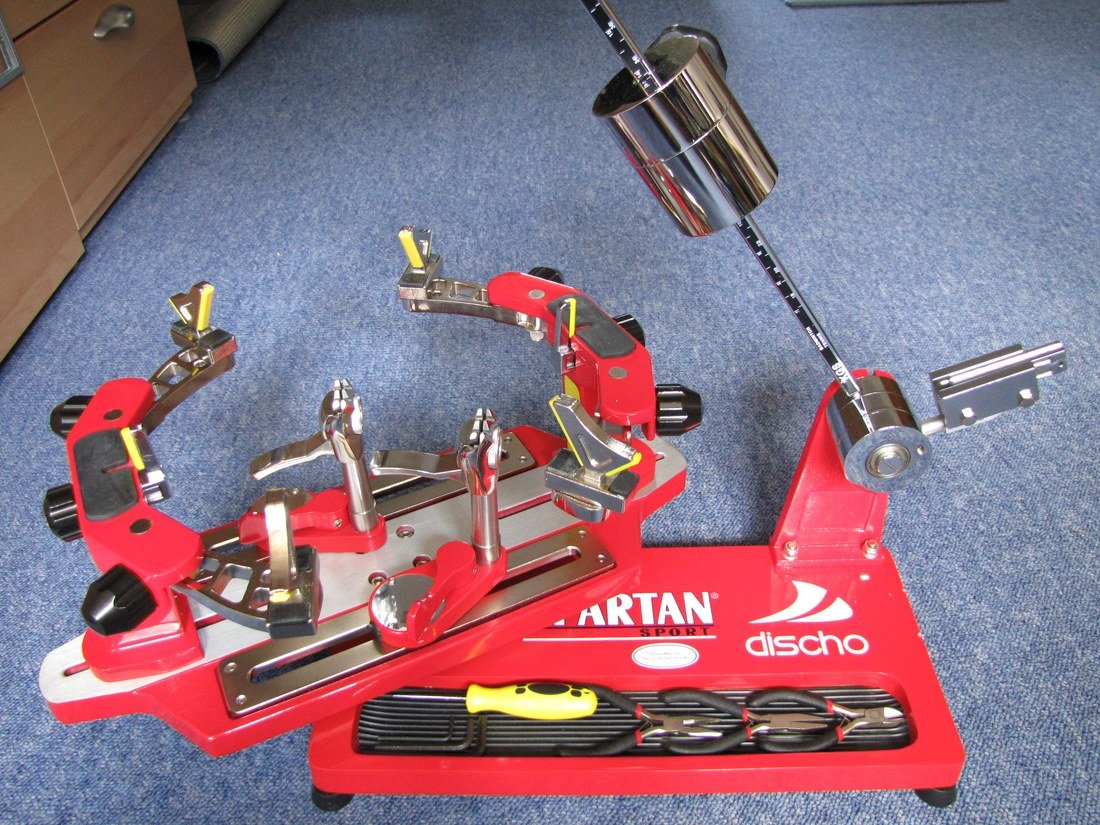
Factory Strings vs Your First Restring
Every racket arrives strung, and the two ends of the market mean very different things by that. At the top end, the string is part of the product: as our pro rackets guide documents, tour frames are fitted with named performance strings — 305 in Asal’s Slash, Dynamix V.P. across the Carboflex line, Hot Zone 120 in Makin’s Karakal — because the frame maker knows the bed defines the first impression. Even there, the factory job is strung to a safe middle tension designed to survive warehousing and shipping, and pros restring to personal tensions before a ball is hit in anger.
At the club and budget end, the factory string is usually a basic nylon fitted for cost and shelf life, and it may have sat at tension in a warehouse for many months before you bought the racket. That is why the single most common piece of stringer advice in the game is also the truest: your first restring is the biggest upgrade you will ever make to a racket you already own. If you have just bought one of the frames in our best squash rackets for beginners guide, play the factory bed while you learn your strokes — then, the first time shots start feeling vague, restring with a 1.20 mm multifilament from this page before you even think about a new frame.
How often after that? Framed honestly, as general club practice rather than lab science: many stringers use the rough rule of thumb of restringing about as many times a year as you play per week — twice-weekly players roughly twice a year, and so on — adjusted by what your eyes tell you. Fraying at the intersections, visible notching, strings that stay displaced after a rally instead of snapping back straight, or a bed that has simply gone dull and spring-less are all the string asking to be replaced. Thin gauges and hard hitting shorten the interval; that is the price written into the gauge section above, and it is why the durability picks exist.
Matching a String to Your Frame
String and frame multiply each other; they do not just add. Three pairings cover most club players. Control frames — the smaller-headed, precision-bred rackets in our pro guide — already supply accuracy from the frame, so they pair best with a feel string that tells you exactly what the ball did: the 305 in 1.20 or 1.25 mm is the classic match, and it is literally the factory pairing in Asal’s control frame. Power frames — open-throated teardrops built to generate pace — need no more free trampoline; a firmer 1.25 mm bed like the SuperNick ZX keeps the frame’s power usable and adds the control the head shape traded away. Budget frames are the opposite case: the frame is fine and the bed is the weak link, so a balanced multifilament like the Hot Zone 120 delivers the largest improvement per unit of money anywhere in this guide.
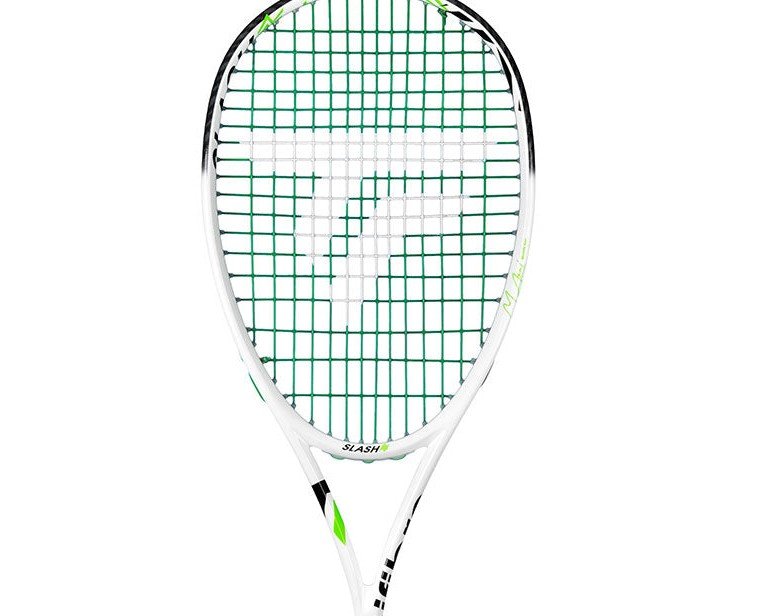
Pattern matters too, briefly. In the fan patterns common on teardrop squash heads, the mains converge toward the throat, which lengthens the central strings and softens the bed’s response low in the head. A slightly thinner gauge or a livelier multifilament compensates if your contact point lives down there; a denser, straighter pattern plays firmer and suits the thicker durability gauges. None of this requires a spreadsheet — tell your stringer your frame, your level and which of the seven cards sounded like you, and a good stringer will land within a gauge and a couple of pounds of ideal. Finally, keep the rest of the setup coherent: a fresh string bed deserves a ball matched to your level, which is exactly the decision our squash ball dot guide walks through.
Our Verdict: Start With the 305, Then Specialise
For most readers, this guide ends where it began: restring with the Tecnifibre 305 in 1.20 mm and play it for a month. It is the benchmark because it does the guide’s title in full — control outright, power when your swing asks for it — and because its three gauges let you adjust durability without learning a new string. Specialise from there with intent. Chasing depth? The Dynamix VP. Breaking strings or losing tension? The SuperNick ZX. Living at the front wall? The X-One Biphase or the biting PowerNick 18. Watching the budget, or upgrading a starter frame? The Hot Zone 120. Wanting Zyex stability with a softer handshake? The UltraNick 18.
Whichever card you choose, the order of operations matters more than the badge on the packet: pick the construction for your game, the gauge for your breakage rate, and the tension inside both makers’ ranges — then restring on a rhythm instead of waiting for a snap at match point. Your frame was never the problem. Your strings were the opportunity.
Squash String FAQs
What are the best squash strings for control?
The Tecnifibre 305 is the control benchmark: a polyamide multifilament with a high polyurethane content and an anti-abrasion SPL coating, it pockets the ball and returns clear feedback on placement shots. In its 1.20 or 1.25 mm gauges it is the classic pairing for control frames — it is the factory string in Mostafa Asal’s Slash 120 Control. For a firmer, tighter control bed with extra durability, the 1.25 mm Ashaway SuperNick ZX is the alternative.
What gauge squash string should a beginner choose?
Start at 1.20 mm in a multifilament — the Karakal Hot Zone Braided 120 or the Tecnifibre 305 in its 1.20 mm set. That middle gauge is lively enough to help a developing swing while surviving the off-centre hits and frame contact that are part of learning. Avoid the very thin 1.10–1.15 mm strings until your contact is consistent, and avoid very thick durability strings that can make a light beginner’s frame feel boardy.
How often should you restring a squash racket?
As general club practice, a widely used stringer’s rule of thumb is to restring roughly as many times per year as you play per week — so a twice-a-week player restrings about twice a year. Restring sooner if you see heavy fraying or notching where the strings cross, if the strings stay out of line after rallies, or if the bed feels dull and has lost its snap. Thin gauges and hard hitting shorten the interval; durable 1.25 mm strings lengthen it.
Are premium strings worth it over the factory string in my racket?
Usually, yes — it is the highest-value upgrade in squash. Most club and budget rackets ship with a basic nylon string fitted for cost and shelf life, and it plays noticeably deader than a proper multifilament. A single restring with any string on this page will change how your existing racket feels more than most frame upgrades would. Top-end frames are the exception: tour models ship with named premium strings already, though even those are fitted at a safe factory tension rather than your personal one.
What tension should I string my squash racket at?
Work within your frame maker’s printed range first, then respect the string’s own limits — Ashaway rates the SuperNick ZX to 40 lb, the PowerNick 18 to 32 lb and the UltraNick 18 to 30 lb. Lower tensions play livelier and more forgiving; higher tensions feel firmer and more precise. One critical exception: Ashaway directs that its Zyex strings (PowerNick, UltraNick, and the ZX layer concept) be strung about 10–20% lower than an equivalent nylon string to achieve the intended feel, so brief your stringer if you switch to one.
What is the difference between multifilament and natural gut squash strings?
Natural gut is the original premium string material — highly elastic, with a soft, connected feel that remains the reference for touch. It is rare in squash today: delicate, moisture-sensitive and hard to justify in a bed that scrapes walls. Multifilament strings imitate the concept with thousands of fine synthetic fibres bundled in polyurethane, delivering most of the pocketing and comfort with far better durability and consistency. When a multifilament is described as “gut-like” — as the Tecnifibre 305 and X-One Biphase are — that is the comparison being made.
Do thinner squash strings really give more power?
Yes, with a condition. A thinner string stretches more at impact, pockets the ball longer and returns more energy — so a 1.10 or 1.15 mm string genuinely plays livelier than a 1.25 mm string of the same family. The condition is durability: there is less material to absorb wear, so thin strings fray and snap sooner, especially for hard hitters. If you rarely break strings, the thin end of a range like the 305’s is free performance; if you break them monthly, the power is not worth the restringing bill and a thicker gauge or a Zyex-reinforced string is the smarter buy.
Which string should I put in a budget squash racket?
A balanced 1.20 mm multifilament — the Karakal Hot Zone Braided 120 is our pick. Budget frames are usually let down by their basic factory nylon rather than by the frame itself, and the Hot Zone’s multifilament core and braided wrap turn that dead bed into a responsive one with a genuine mix of power and control. It is also the factory string in a tour-level Karakal frame, so you are buying proven performance rather than a compromise. Keep the same logic if you upgrade later: match the string to the frame using the pairings in this guide.
Affiliate disclosure: Ali Shuttler is a participant in the Amazon Services LLC Associates Program. Product links on this page are affiliate links — if you buy through them we may earn a commission at no additional cost to you. Rankings are editorial, based on published specifications and manufacturer positioning, and are never sold.